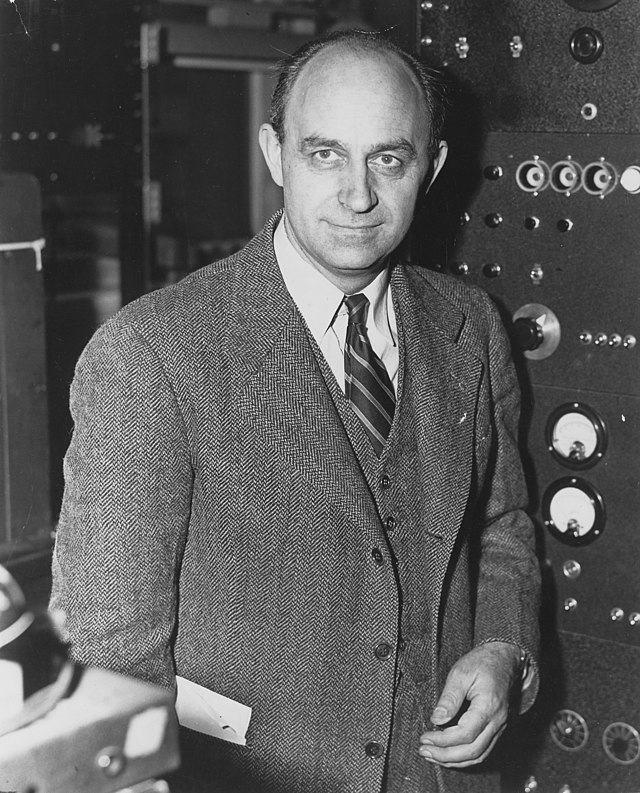
Enrico Fermi
Italian-American physicistWikipedia
292
MENTIONS
82
EPISODES
64
PODCASTS
Search complete. 292 mentions across 82 episodes found for "Enrico Fermi".
Sep 12, 2026

Mark DonovanGUEST
Which Italian-born physicist led the team that built the first nuclear reactor, Chicago Pile? One in 1942.
Mark DonovanGUEST
Answer, Enrico Fermi.
Mark DonovanGUEST
Which Shakespeare play features the character Constable Dull? Love's Labour's Lost.
Mark DonovanGUEST
Which region of Romania is often associated with legends of vampires and Gothic castles? Transylvania.

Simon WhistlerHOST
Fermi began life in a pretty offhand way.
Simon WhistlerHOST
One lunchtime, all the way back in 1950, the physicist Enrico Fermi was chin-wagging with his colleagues when he made a simple quip.
Simon WhistlerHOST
If the universe is so very old, why haven't we seen any other civilizations? And in time, this quip began to develop into something a little more robust.
Simon WhistlerHOST
It was the physicist Carl Sagan who published it for the first time and later attributed it to Fermi himself.

Eörs SzathmáryGUEST
And if so, what would those situations be? That's an interesting question, and I wouldn't like to rule out any of those scenarios, because I don't know, right, how to rule any of those.
Eörs SzathmáryGUEST
But I actually would like to say that, curiously enough, what you are saying is linked to something like Fermi's paradox.
Daniel FaggellaHOST
Yeah,
Eörs SzathmáryGUEST
yeah.
Eörs SzathmáryGUEST
You know, there was a lunch, you know, I think at Princeton, where Enrico Fermi And also probably Leo Szilard and some other people were sitting.
Eörs SzathmáryGUEST
And then Fermi raised the following question.
Eörs SzathmáryGUEST
I mean, do you believe in evolution? Yes.
Eörs SzathmáryGUEST
Do you believe that mankind with his intelligence is a result of evolution? Do you think that evolution would happen also in other places at the galaxy? Yes.

IreneHOST
Bella was among the American intellectuals who attempted, with some early help from the CIA, to present the United States as a glamorous alternative to the idea of Europe as a cultural mecca and intellectual sanctuary.
IreneHOST
Fascism and war had already forced many of the continent's most distinguished thinkers and artists, among them Thomas Mann, Albert Einstein, Hannah Arendt, Enrico Fermi, and Arturo Toscanini into exile in the United States.
IreneHOST
Sumptuously endowed American institutions began to exert a powerful gravitational pull.
IreneHOST
New York emerged as the new center of the avant-garde, once based in Paris, Berlin, Vienna, and London.

low-tech speedrun enjoyerHOST
But yeah, so...
low-tech speedrun enjoyerHOST
There's only ever been one good Italian engineering guy, and that was Enrico Fermi.
low-tech speedrun enjoyerHOST
It's been downhill ever since.
Proctor MaloneHOST
not not a ferrari man then

17 Laws GuyHOST
61 scientists.
17 Laws GuyHOST
Max Planck, Werner Heisenberg, Wolfgang Pauli, Paul Dirac, Enrico Fermi, and Niels Bohr.
17 Laws GuyHOST
Quantum mechanics itself is being rebuilt by people gathered around Lake Como.
17 Laws GuyHOST
During the Congress, Bohr gives the first public formulation of what becomes his principle of complementarity.

speaker_3NARRATOR
If the Milky Way contains hundreds of billions of stars and billions of years, why have we not seen signs of another civilization? That is the contradiction at the center of the Fermi paradox.
speaker_3NARRATOR
In nineteen fifty, Enrico Fermi, the nineteen thirty-eight Nobel Prize winner in physics, reduced it to a question: Where is everybody? In nineteen sixty-four, Nikolai Kardashev created a scale of civilizations based on energy use.
speaker_3NARRATOR
An advanced society should leave signals, probes, or detectable changes.
speaker_3NARRATOR
The barrier has a name: the Great Filter.
speaker_1NARRATOR
A form of life can emerge, reproduce, and disappear without producing signals or altering its environment beyond its own world.
speaker_1NARRATOR
The Fermi paradox begins when that question changes scale.
speaker_1NARRATOR
What happens if life develops an intelligence capable of extending its reach? Enrico Fermi, an Italian physicist and winner of the nineteen thirty-eight Nobel Prize in Physics, became associated with this question because it turns an abstract possibility into a concrete problem.
speaker_1NARRATOR
If an earlier civilization had learned to leave its own world, some signal, probe, or alteration should have reached us.

Joe HoxhaGUEST
that.
Joe HoxhaGUEST
I'm actually glad you brought that up because that is, to me, it's what is it? I don't know if it's the Fermi paradox or the other one.
Joe HoxhaGUEST
You would know it's like a mathematical thing where it's like almost impossible that we're the only living intelligent lives in the universe,
Marc D'AntonioGUEST
right? The Fermi paradox, which was wrongly attributed to Enrico Fermi.
Marc D'AntonioGUEST
Actually, there was a bunch of scientists there actually.
Marc D'AntonioGUEST
It was in
Ty RobertsHOST
like the lunch room.
Marc D'AntonioGUEST
Yeah, it was like during lunch.

Jeff LippmanHOST
And you can fit in the Fermi paradox at all.
Jeff LippmanHOST
I mean, but if I am correct, I think it's Enrique or Enrico Fermi, part of the Manhattan Project, you know, a physicist.
Jeff LippmanHOST
And I believe his theory is simply...
Jeff LippmanHOST
If there were alien civilizations out there, we'd know about it by now.
Terry AdairGUEST
I expect this, but this is what I see.
Terry AdairGUEST
And so the expectation is more or less mathematical.
Terry AdairGUEST
And this is interesting because Enrico Fermi was a very famous 20th century physicist.
Terry AdairGUEST
In fact, if you follow particle physics, half of the subatomic particles are fermions.

ThomasGUEST
It wasn't Einstein.
ThomasGUEST
You know, it wasn't Enrico Fermi.
ThomasGUEST
You know, it was these guys, you know, and it's I mean, there's something, you know, yeah, it's a trope that scientists are naive, but it's also kind of true.
ThomasGUEST
It was certainly true here.
72 more episodes mention Enrico Fermi.
Create an account to see the whole feed, search across every transcript, and follow the entities you care about.