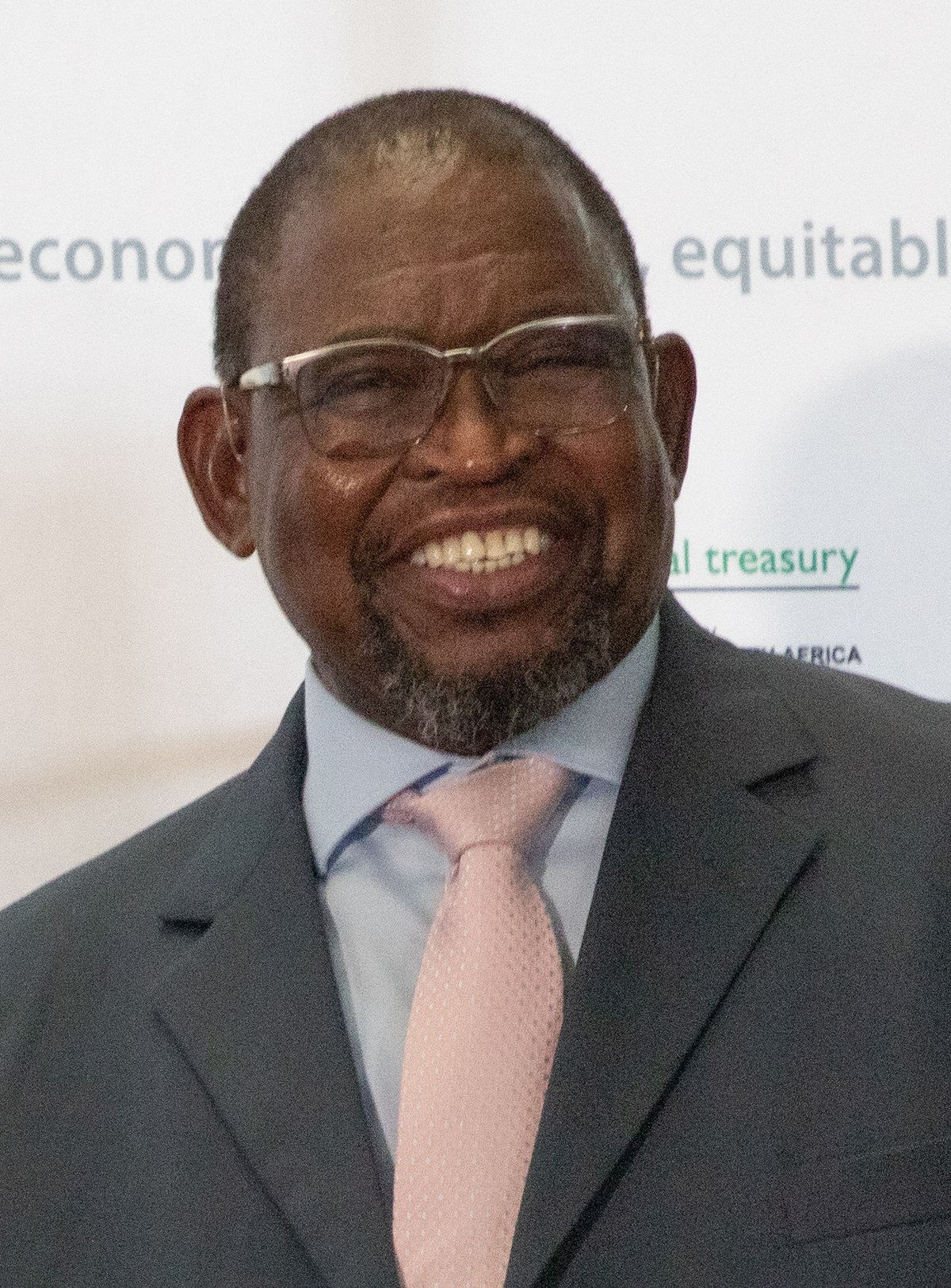
Enoch Godongwana
Minister of Finance of South AfricaWikipedia
10
MENTIONS
8
EPISODES
7
PODCASTS
Search complete. 10 mentions across 8 episodes found for "Enoch Godongwana".
Oct 16, 2026

Zimasa VabazaHOST
Monthly volumes have surged from five to six million transactions a year ago to more than 45 million transactions today.
Zimasa VabazaHOST
The South African Reserve Bank has positioned this as critical infrastructure for the country's economic future, and Finance Minister Enoch Godongwana confirmed in a 2026 budget speech that Pay Inc, the entity that's behind PayShap, would provide open shared digital payments infrastructure in order to serve as the main platform for both high-value and retail transactions.
Zimasa VabazaHOST
The numbers are pretty impressive, but what's core to unpack here is this, despite all of the growth, PayShap hasn't reached critical mass yet.
Zimasa VabazaHOST
Cash in circulation in South Africa has been growing at a compounded annual growth rate of 12% over the last few decades and 9% per capita.

Michael AveryHOST
For the first time in a very long time, the fiscal story is actually getting better.
Michael AveryHOST
When Enoch Godongwana became finance minister back in August of 2021, he inherited a government still reeling from COVID, uh, the July unrest, a budget deficit approaching 8% of GDP, debt north of 4 trillion rand, and an interest bill steadily swallowing the budget.
Michael AveryHOST
Five years later, the deficit has narrowed substantially.
Michael AveryHOST
Government is running a primary surplus.
22 MINS LATER
Azar JammineGUEST
... because it is at least preventing complete loss of control over our finances.
Azar JammineGUEST
And I think Godongwana, despite all the pressures on him, needs to try and convey that continuity of that message irrespective of what, all the other problems that we face.
Michael AveryHOST
Well, there you have it, some edification for Enoch Godongwana, the finance minister.
Michael AveryHOST
That's it for this edition of the Monicle Banking Podcast.

Maxine BezuidenhoutGUEST
Cape Talk.
Lester KiewitHOST
[upbeat music] The Finance Minister, Enoch Godongwana, he will be expected to make some sort of pronouncement on the fuel price next week when he delivers his medium-term budget policy statement on the 21st.
Lester KiewitHOST
And with the high fuel prices at record highs, it's not only households who are struggling.
Lester KiewitHOST
We've spoken to various industries this week about how they're coping with the fuel crisis, but it's also government departments who are now also facing the pressure because budgets approved months ago are now struggling to keep up with the rising operational costs.

Halima FrostHOST
It says the country has reached an inflection point after stabilizing its debt and delivering pro-growth economic reforms.
Halima FrostHOST
Finance Minister Enoch Godongwana delivers his midterm budget review on October 21, and is expected to show continued growth in the country's primary budget surplus, a gauge of how much revenue exceeds non-interest expenditure amid higher income.
Halima FrostHOST
Evan Wollman, a vice president at Moody's, said the baseline forecast was for debt that peaked in the last fiscal year at 87% of gross domestic product to gradually decline to 84% of GDP by the end of the decade, supported by an uptick in economic output.
Halima FrostHOST
Africa's largest economy has expanded by less than 1% on average over the past decade, but structural reforms are beginning to deliver, with Nedbank Group predicting growth will edge up to 1.9% in the next two years, with 2.5% possible by 2030.

Thalia PetousisGUEST
It was liberalized to 45%.
Thalia PetousisGUEST
And then the first time we heard, um, our Finance Minister, um, Enoch Godongwana, express some regret was in 2024.
Thalia PetousisGUEST
Um, following the budget, he said it had been a grave mistake.
Thalia PetousisGUEST
And then more recently this year, he's also made some comments.
Zimasa VabazaHOST
Fewer than 9% have access to bank loans, and cash remains the dominant transaction method, driven not by resistance to modernity, but by customers' preference and the very real barrier of high digital fees.
Zimasa VabazaHOST
On November 12, 2025, Finance Minister Enoch Godongwana announced that South Africa was changing its inflation targeting for the first time in 25 years.
Zimasa VabazaHOST
The old range of 3% to 6% is now gone.
Zimasa VabazaHOST
In its place, a 3% target with a 1% point tolerance band of 2% to 4%.

Ruan JoosteHOST
Value for money also occupied the entire first half of the conference, with sessions on defining value beyond cost, governance and transparency, and the use of metrics, comparisons, and accountability.
Ruan JoosteHOST
Finance Minister Enoch Godongwana also said that the FSCA is exploring a South African value for money framework.
Ruan JoosteHOST
What did the international discussion add to the FSCA's thinking, and what problem should a local framework solve?
Zareena CamroodienGUEST
So I think what was very valuable for us, um, was the p- You know, the presentations, I think, well, all of them were very valuable.

Jeremy MaggsHOST
Electricity infrastructure fails and municipal projects routinely arrive late or not at all.
Jeremy MaggsHOST
The finance minister, Enoch Godongwana, says the problem is increasingly not a shortage of money, but our inability to plan, build and maintain properly.
Jeremy MaggsHOST
Now, Pragma, a South African enterprise asset management company, is arguing that neglected infrastructure contributed to some 36 billion rand in municipal water and electricity losses in a single year.
Jeremy MaggsHOST
Those are big numbers.
Bani KhaosanaGUEST
And we do have to get to a point where we say there is something fundamentally broken in the system.
Bani KhaosanaGUEST
We can't continuously be coming back to discussions like the one we're having where so time after time we keep on.
Bani KhaosanaGUEST
having to have conversations where we say things are broken, things are not working, they're still not working, at what point do we say that there seems to be an intent behind the failure to execute? When a finance minister tells you that he has provided the money, when the auditor general indicates that their findings are, there are projects where there is an average of 25 months of delay, that tells you that Most projects, over 70% of the projects at municipalities are delayed by more than two years.
Bani KhaosanaGUEST
And when you talk about infrastructure, that means that a problem that you had two years ago for which an RFP was released, for which responses were received, when there is a 25-month delay on those projects, you don't pick up where you started off when you return back, when you eventually get going with and finish the project.