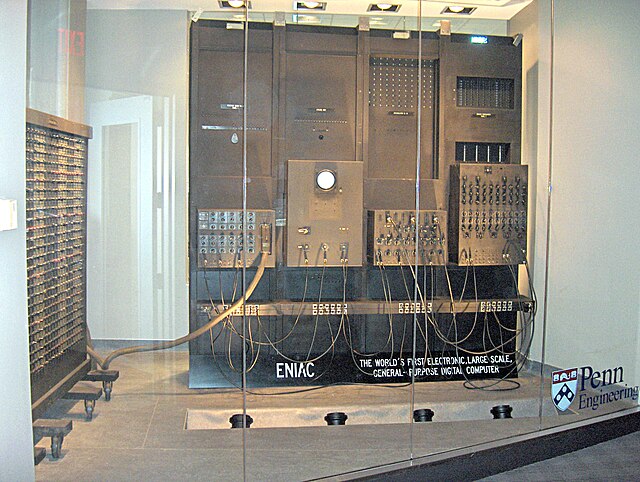
ENIAC
ComputerWikipedia
42
MENTIONS
21
EPISODES
19
PODCASTS
Search complete. 42 mentions across 21 episodes found for "ENIAC".
Sep 22, 2026

AlexaHOST
In the 1940s, McCullough and Pitts introduced the first mathematical neural network model in 1943.
AlexaHOST
Claude Shannon's 1948 information theory paper gave probabilistic language tools, and early computers like ENIAC provided the hardware that made AI research possible.
AlexaHOST
Those early ideas were just the beginning.
AlexaHOST
Want to hear how they evolved into the AI we know today?

Naveen RaoGUEST
They were always faster than the alternative.
Naveen RaoGUEST
Uh, incidentally, that computer in 1945 that was built, called ENIAC, was built to do artillery trajectory calculation, and it was built to do it faster than the alternative.
Naveen RaoGUEST
The alternative were humans who actually did the calculations.
Naveen RaoGUEST
Now, the alternative typically is some other computer.

AlexaHOST
In the 1940s, McCullough and Pitts introduced the first mathematical neural network model in 1943.
AlexaHOST
Claude Shannon's 1948 information theory paper gave probabilistic language tools, and early computers like ENIAC provided the hardware that made AI research possible.
AlexaHOST
Those early ideas were just the beginning.
AlexaHOST
Want to hear how they evolved into the AI we know today?

John BorthwickGUEST
Two years ago, I read a wonderful book called The Maniac, which is all about, or just Maniac, it was all about von Naumann.
John BorthwickGUEST
And when he was running simulations of H-bomb on the Maniac computer, which was a cousin to the ENIAC computer in 1947, 48 at Princeton University.
John BorthwickGUEST
He let a crazy ass engineer who's half Italian, half Norwegian create digital life.
John BorthwickGUEST
at night and create simulations of digital worlds at night.

Egberto WilliesHOST
Please, let's not buy into AI is going to kill us.
Egberto WilliesHOST
As a software developer myself, as someone who was in the software development from its, I don't want to say its inception because that started with ENIAC and all those vacuum tube, that's way before my time.
Egberto WilliesHOST
But at the time I came at the, when CPU started to take off, central processing units, microprocessors used to take off.
Egberto WilliesHOST
So I programmed from there.
Egberto WilliesHOST
As a software developer myself, as someone who was in the software development from its...
Egberto WilliesHOST
I don't want to say its inception because that started with ENIAC and all those vacuum tube.
Egberto WilliesHOST
That's way before my time.
Egberto WilliesHOST
But at the time I came at the...

Megan SmithGUEST
You see over here on the right, Harvard Mark I. There's Grace Hopper and other members of her team.
Megan SmithGUEST
This is the ENIAC on the bottom left.
Megan SmithGUEST
That's the first computer at University of Pennsylvania.
Megan SmithGUEST
Eckhart Mochley, Jean Jennings, six women were the first digital programmers in the United States over there.
Egberto WilliesHOST
Even if the AI model that you're using doesn't risk a chance of doing anything to the internet because you have it restricted to a particular type of of doing so my thing my friends is the following please Let's not buy into AI is going to kill us.
Egberto WilliesHOST
As a software developer myself, as someone who was in the software development from its, I don't want to say its inception because that started with ENIAC and all those vacuum tube, that's way before my time.
Egberto WilliesHOST
But at the time I came at the, when CPU started to take off, central processing units, microprocessors used to take off.
Egberto WilliesHOST
So I programmed from bit banging, meaning with ones and zeros on the older systems to assembly language, to C, C++, Pascal, Fortran, all these languages.

David BlumensteinGUEST
Right.
David BlumensteinGUEST
ENIAC or whatever, whatever those computers were.
David BlumensteinGUEST
And so just the expectation of the interaction with the benefits that a participant has has just been totally raised.
David BlumensteinGUEST
So just the – it used to be that we would have to struggle with our clients to get them to do something more than just – uh, kind of Xerox, you know, a word processed summary plan description to, to give to, um, to their plan participants.

TheoHOST
If you mean a modern data center campus, large purpose-built warehouse-like buildings packed with rows of servers and surrounded by cooling equipment, substations, generators, fences, and security, the cleanest starting point is the late 1990s into the early 2000s.
TheoHOST
We can trace data centers back to 1945, when ENIAC occupied an enormous dedicated room at the University of Pennsylvania.
TheoHOST
By the 1950s and '60s, governments, universities, banks, and large corporations had specialized mainframe rooms with raised floors, heavy cooling, backup power, and restricted access.
TheoHOST
Someone from our time could walk into one and recognize the ancestor of a data center.
TheoHOST
The recognizable campus appears around 2006.
TheoHOST
The giant AI campus, the one measured in gigawatts and discussed like its own power province, is the much newer beast currently kicking down the door.
TheoHOST
Google identifies The Dalles facility as established in 2006, while IBM's history traces the underlying data center lineage back to ENIAC and the 1940s.
Tracy HarrisHOST
I don't wanna get ahead of ourselves.
11 more episodes mention ENIAC.
Create an account to see the whole feed, search across every transcript, and follow the entities you care about.