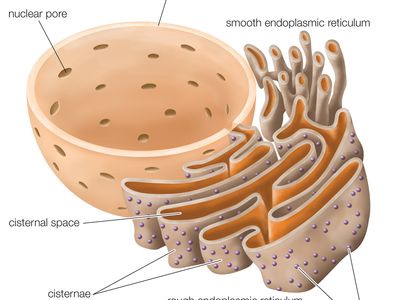
Endoplasmic reticulum
Gene groupWikipedia
18
MENTIONS
5
EPISODES
5
PODCASTS
Search complete. 18 mentions across 5 episodes found for "Endoplasmic reticulum".
Oct 7, 2026

Jackie MullinsHOST
The cytoplasm becomes the city.
Jackie MullinsHOST
The ER becomes the factory district.
Jackie MullinsHOST
Suburban ricks manufacture proteins.
Jackie MullinsHOST
Hippie ricks float freely through the cytoplasm.

Daniel J. GuerraHOST
So the SCD isoform 1 activity.
Daniel J. GuerraHOST
relies on, this is all the detail now I'm going to give you, an endoplasmic reticulum bound.
Daniel J. GuerraHOST
You wonder where that reductase was? It was in the ER.
Daniel J. GuerraHOST
That's the ER-bound cytochrome B5 reductase, which, recall, because I just went through the reaction mechanism, accepts an electron of many DH and donates it to cytochrome B5 and then to the steroid or desaturated cytochrome 1 prosthetic iron for its reduction, you see? So in the presence of molecular oxygen, reduced stereocoy desaturase one introduces a single double bond at the Delta nine, 10 position of any, not just stearate, long chain acyl coy.
Daniel J. GuerraHOST
That would include how nirvanic acid was generated.
Daniel J. GuerraHOST
That's why I brought that up.
12 MINS LATER
Daniel J. GuerraHOST
And this will go all the way into leading to dysregulation of endoplasmic reticulum activity, which will further exacerbate inflammation because of calcium store flux.
Daniel J. GuerraHOST
So this is actually now a better picture for you on how inflammation occurs from adiposity.

Sam SmithHOST
And biological membranes are formed by adding to preexisting membranes.
Sam SmithHOST
So in eukaryotic cells, membrane synthesis occurs in the endoplasmic reticulum, and essentially new membrane lipids are created in the smooth ER, then they're transported through the secretory pathway and are distributed to the plasma membrane and the other membranes throughout the cell.
Sam SmithHOST
And I will also say that individual phospholipids can actually flip back and forth from being on the exterior of the membrane to the interior, and this is catalyzed by two different enzymes with very cool names.
Sam SmithHOST
Flippases are transmembrane enzymes that catalyze the transfer of phospholipids from inside the cell to outside the cell.
7 MINS LATER
Sam SmithHOST
And this nuclear envelope plays a pretty important role in regulating translation.
Sam SmithHOST
So again, translation is the conversion of mRNA to protein by ribosomes.
Sam SmithHOST
So there's ribosomes that are located in the cytoplasm and also bound to the rough ER, and there's not ribosomes inside the nucleus.
Sam SmithHOST
So in short, these nucleoporins can regulate the rate at which mRNAs make it out of the nucleus and into the cytoplasm where they can then be translated.

SammyHOST
Once the instructions reach the ribosomes over in the cytoplasm, they turn the instructions from City Hall into a protein that helps make action happen in the body.
SammyHOST
Now, if you look to your right, you'll see that sometimes the nucleus dumps the RNA right into these buildings of the endomembrane system, where they enter the endoplasmic reticulum.
SammyHOST
We just call it the ER around here.
SammyHOST
And it has two sections, the rough and the smooth.
SammyHOST
The rough ER, as you can see, is dotted with ribosomes of its own.
SammyHOST
So it makes proteins same as the cytoplasm.
SammyHOST
But here in the ER, the cell can make more complex proteins with modifications.
speaker_3UNKNOWN
The smooth

James Van EttenGUEST
And a lot of viruses contain glycoproteins, mainly in their major capsid protein.
James Van EttenGUEST
But in every other virus, the glycosylation is made in the host EG, ER, and Golgi apparatus, and then is put on the protein in there, and typically is transported to the membrane of the cell.
James Van EttenGUEST
So then when the provirus moves through the membrane, it acquires its coat and exits the cell.
James Van EttenGUEST
So it becomes infectious only when it gets outside.