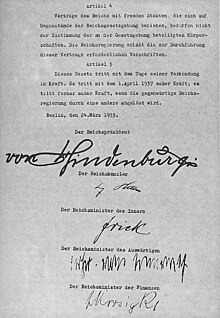
Enabling Act of 1933
Constitutional amendmentWikipedia
48
MENTIONS
22
EPISODES
20
PODCASTS
Search complete. 48 mentions across 22 episodes found for "Enabling Act of 1933".
Oct 17, 2026

speaker_0HOST
The decree issued the following morning suspended civil liberties and broke the Communist Party.
speaker_0HOST
The Enabling Act passed on March twenty-third with communist deputies already in custody.
speaker_0HOST
The trade unions were abolished in May.
speaker_0HOST
Hold the exact terms of that transaction.

Timothy RybackGUEST
And what Hitler said, everyone is always looking at these issues from the fanatic point of view.
Timothy RybackGUEST
Hitler, right before he was appointed basically dictator through something called the Enabling Act, when two-thirds of the legislative body voted to give Hitler dictatorial powers for four years.
Timothy RybackGUEST
Completely democratic process.
Timothy RybackGUEST
And there you watch a democracy committing suicide live.

David WhiteheadHOST
These are the people calling the cops when you had a barbecue during lockdowns, et cetera, where you didn't wear the two masks alone in your car and let's call the police, you know? got fascist and nazi cases as well you had the reichstag fire in february 1933 was immediately blamed on a communist plot so they'll play the other side they'll be like oh well we're against the communists but really they're all the same right the resulting reichstag fire decree suspended civil liberties free speech press assembly etc enabled mass arrests of political opponents and was sold as necessary to prevent imminent bolshevik revolution Nazi propaganda maintained a continuous threat narrative around communists, Jews, and other internal enemies.
David WhiteheadHOST
The Enabling Act soon followed, consolidating power.
David WhiteheadHOST
And this matches the crisis emergency powers normalization pattern.
David WhiteheadHOST
And it's also how we understand that when you see the battles going on between these variants of the same Kool-Aid, you'll see that they're just two different gangs fighting over the same turf.

Thomas777GUEST
You know, um, he-- Mussolini, Mussolini fundamentally, uh- fundamentally, um, altered the structural balance of power between the executive and, um, and, um, and the parliament, and, and, and, and the electoral system itself, as well as the parliament, which was largely becoming somewhat gelded anyway by, uh, the Acerbo law, um, which basically guaranteed, like, the National Fascist Party, you know, like a s- a certain percentage of cabinet seats, okay.
Thomas777GUEST
So, um, it, it essentially became a one-party state without, um, you know, um, something like the Enabling Act to finesse it.
Thomas777GUEST
And for the record too, and this is a subject for a different series or epher- or episode, but, um, you know, Hitler didn't, uh, Hitler didn't, um, take the oath of office as, as chancellor.
Thomas777GUEST
You know, and then, um, or even later after the, after the Enabling Act, you know, when he became a chancellor and, and Führer of the German Reich, he didn't, um, he didn't suddenly declare that, like, you know, now, like, you know, organs of state are all, you know, are all apparatus of the party, you know.
Thomas777GUEST
Um, and the internal police apparatus was very directly, um, co-opted by National Socialists and became an organ of the party, which is interesting in and of itself.
Thomas777GUEST
But other than that, um, that's one of the reasons there was this kind of agonistic pluralism in the Third Reich, where in some ways people didn't, couldn't quite grasp, like, where, you know, sort of like the state bureaucracy stopped and the party bureaucracy began.

ThomasGUEST
But as Mussolini's grip kind of became absolute, and unlike Hitler, who, you know, was a huge or a tremendous aspect of his ascendancy owed, you know, strategic use of plebiscites, you know, Mussolini was much more, there was definitely a cult of personality around Mussolini, and there definitely wasn't a, you know, from the center right to the truly fascist, you know, Mussolini had a very strong mandate for a 20th century executive, but he was prone to almost, like, quasi-Leninist, you know, sort of utterances that henceforth just became the law.
ThomasGUEST
You know, Mussolini fundamentally altered the structural balance of power between the executive and the electoral system itself, as well as the parliament, which was largely becoming somewhat gelded anyway, by the Acerbo law, which basically guaranteed, like, the National Fascist Party, you know, like, a certain percentage of cabinet seats, okay? So it essentially became a one-party state without You know, something like the Enabling Act to finesse it.
ThomasGUEST
And for the record, too, and this is a subject for a different series or episode, but, you know, Hitler didn't take the oath of office as counselor, you know, and then or even later after the Enabling Act, you know, when he became a counselor and Fuhrer of the German Reich.
ThomasGUEST
He didn't he didn't suddenly declare that, like, you know, now, like, you know, organs of state are all, you know, are all apparatus of the party, you know.
ThomasGUEST
And the internal police apparatus was very directly co-opted by National Socialists and became an organ of the party, which is interesting in and of itself.

Mark ThompsonHOST
Um, it's, it, as they, uh-
John RothmannGUEST
The Enabling Act.
Mark ThompsonHOST
Exactly.
John RothmannGUEST
The Enabling Act after the Reichstag fire.
Mark ThompsonHOST
Exactly.
Mark ThompsonHOST
Very, very good.
Thomas777GUEST
You know, like the National Socialist Party, um, it was, it was e- it was literally elected.
Thomas777GUEST
Um, Hitler himself, by the Enabling Act and by, um, various referendums, he had tremendous power, but even that wasn't really unprecedented.
Thomas777GUEST
You know, like the Reich president had had literally like extra constitutional authority as he saw fit.
Thomas777GUEST
But, um, you know, the German state and the National Socialist Party were discrete entities, and it, um, it-- there, there were, there was tension there, like structurally.

Mark ThompsonHOST
You know this.
Mark ThompsonHOST
The Enabling Act.
Mark ThompsonHOST
The Enabling
John RothmannGUEST
Act after the Reichstag fire.

Neil OliverHOST
He passed what was formally called the law to remedy the distress of people and the Reich.
Neil OliverHOST
But it's gone down in history as the Enabling Acts.
Neil OliverHOST
And by the Enabling Acts, Hitler assumed power, a new power to pass law without having to go through the Reichstag or the president.
Neil OliverHOST
He just bypassed all of that.
Neil OliverHOST
And you see that happening as well in the present day.
ThomasGUEST
And that's a really interesting counterfactual, but, um, that um and amidst all this kind of excitement um you know it's got to be said despite um the impression people have um i mean not just court historians even people who you know are more kind of critical in their thinking about historical topics there's this idea that the so that that the german reich was some kind with almost some kind of like rightist mirror of the soviet union it's not true at all You know, like, the National Socialist Party, it was literally elected.
ThomasGUEST
Hitler himself, by the Enabling Act and by various referendums, he had tremendous power, but even that wasn't really unprecedented.
ThomasGUEST
You know, like, the Reich president had had literally, like, extra constitutional authority, as he saw fit.
ThomasGUEST
But, you know, the German state and the National Socialist Party were discrete entities, and it...
12 more episodes mention Enabling Act of 1933.
Create an account to see the whole feed, search across every transcript, and follow the entities you care about.