Employment Division v. Smith
Court caseWikipedia
32
MENTIONS
9
EPISODES
9
PODCASTS
Search complete. 32 mentions across 9 episodes found for "Employment Division v. Smith".
Oct 21, 2026

Mike SachsCORRESPONDENT
Problem is, there's a landmark 1990 precedent written by the late conservative icon Justice Scalia saying that generally applicable rules like Colorado's that happen to burden someone's religion don't violate the free exercise clause.
Mike SachsCORRESPONDENT
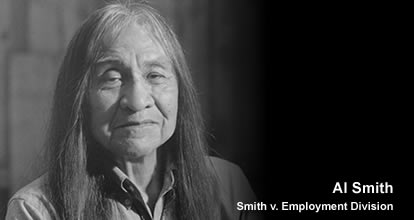
Now, at the time, the ruling called Employment Division v. Smith was designed to punch that case's hippy-dippy peyote-tripping co-plaintiff's Native American church by rejecting the liberal Warren Court's free exercise precedents from the 1960s that protected members of minority religions.
Mike SachsCORRESPONDENT
The facts were almost tailor-made for controversy.
Mike SachsCORRESPONDENT
Two members of the Native American church who worked as drug counselors were fired after ingesting peyote as part of a religious ceremony.
8 MINS LATER
Mike SachsCORRESPONDENT
Think the anti-affirmative action cases against Harvard and UNC.
Mike SachsCORRESPONDENT
But sometimes, the Roberts Court repeatedly rejects requests to outright overrule certain precedents, instead preferring death by a thousand cuts.
Mike SachsCORRESPONDENT
Think Employment Division v. Smith and this term St. Mary's Parish case that I rabbit-holed you down a few minutes ago.
Mike SachsCORRESPONDENT
The same goes for a case called Bivens v.

Allison GillHOST
Like, basically, Smith doesn't exist and no laws can be enforced against a religious actor that has a religious reason not to abide by it.
Liz CavellHOST
It also has things like repeal the Johnson Amendment, and DOJ should litigate to overturn Employment Division v. Smith, and Bernie v. Flores, and what else? Oh, CLS v.
Liz CavellHOST
Martinez, Christian Legal Society v. Martinez.
Liz CavellHOST
Basically, three of the major cases that the right wing lost.

Masha HansfordGUEST
Shout out to our host city here, which was a very similar case about foster placements by whether a Catholic organization had to allow foster placements placements by gay couples in order to participate in Philadelphia's foster program.
Masha HansfordGUEST
And people expected that the court was going to overrule Employment Division v. Smith and Justice Barrett, who was then newly on the court, was going to be in the lead on that.
Masha HansfordGUEST
But actually what the court did was it did rule against the city of Philadelphia, but it did so on narrow grounds.
Masha HansfordGUEST
And Justice Barrett, joined by Justice Kavanaugh, wrote a concurrence that said, if not Employment Division v. Smith, then what? It's actually really hard.
Masha HansfordGUEST
And really raising questions as to what would replace Employment Division v. Smith.
Masha HansfordGUEST
And so the challengers in this case filed this petition.
Masha HansfordGUEST
One of the questions they raised was whether Employment Division v. Smith should be overruled.
Masha HansfordGUEST
It's been five years.

Charles C. W. CookeHOST
And as a result, we are committed to our teachings on marriage and gender that contradict the non-discrimination agreement.
Charles C. W. CookeHOST
And as a result, they say they're being unconstitutionally excluded from a public benefit because of, as a direct result of, their religious convictions and that this is a violation of of the First Amendment, the Tenth Circuit said, nope, it agreed with a lower court ruling and it cited Employment Division v. Smith, a Supreme Court case from 1990, saying that the program and the law and the details of the agreement are generally applicable.
Charles C. W. CookeHOST
They don't specifically target the preschools in question.
Charles C. W. CookeHOST
They don't particularly target Catholics.
Charles C. W. CookeHOST
Yeah, no atheist he... is still on the books.
Charles C. W. CookeHOST
And the state of Colorado's case that this is consistent with it does seem somewhat strong to me.
Charles C. W. CookeHOST
So if you're not going to overturn Employment Division v. Smith, isn't St. Mary Catholic Parish going to lose?
Richard EpsteinGUEST
I don't think they will lose this particular case.

Charles C. W. CookeHOST
And St. Mary Catholic Parish, which is in the town of Littleton, Colorado, along with some other Catholic preschools, have said, "Well, we can't comply with those rules as written because we're a Catholic school, and as a result, we are committed to our teachings on marriage and gender that contradict the non-discrimination agreement." And as a result, they say they're being unconstitutionally excluded from a public benefit because of, as a direct result of, their religious convictions, and that this is a violation of the First Amendment.
Charles C. W. CookeHOST
The Tenth Circuit said nope, and it agreed with a lower court ruling, and it cited Employment Division v. Smith-
Richard EpsteinGUEST
Smith
Charles C. W. CookeHOST
...
Charles C. W. CookeHOST
They don't specifically target, uh, the preschools in question.
Charles C. W. CookeHOST
They don't particularly target Catholics.
Charles C. W. CookeHOST
Now, the Supreme Court agreed to hear this, but it is not, at least thus far, it is not going to look at whether Employment Division v. Smith should be overturned, but at a narrow question, which is how the Supreme Court's precedents in this area should apply when lower courts take up these cases.
Charles C. W. CookeHOST
So in such cases as a government, state or federal, is excluding religious institutions from public benefit, what is it obliged to do? I don't think that the court really can look at this completely independently of Employment Division v.

Masha HansfordGUEST
... uh, which was a very similar case about foster, uh, placements by, um, whether a Catholic organization had to a- allow foster p- uh, placements by gay couples in order to participate in Philadelphia's foster program.
Masha HansfordGUEST
And people expected that the court was going to overrule Employment Division v. Smith, and Justice Barrett, who was then newly on the court, was going to be in the lead on that.
Masha HansfordGUEST
But actually, what the court did was it did, um, rule against the City of Philadelphia, but it did so on narrow grounds, and Justice Barrett, joined by Justice Kavanaugh, wrote a concurrence that said, "If not Employment Division v. Smith, then what?" It's actually really hard, um, and really raising questions as to what would replace Employment Division v.
Masha HansfordGUEST
Smith.
Masha HansfordGUEST
And so the challengers in this case filed this petition.
Masha HansfordGUEST
One of the questions they raised was whether Employment Division v. Smith should be overruled.
Masha HansfordGUEST
And you know, it's been five years.
Masha HansfordGUEST
Justice Barrett has had more time to think about it.

Gregory GarreGUEST
And in particular, they allege that even though the non-discrimination requirement is categorical on its face, Colorado, in fact, has granted exemptions to schools that serve only particular groups, including families from the LGBTQ community, while refusing similar exemptions to religious schools.
Gregory GarreGUEST
And in a case called Employment Division v. Smith, the Supreme Court held decades ago that a neutral and generally applicable rule need not give way to religious exemptions.
Gregory GarreGUEST
But several justices on the court have criticized the Smith case, and this case will test the application of that principle.
Gregory GarreGUEST
And here the challengers argue that the Smith principle should at least give way where a state has granted exemptions to a law that is generally applicable on its face.

speaker_2PANELIST
I wanted to have you address the free exercise clause briefly, if you could.
speaker_2PANELIST
Your argument seems to rely fairly heavily on Employment Division v. Smith, and I was wondering if that case were to be overturned, does your argument falter?
PattersonGUEST
It doesn't, Your Honor, for two reasons.
PattersonGUEST
One is that plaintiffs don't even really dispute that it's neutral and generally applicable, so they forfeited that argument.