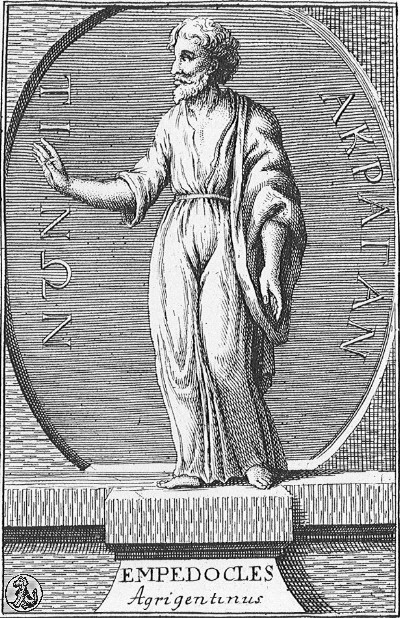
Empedocles
PhilosopherWikipedia
314
MENTIONS
84
EPISODES
70
PODCASTS
Search complete. 314 mentions across 84 episodes found for "Empedocles".
Oct 7, 2026

speaker_1NARRATOR
Amongst the Christian fathers, Origen, with praiseworthy courage, took this view, which is further justified by certain objective theories of life.
speaker_1NARRATOR
I refer not to my own philosophy alone, but to the wisdom of all ages, as expressed in Brahmanism and Buddhism, and in the sayings of Greek philosophers like Empedocles and Pythagoras, as also by Cicero, in his remark that the wise men of old used to teach that we come into this world to pay the penalty of crime committed in another state of existence, a doctrine which formed part of the initiation into the mysteries.
speaker_1NARRATOR
And Venini, whom his contemporaries burned, finding that an easier task than to confute him, puts the same thing in a very forcible way.
speaker_1NARRATOR
Man, he says, is so full of every kind of misery that were it not repugnant to the Christian religion, I should venture to affirm that if evil spirits exist at all, they have posed into human form and are now atoning for their crimes.

Ted GoodGUEST
And so you get three times creation, mixture, separation.
Peter AdamsonHOST
That sounds remarkably like Empedocles, actually.
Peter AdamsonHOST
So, you know, you have the separation of the four elements.
Peter AdamsonHOST
You have mixture, and then you have the sphere when everything is put together.
Peter AdamsonHOST
But maybe it just illustrates a tendency of these ancient thought traditions to think in terms of cycles and things coming together and apart.
Ted GoodGUEST
Well, Empedocles is probably related to some of the other things I think we'll talk about, about the elements and stuff.
Ted GoodGUEST
But one thing that's important is that this is supposed to be not a cycle.
Ted GoodGUEST
It's a one-shot go.

LennyNARRATOR
He uses the thoughts and almost the words of Parmenides when he discourses of being and of essence, adopting from old religion into philosophy the conception of God, and from the Megarians the idea of good.
LennyNARRATOR
He agrees with Empedocles and the atomists in attributing the greater differences of kinds to the figures of the elements and their movements into and out of one another.
LennyNARRATOR
With Heraclitus, he acknowledges the perpetual flux.
LennyNARRATOR
Like Anaxagoras, he asserts the predominance of mind, although admitting an element of necessity which reason is incapable of subduing.
2 HRS 36 MINS LATER
PhilippaNARRATOR
He has also created time, the moving image of eternity, and space, existing by a sort of necessity and hardly distinguishable from matter.
PhilippaNARRATOR
The matter out of which the world is formed is not absolutely void, but retains in the chaos certain germs or traces of the elements.
PhilippaNARRATOR
These Plato, like Empedocles, supposed to be four in number, fire, air, earth, and water.
PhilippaNARRATOR
They were at first mixed together, but already in the chaos, before God fashioned them by form and number, the greater masses of the elements had an appointed place.

speaker_3NARRATOR
But if some relative progress might be admitted, the general view of Greek philosophers was that they were living in a period of inevitable degeneration and decay, inevitable because it was prescribed by the nature of the universe.
speaker_3NARRATOR
We have only an imperfect knowledge of the influential speculations of Heraclitus, Pythagoras, and Empedocles, but we may take Plato's tentative philosophy of history to illustrate the trend and the prejudices of Greek thought on this subject.
speaker_3NARRATOR
The world was created and set going by the deity, and as his work, it was perfect.
speaker_3NARRATOR
But it was not immortal and had in it the seeds of decay.

Jeffrey EdwardsNARRATOR
Hence Democritus affirms the soul to be a sort of fire or heat, for the shapes or atoms are infinite, and those which are spherical he declares to be fire and soul.
Jeffrey EdwardsNARRATOR
they may be compared with the so-called motes in the air which are seen in the sunbeams that enter through our windows the aggregate of such seeds he tells us forms the constituent elements of the whole of nature and herein he agrees with leucippus while those of them which are spherical form the soul because such figures most easily find their way through everything and being themselves in motion set other things in motion the atomists assume that it is the soul which imparts motion to animals it is for this reason that they make life depend upon respiration for when the surrounding air presses upon bodies and tends to extrude those atomic shapes which because they are never at rest themselves impart motion to animals then they are reinforced from outside by the entry of other like atoms in respiration which in fact by helping to check compression and solidification prevent the escape of the atoms already contained in the animals and life so they hold continues so long as there is strength to do this the doctrine of the pythagoreans seems also to contain the same thought some of them identified soul with the motes in the air others with that which sets these motes in motion and as to these motes it has been stated that they are seen to be in incessant motion even though there be a perfect calm the view of others who describe the soul as that which moves itself tends in the same direction for it would seem that all these thinkers regard motion as the most distinctive characteristic of the soul everything else they think is moved by the soul but the soul is moved by itself and this because they never see anything cause motion without itself being in motion similarly the soul is said to be the moving principle by anaxagoras and all others who have held that mind sets the universe in motion but not altogether in the same sense as by democritus the latter indeed absolutely identified soul and mind holding that the presentation to the senses is the truth hence he observed homer had well sung of hector in his swoon that he lay with other thoughts democritus then does not use the term mind to denote a faculty conversant with truth but regards mind as identical with soul anaxagoras however is less exact in his use of the terms in many places he speaks of mind as the cause of goodness and order but elsewhere he identifies it with the soul as where he attributes it to all animals both great and small high and low as a matter of fact however mind in the sense of intelligence would not seem to be present in all animals alike nor even in all men those then who have directed their attention to the motion of the animate being conceived the soul as that which is most capable of causing motion while those who laid stress on its knowledge and perception of all that exists identified the soul with the ultimate principles whether they recognized a plurality of these or only one Thus Empedocles compounded soul out of all the elements, while at the same time regarding each one of them as a soul.
Jeffrey EdwardsNARRATOR
His words are, "...with earth we see earth, with water, water, with air, bright air, but ravaging fire by fire, love by love, in strife by gruesome strife." in the same manner plato in the timaeus constructs the soul out of the elements like he there maintains is known by like and the things we know are composed of the ultimate principles in like manner it was explained in the lectures on philosophy that the self-animal or universe is made up of the idea of one and of the idea numbers two or primary length three primary breadth and four primary depth and similarly with all the rest of the ideas and again this has been put in another way as follows reason is the one knowledge is the two because it proceeds by a single road to one conclusion opinion is the number of a surface three and sensation the number of a solid four in fact according to them the numbers though they are the ideas themselves or the ultimate principles are nevertheless derived from elements and things are judged some by reason others by knowledge others again by opinion and others by sensation while these idea numbers are forms of things and since the soul was held to be thus cognitive as well as capable of causing motion some thinkers have combined the two and defined the soul as a self-moving number but there are differences of opinion as to the nature and number of the ultimate principles especially between those thinkers who make the principles corporeal and those who make them incorporeal and again between both of these and others who combine the two and take their principles from both but further they differ also as to their number some assuming a single principle some a plurality and when they come to give an account of the soul they do so in strict accordance with their several views for they have assumed not unnaturally that the soul is that primary cause which in its own nature is capable of producing motion and this is why some identified soul with fire this being the element which is made up of the finest particles and is most nearly incorporeal while further it is pre-eminently an element which both moves and sets other things in motion democritus has expressed more neatly the reason for each of these facts soul he regards as identical with mind and this he makes to consist of the primary indivisible bodies and considers it to be a cause of motion from the fineness of its particles and their shape now the shape which is most susceptible of motion is the spherical and of atoms of this shape mind like fire consists anaxagoras while apparently understanding by mind something different from soul as we remarked above really treats both as a single nature except that it is pre-eminently mind which he takes as his first principle he says at any rate that mind alone of things that exist is simple unmixed pure but he refers both knowledge and motion to the same principle when he says that mind sets the universe in motion thales too apparently judging from the anecdotes related of him conceived soul as a cause of motion if it be true that he affirmed the lodestone to possess soul because it attracts iron diogenes however as also some others identified soul with air air they thought is made up of the finest particles and is the first principle and this explains the fact that the soul knows and is a cause of motion knowing by virtue of being the primary element from which all else is derived and causing motion by the extreme fineness of its parts Heraclitus takes soul for his first principle, as he identifies it with the vapour from which he derives all other things, and further says that it is the least corporeal of things, and in ceaseless flux, and that it is by something in motion that what is in motion is known, for he, like most philosophers, conceived all that exists to be in motion.
Jeffrey EdwardsNARRATOR
Alcmaon too seems to have had a similar conception, for soul, he maintains, is immortal, because it is like the beings which are immortal, and it has this attribute in virtue of being ever in motion, for he attributes continuous and unending motion to everything which is divine, moon, sun, stars, and the whole heaven.

speaker_2NARRATOR
Amongst the Christian fathers, Origen, with praiseworthy courage, took this view, which is further justified by certain objective theories of life.
speaker_2NARRATOR
I refer not to my own philosophy alone, but to the wisdom of all ages, as expressed in Brahmanism and Buddhism, and in the sayings of Greek philosophers like Empedocles and Pythagoras.
speaker_2NARRATOR
As also by Cicero, in his remark that the wise men of old used to teach that we come into this world to pay the penalty of crime committed in another state of existence, a doctrine which formed part of the initiation into the mysteries.
speaker_2NARRATOR
And Venini.

Hugh McGuireNARRATOR
In this way, Nietzsche treats of Thales and Anaximander, Heraclitus, Parmenides, Xenophanes, and Anaxagoras.
Hugh McGuireNARRATOR
There are also some sketches of a draft for an intended but never accomplished continuation in which Empedocles, Democritus, and Plato were to be dealt with.
Hugh McGuireNARRATOR
Probably the most popular of the essays in the book will prove to be the one on truth and falsity.
Hugh McGuireNARRATOR
It is an epistemological rhapsody on the relativity of truth, on appearance and reality, on perceptual flux versus conceptual conceit.
2 HRS 30 MINS LATER
Hugh McGuireNARRATOR
Involuntarily, on account of that loss, we measure them according to wrong standards and allow ourselves to be influenced unfavorably towards them by the mere accidental fact that Plato and Aristotle never lacked appreciators and copyists.
Hugh McGuireNARRATOR
Some people presuppose a special providence for books, a fatum liberorum.
Hugh McGuireNARRATOR
Such a providence, however, would at any rate be a very malicious one if it deemed it wise to withhold from us the works of Heraclitus, Empedocles' wonderful poem, and the writings of Democritus, whom the ancients put on a par with Plato, whom he even excels as far as ingenuity goes, and as a substitute put into our hand Stoics, Epicureans, and Cicero.
Hugh McGuireNARRATOR
Probably the most sublime part of Greek thought and its expression in words is lost to us, a fate which will not surprise the man who remembers the misfortunes of Scotus, Arigena, or of Pascal, and who considers that even in this enlightened century the first edition of Schopenhauer's The World as Will and Idea became waste paper.

Robin DouglasGUEST
Yeah, the notion that we're from the wrong planet or that we've fallen from on high, that we've descended into these bodies from the divine realm and we're exiles here.
Robin DouglasGUEST
That first comes up, I think, in the pre-Socratic philosopher Empedocles.
Robin DouglasGUEST
I should probably have looked that up before I came on, but I think that's the first testimony of that.
Robin DouglasGUEST
So this stuff goes back a long, long way.

Geoffrey EdwardsNARRATOR
It is for this reason that they make life depend upon respiration.
Geoffrey EdwardsNARRATOR
For, when the surrounding air presses upon bodies and tends to extrude those atomic shapes which, because they are never at rest themselves, impart motion to animals, then they are reinforced from outside by the entry of other like atoms in respiration, which in fact by helping to check compression and solidification prevent the escape of the atoms already contained in the animals and life so they hold continues so long as there is strength to do this the doctrine of the pythagoreans seems also to contain the same thought some of them identified soul with the motes in the air others with that which sets these motes in motion and as to these motes it has been stated that they are seen to be in incessant motion even though there be a perfect calm the view of others who describe the soul as that which moves itself tends in the same direction for it would seem that all these thinkers regard motion as the most distinctive characteristic of the soul everything else they think is moved by the soul but the soul is moved by itself and this because they never see anything cause motion without itself being in motion similarly the soul is said to be the moving principle by anaxagoras and all others who have held that mind sets the universe in motion but not altogether in the same sense as by democritus the latter indeed absolutely identified soul and mind holding that the presentation to the senses is the truth hence he observed homer had well sung of hector in his swoon that he lay with other thoughts democritus then does not use the term mind to denote a faculty conversant with truth but regards mind as identical with soul anaxagoras however is less exact in his use of the terms in many places he speaks of mind as the cause of goodness and order but elsewhere he identifies it with the soul as where he attributes it to all animals both great and small high and low as a matter of fact however mind in the sense of intelligence would not seem to be present in all animals alike nor even in all men those then who have directed their attention to the motion of the animate being conceived the soul as that which is most capable of causing motion while those who laid stress on its knowledge and perception of all that exists identified the soul with the ultimate principles whether they recognized a plurality of these or only one Thus Empedocles compounded soul out of all the elements, while at the same time regarding each one of them as a soul.
Geoffrey EdwardsNARRATOR
His words are, "...with earth we see earth, with water, water, with air, bright air, but ravaging fire by fire, love by love, in strife by gruesome strife." in the same manner plato in the timaeus constructs the soul out of the elements like he there maintains is known by like and the things we know are composed of the ultimate principles in like manner it was explained in the lectures on philosophy that the self-animal or universe is made up of the idea of one and of the idea numbers two or primary length three primary breadth and four primary depth and similarly with all the rest of the ideas and again this has been put in another way as follows reason is the one knowledge is the two because it proceeds by a single road to one conclusion opinion is the number of a surface three and sensation the number of a solid four in fact according to them the numbers though they are the ideas themselves or the ultimate principles are nevertheless derived from elements and things are judged some by reason others by knowledge others again by opinion and others by sensation while these idea numbers are forms of things and since the soul was held to be thus cognitive as well as capable of causing motion some thinkers have combined the two and defined the soul as a self-moving number but there are differences of opinion as to the nature and number of the ultimate principles especially between those thinkers who make the principles corporeal and those who make them incorporeal and again between both of these and others who combine the two and take their principles from both but further they differ also as to their number some assuming a single principle some a plurality and when they come to give an account of the soul they do so in strict accordance with their several views for they have assumed not unnaturally that the soul is that primary cause which in its own nature is capable of producing motion and this is why some identified soul with fire this being the element which is made up of the finest particles and is most nearly incorporeal while further it is pre-eminently an element which both moves and sets other things in motion has expressed more neatly the reason for each of these facts soul he regards as identical with mind and this he makes to consist of the primary indivisible bodies and considers it to be a cause of motion from the fineness of its particles and their shape now the shape which is most susceptible of motion is the spherical and of atoms of this shape mind like fire consists anaxagoras while apparently understanding by mind something different from soul as we remarked above really treats both as a single nature except that it is pre-eminently mind which he takes as his first principle he says at any rate that mind alone of things that exist is simple unmixed pure but he refers both knowledge and motion to the same principle when he says that mind sets the universe in motion thales too apparently judging from the anecdotes related of him conceived soul as a cause of motion if it be true that he affirmed the lodestone to possess soul because it attracts iron diogenes however as also some others identified soul with air air they thought is made up of the finest particles and is the first principle and this explains the fact that the soul knows and is a cause of motion knowing by virtue of being the primary element from which all else is derived and causing motion by the extreme fineness of its parts heraclitus takes soul for his first principle as he identifies it with the vapour from which he derives all other things and further says that it is the least corporeal of things and in ceaseless flux and that it is by something in motion that what is in motion is known for he like most philosophers conceived all that exists to be in motion Alcmaon, too, seems to have had a similar conception, for soul, he maintains, is immortal, because it is like the beings which are immortal, and it has this attribute in virtue of being ever in motion, for he attributes continuous and unending motion to everything which is divine—moon, sun, stars, and the whole heaven.
Geoffrey EdwardsNARRATOR
Among cruder thinkers there have been some, like Hyppon, who have even asserted the soul to be water.

Ted LinhartNARRATOR
It was introduced to solve the difficulties supposed to arise from matter being thought to act on mind and mind on matter.
Ted LinhartNARRATOR
The principle was laid down as early as the days of Empedocles, that light could act only on light.
Ted LinhartNARRATOR
So it was necessary to bring in something to interpose between the object perceived and the perceiving mind.
Ted LinhartNARRATOR
According to Democritus, the expounder of the atomic theory of matter, images, blank, composed of the finest atoms floated from the object to the mind.
74 more episodes mention Empedocles.
Create an account to see the whole feed, search across every transcript, and follow the entities you care about.