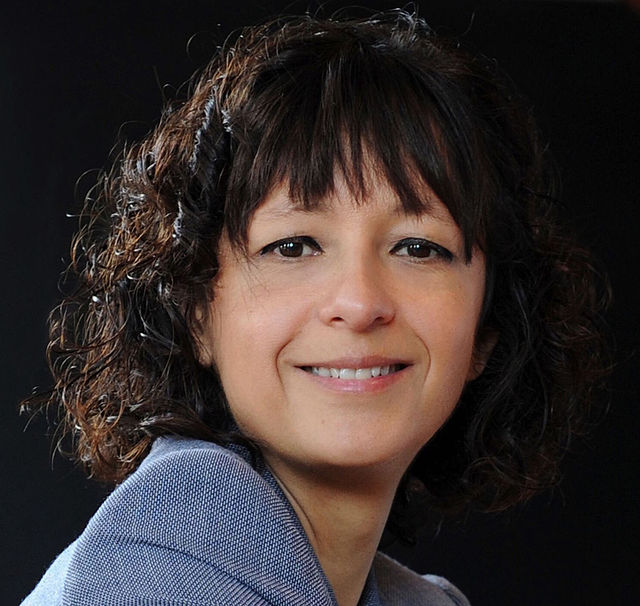
Emmanuelle Charpentier
French academic and microbiologistWikipedia
46
MENTIONS
17
EPISODES
17
PODCASTS
Search complete. 46 mentions across 17 episodes found for "Emmanuelle Charpentier".
Nov 24, 2026

Hank GreenHOST
First, scientists had to move beyond finding the palindromic repeats in different microbes to understanding how the whole system worked.
Hank GreenHOST
What told the cutting protein where to cut? How could the system be reprogrammed? Swiss microbiologist Emmanuelle Charpentier and German microbiologist Jörg Vogel figured out that a special piece of nucleic acid called a guide RNA tells the cutting Cas9 protein to cut DNA at that right place.
Hank GreenHOST
Other scientists worked out how to move a whole system that evolved in microbes into the cells of mice and humans.
Hank GreenHOST
A whole system of genes, tracer RNAs, and proteins.

Helene BorrmannGUEST
It was very much, I was more on the scientific side.
Helene BorrmannGUEST
I think the first time that I actually got like tickled by it was doing my undergrad, which was in Emanuel Charpentier's lab in Germany that found CRISPR, like won the Nobel Prize after.
Helene BorrmannGUEST
And that was the first time when I saw incredible technology inside of a lab.
Helene BorrmannGUEST
And I was like, wow, there's so much you can do with that.

Christian TitusNARRATOR
In 2011, Doudna was at an American Society for Microbiology meeting in San Juan, Puerto Rico, when an intense, dark-haired French scientist asked her if she wouldn't mind stepping outside the conference hall for a chat.
Christian TitusNARRATOR
This was Emmanuel Charpentier, a microbiologist at Umeå University in Sweden.
Christian TitusNARRATOR
As they wandered through the alleyways of old San Juan, Charpentier explained that one of CRISPR's associated proteins, named CSN1, appeared to be extraordinary.
Christian TitusNARRATOR
It seemed to search for specific DNA sequences in viruses and cut them apart like a microscopic multi-tool.
Christian TitusNARRATOR
Charpentier asked Doudna to help her figure out how it worked.
Christian TitusNARRATOR
Somehow, the way she said it, I literally, I can almost feel it now.
Christian TitusNARRATOR
I had this chill down my back, Doudna says.
Christian TitusNARRATOR
When she said the mysterious CSN-1, I just had this feeling there is going to be something good here.

Christian TitusNARRATOR
In 2011, Doudna was at an American Society for Microbiology meeting in San Juan, Puerto Rico, when an intense, dark-haired French scientist asked her if she wouldn't mind stepping outside the conference hall for a chat.
Christian TitusNARRATOR
This was Emmanuelle Charpentier.
Christian TitusNARRATOR
a microbiologist at Umea University in Sweden.
Christian TitusNARRATOR
As they wandered through the alleyways of old San Juan, Charpentier explained that one of CRISPR's associated proteins, named CSN1, appeared to be extraordinary.

Christian TitusNARRATOR
In 2011, Doudna was at an American Society for Microbiology meeting in San Juan, Puerto Rico, when an intense, dark-haired French scientist asked her if she wouldn't mind stepping outside the conference hall for a chat.
Christian TitusNARRATOR
This was Emmanuelle Charpentier, a microbiologist at Umea University in Sweden.
Christian TitusNARRATOR
As they wandered through the alleyways of Old San Juan, Charpentier explained that one of CRISPR's associated proteins, named CSN1, appeared to be extraordinary.
Christian TitusNARRATOR
It seemed to search for specific DNA sequences in viruses and cut them apart like a microscopic multitool.
Christian TitusNARRATOR
Charpentier asked Doudna to help her figure out how it worked.
Christian TitusNARRATOR
Somehow, the way she said it, I literally, I can almost feel it now.
Christian TitusNARRATOR
I had this chill down my back, Doudna says.
Christian TitusNARRATOR
When she said the mysterious CSN1, I just had this feeling there is going to be something good here.

Jennifer DoudnaGUEST
Sort of crazy.
Jennifer DoudnaGUEST
And that eventually led us to a collaboration with Emmanuelle Charpentier, who you mentioned.
Jennifer DoudnaGUEST
She is a medical microbiologist and had come to CRISPR from a very different direction from my own lab.
Jennifer DoudnaGUEST
She had been fascinated by how bacteria that infect humans, immune compromised humans, how they use CRISPR systems to become more pathogenic.

Christian TitusNARRATOR
In 2011, Doudna was at an American Society for Microbiology meeting in San Juan, Puerto Rico, when an intense, dark-haired French scientist asked her if she wouldn't mind stepping outside the conference hall for a chat.
Christian TitusNARRATOR
This was Emmanuel Charpentier, a microbiologist at Umeå University in Sweden.
Christian TitusNARRATOR
As they wandered through the alleyways of old San Juan, Charpentier explained that one of CRISPR's associated proteins, named CSN1, appeared to be extraordinary.
Christian TitusNARRATOR
It seemed to search for specific DNA sequences in viruses and cut them apart like a microscopic multi-tool.
Jennifer DoudnaGUEST
Sort of crazy.
Jennifer DoudnaGUEST
And that eventually led us to a collaboration with Emmanuelle Charpentier, who you mentioned.
Jennifer DoudnaGUEST
She is a medical microbiologist and had come to CRISPR from a very different direction from my own lab.
Jennifer DoudnaGUEST
She had been fascinated by how bacteria that infect humans, immune compromised humans, how they use CRISPR systems to become more pathogenic.

Jennifer DoudnaGUEST
Sort of crazy.
Jennifer DoudnaGUEST
And that eventually led us to a collaboration with Emmanuelle Charpentier, who you mentioned.
Jennifer DoudnaGUEST
She is a medical microbiologist and had come to CRISPR from a very different direction from my own lab.
Jennifer DoudnaGUEST
She had been fascinated by how bacteria that infect humans, immune compromised humans, how they use CRISPR systems to become more pathogenic.
Jennifer DoudnaGUEST
Sort of crazy.
Jennifer DoudnaGUEST
And that eventually led us to a collaboration with Emmanuelle Charpentier, who you mentioned.
Jennifer DoudnaGUEST
She is a medical microbiologist and had come to CRISPR from a very different direction from my own lab.
Jennifer DoudnaGUEST
She had been fascinated by how bacteria that infect humans, immune compromised humans, how they use CRISPR systems to become more pathogenic.
7 more episodes mention Emmanuelle Charpentier.
Create an account to see the whole feed, search across every transcript, and follow the entities you care about.