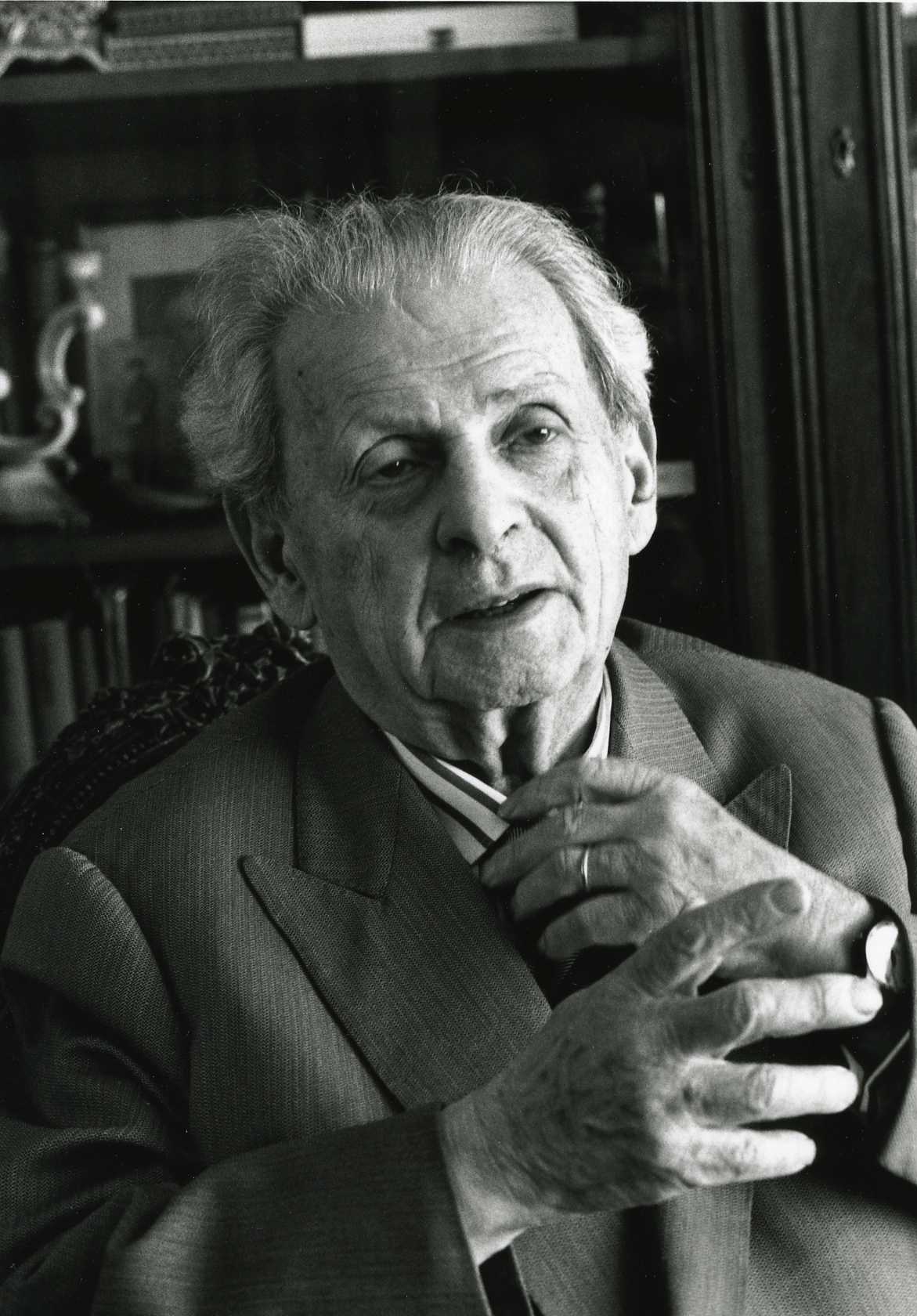
Emmanuel Levinas
French philosopherWikipedia
47
MENTIONS
24
EPISODES
24
PODCASTS
Search complete. 47 mentions across 24 episodes found for "Emmanuel Levinas".
Sep 16, 2026

Nick TrakakisGUEST
The, um, uh ...
Nick TrakakisGUEST
This is a criticism that, um, even in French continental philosophy some critics made of, uh, writers like Emmanuel Levinas.
James EllisHOST
Mm.
Nick TrakakisGUEST
Um, and you could make the same ...

Christopher FynskGUEST
The second point I would emphasize with respect to this early reading of Heidegger is that it made me quite sensitive to the topic of the finitude of the human Dasein.
Christopher FynskGUEST
This preoccupation emerges strongly in my other writing on Heidegger, but also in my work on Levinas and Blanchot, and even in my work on infancy.
Christopher FynskGUEST
I followed my first book on Heidegger then with a second that addressed his later thought on language, language and relation, that there is language.
Christopher FynskGUEST
This volume also touched on the topic of language in readings of Luce Irigaray, Paul Celan, Maurice Blanchot, and Walter Benjamin, but its long first section with three essays were devoted principally to Heidegger's On the Way to Language.

Creighton McElveenHOST
So I wanted to kind of bring up two philosophers who I think help us give some vocabulary to what's going on with silence and solitude.
Creighton McElveenHOST
The first is Emmanuel Levinas and the second is Jean-Luc Marion.
Creighton McElveenHOST
So I think both are awesome.
Creighton McElveenHOST
If you haven't read anything from these guys, you should.
Creighton McElveenHOST
This goes all the way back to Heidegger and Husserl and some of the beginners of phenomenology.
Creighton McElveenHOST
But this idea, it's like, what's the place? What's our starting point? Kind of peel back the layers of the onion.
Creighton McElveenHOST
Where's our starting point? And Levinas's reduction is sometimes called the vocative or ethical alterity reduction.
Creighton McElveenHOST
And that's a lot of fancy 10-cent sounding words, but we'll kind of break this down.

David GuedaliaGUEST
I spent some time in different worlds.
David GuedaliaGUEST
So in parallel with my professional life, I studied with a friend in Hebrew University, David Hansel, who happens to be the grandson of Emmanuel Levinas, if you're familiar with some of his philosophy and writing.
David GuedaliaGUEST
And he introduced me into what's called the Ashlag world.
David GuedaliaGUEST
So I spent some time in a Beit Midrash in Telstone, learning the Ashlag way, which was a little bit different than Brisk, as you can imagine.

Dan MillerHOST
So, uh,
Frédéric SamamaGUEST
And here, Immanuel Kant, the philosopher, and on the first one, Immanuel Levinas, another philosopher, wrote pages that when you see the fragility, it triggers
Dan MillerHOST
I gotta factor that in.
Dan MillerHOST
Um, I was gonna go into this back and forth a little bit

Joshua YenHOST
In Camus, the plague also says something along the lines of saying, well, I simply refuse to worship a God who allows the suffering of children.
Joshua YenHOST
And of course, this takes a phenomenological turn in Levinas, who develops on Dostoevsky.
Joshua YenHOST
He's very influenced by Dostoevsky, but then takes it further by saying suffering is passive and prior to receptivity, there's this ultimate passiveness of suffering.
Joshua YenHOST
of suffering.

David AndersHOST
We share a kind of common sort of moral framework.
David AndersHOST
I remember listening one time to an interview with Emmanuel Levinas, who was a famous Jewish-French philosopher.
David AndersHOST
And he was giving his take on how he understood Judaism.
David AndersHOST
And he said, you know, in his mind, Judaism was less a kind of cultic community than it was an existential stance towards reality.

Catherine LiuGUEST
And so do we say, "Oh, you were never a worker in a textile factory, so you have no right to speak of it"? I think that that is the deepest kinds of anti-intellectualism, um, possible, so that this sort of lived experience authentification is part and parcel of an anti-materialism that's part of liberal centrist politics in the Anglo-American world that we export to the rest of the world as some kind of moral good.
speaker_2HOST
That focus on lived experience, does that come from philosophers such as Levinas, who say that the other is unknowable, that we, the other is eternal?
Catherine LiuGUEST
Um, Levinas is a kind of metaphysician of intersubjectivity.
Catherine LiuGUEST
I do think the other is unknowable.
Catherine LiuGUEST
I don't know if he...
Catherine LiuGUEST
You instrumentalize their suffering, and you make yourself the agent of cure, recovery, witness, et cetera.
Catherine LiuGUEST
So in trauma studies, for instance, that came out of, um, Yale University literature department, the highest order of, um, ethical moral activity was actually witnessing, witnessing the other.
Catherine LiuGUEST
And they were very, they owed a lot to, um, Levinas.

Jonathan SacksHOST
Each individual is theoretically capable of a unique insight into its meaning.
Jonathan SacksHOST
The French philosopher Emmanuel Levinas commented, The revelation has a particular way of producing meaning which lies in its calling upon the unique within me.
Jonathan SacksHOST
It's as if a multiplicity of persons were the condition for the plenitude of absolute truth, as if each person, by virtue of his own uniqueness, were able to guarantee the revelation of one unique aspect of the truth, so that some of its facets would never have been revealed.
Jonathan SacksHOST
if certain people had been absent from humankind.

Ernie HarwellHOST
The Tigers have a 3-1 lead for him as he faces the Birds in the second inning.
Ernie HarwellHOST
We'd like to salute Mr. and Mrs. Nicholas Levinas.
Ernie HarwellHOST
Mr. Levinas, 90 years old on the 1st of June.
Ernie HarwellHOST
And he and Mrs. Levinas are celebrating their 50th anniversary on this date, and they have been loyal Tiger fans for many years.
Ernie HarwellHOST
It'll be Descense, Dower, and Skagg to lead it off for the Baltimore.
Ernie HarwellHOST
Descense, who hit that dramatic home run last night, a two-run homer that won the ballgame.
14 more episodes mention Emmanuel Levinas.
Create an account to see the whole feed, search across every transcript, and follow the entities you care about.