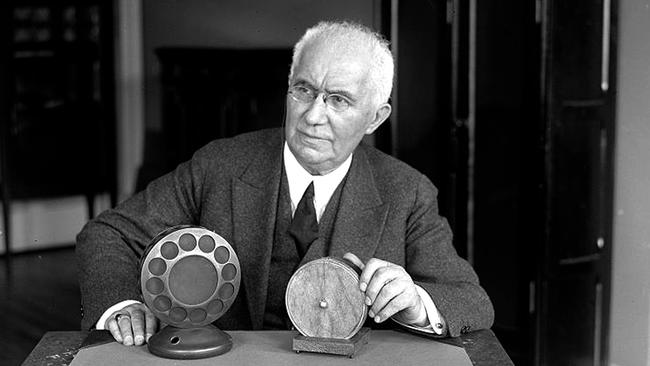
Emile Berliner
German-American inventor and businessmanWikipedia
13
MENTIONS
11
EPISODES
10
PODCASTS
Search complete. 13 mentions across 11 episodes found for "Emile Berliner".
Sep 15, 2026

Mark SmithNARRATOR
Scientific divining rod used in electromagnetic method of locating metal ore, petroleum, and other minerals devised by Hans Lundberg and Carl Sundberg, Swedes.
Mark SmithNARRATOR
In inventing telephone transmitter and motion picture projector, Edison, Scott Netherlander, helped by Emil Berliner, German Jew.
Mark SmithNARRATOR
Accuracy gauges from which precision machinery is made invented by Carl Johansson, Swede.
Mark SmithNARRATOR
Process for making artificial stone invented by Michael Timofeyeff, Ukrainian.

Mark SmithNARRATOR
Scientific divining rod used in electromagnetic method of locating metal ore, petroleum, and other minerals devised by Hans Lundberg and Carl Sundberg, Swedes.
Mark SmithNARRATOR
In inventing telephone transmitter and motion picture projector, Edison, Scott Netherlander, helped by Emil Berliner, German Jew.
Mark SmithNARRATOR
Accuracy gauges from which precision machinery is made invented by Carl Johansson, Swede.
Mark SmithNARRATOR
Process for making artificial stone invented by Michael Timofieff, Ukrainian.

speaker_5NARRATOR
In Camden, New Jersey in 1896...
speaker_5NARRATOR
Emile Berliner and Eldridge Johnson founded the modern music and home entertainment industry out of this little garage when they invented and developed the turntable and
Buzz KnightHOST
disc record.
Buzz KnightHOST
For the first time in history, music wasn't just something you heard.

speaker_5NARRATOR
In Camden, New Jersey in 1896...
speaker_5NARRATOR
Emile Berliner and Eldridge Johnson founded the modern music and home entertainment industry out of this little garage when they invented and developed the turntable and
Buzz KnightHOST
disc record.
Buzz KnightHOST
For the first time in history, music wasn't just something you heard.

Alex SchmidtHOST
He has a wild connection to another SIF.
Alex SchmidtHOST
The past episode about vinyl records, we talk about a German engineer named Emil Berliner inventing discs for recorded music.
Alex SchmidtHOST
Hans was his great nephew.
Katie GoldinHOST
Whoa.

Robert RobinsonNARRATOR
This evening, about 7 p.m., Tainter noted on July 7, 1881, the apparatus being ready, the valve upon the top of the air cylinder was opened slightly until a pressure of about 100 pounds was indicated by the gauge.
Robert RobinsonNARRATOR
the phonograph cylinder was then rotated and the sounds produced by the escaping air could be heard and the words understood a distance of at least eight feet from the phonograph the point of the jet is glass and could be directed at a single groove the other experimental gramophones indicate an amazing range of experimentation while the method of cutting a record on wax was the one later exploited commercially everything else seems to have been tried at least once the following was noted on wednesday march twentieth eighteen eighty one a fountain pen is attached to a diaphragm so as to be vibrated in a plane parallel to the axis of a cylinder the ink used in this pen to contain iron in a finely divided state and the pen caused to trace a spiral line around the cylinder as it turned the cylinder to be covered with a sheet of paper upon which the record is made this ink can be rendered magnetic by means of a permanent magnet the sounds were to be reproduced by simply substituting a magnet for the fountain pen the result of these ideas for magnetic reproduction resulted in patent three four one two eight seven granted on may fourth eighteen eighty six it deals solely with the reproduction through the action of magnetism of sounds by means of records in solid substances the air jet used in reproducing has already been described other jets of molten metal wax and water were also tried on saturday may nineteenth eighteen eighty three tainter wrote made the following experiment to-day the cylinder of the edison photograph was covered with a coating of paraffin wax and then turned off true and smooth a cutting style a secured by the end of a lever b was then adjusted over the cylinder as shown lever b was pivoted at the points c d and the only pressure exerted to force the style into the wax was due to the weight of the parts upon the top of a was fixed a small brass disc and immediately over it a sensitive water jet adjusted so that the stream of water at its sensitive part fell upon the centre of the brass disc the phonograph cylinder e was rotated while words and sounds were shouted to the support to which the water jet was attached and a record that was quite visible to the unaided eye was the result the tape recorder an unusual instrument which recorded mechanically on a three sixteenth inch strip of wax-covered paper is one of the machines described and illustrated in u s patent three four one two one four dated may fourth eighteen eighty six the strip was coated by dipping it in a solution of beeswax and paraffin one part white beeswax two parts paraffin by weight then scraping one side clean and allowing the other side to harden the machine of sturdy wood and metal construction is hand powered by means of a knob fastened to the flywheel from the flywheel shaft power is transferred by a small friction wheel to a vertical shaft at the bottom of the shaft a v pulley transfers motion by belts to corresponding v pulleys beneath the horizontal reels the wax strip passes from one eight inch reel around the periphery of a pulley with guided flanges mounted above the v pulleys on the main vertical shaft where it comes in contact with the recording or reproducing stylus it is then taken up on the other reel the sharp recording stylus actuated by a vibrating mica diaphragm cuts the wax from the strip in reproducing a dull loosely mounted stylus attached to a rubber diaphragm carried sounds through an ear tube to the listener both recording and reproducing heads mounted alternately on the same two posts could be adjusted vertically so that several records could be cut on the same three sixteenth inch strip while this machine was never developed commercially it is an interesting ancestor of the modern tape recorder which it resembles somewhat in design how practical it was or just why it was built we do not know the tape is now brittle the heavy paper reels warped and the reproducing head missing otherwise with some reconditioning it could be put into working condition most of the disc machines designed by the volta associates had the disc mounted vertically the explanation is that in the early experiments the turntable with disc was mounted on the shop lathe along with the recording and reproducing heads later when the complete models were built most of them featured vertical turntables an interesting exception has a horizontal seven inch turntable this machine although made in eighteen eighty six is a duplicate of one made earlier but taken to europe by chichester bell tainter was granted u s patent three eight five eight eight six for it on july tenth eighteen eighty eight the playing arm is rigid except for a pivoted vertical motion of ninety degrees to allow removal of the record or return to the starting position while recording or playing the record not only rotated but moved laterally under the stylus which thus described a spiral recording a hundred and fifty grooves to the inch the bell and tainter records preserved at the smithsonian are both of the lateral cut and hill and dale types edison for many years used the hill and dale method with both cylinder and disc records and emile berliner is credited with the invention of the lateral cut gramophone record in eighteen eighty seven the volta associates however had been experimenting with both types as early as eighteen eighty one as is shown by the following quotation from tainter the record on the electrotype in the smithsonian package is of the other form where the vibrations are impressed parallel to the surface of the recording material as was done in the old scott phonautograph of eighteen fifty seven thus forming a groove of uniform depth but of wavy character in which the sides of the groove act upon the tracing point instead of the bottom as is the case of the vertical type this form we named the zigzag form and refer to it in that way in our notes its important advantage in guiding the reproducing needle i first called attention to in the note on page nine volume one home notes on march twenty ninth eighteen eighty one and endeavored to use it in my early work but encountered so much difficulty in getting a form of reproducer that would work with the soft wax records without tearing the groove we used the hill and valley type of record more often than the other in eighteen eighty five when the volta associates were sure that they had a number of practical inventions they filed applications for patents they also began to look around for investors after giving several demonstrations in washington they gained the necessary support and the american gramophone company was organized to manufacture and sell the machines the volta gramophone company was formed to control the patents the howe sewing machine factory at bridgeport connecticut became the american gramophone plant tainter went there to supervise the manufacturing and continued his inventive work for many years this bridgeboard plant is still in use to-day by a successor firm the dictaphone corporation The work of the Volta Associates laid the foundation for the successful use of the dictating machine in business, for their wax recording process was practical and their machines sturdy.
Robert RobinsonNARRATOR
But it was to take several more years and the renewed work of Edison and further developments by Berliner and many others before the talking machine industry really got underway and became a major factor in home entertainment.
Robert RobinsonNARRATOR
End of Development of the Phonograph at Alexander Graham Bell's Volta Laboratory Recording by Robert Robinson

Nate WilcoxHOST
Absolutely, and another thing where reading your book brings back current memories today is you talk about format wars that literally go back to the very beginning of recorded sound, where, where Thomas Edison, uh, and Alexander Graham Bell, and others are competing to create, um, the perfect musical format.
Nate WilcoxHOST
I believe it was Emile Berliner's gramophone that competed with Thomas Edison's phonograph.
Nate WilcoxHOST
This is like the first version of Betamax versus VHS, or for contemporary users, you know, Spotify versus SoundCloud.
Nate WilcoxHOST
Can you give us some of the handicap of the battle between Edison's phonograph and Berliner's gramophone?
Peter DoggettGUEST
... that was Edison, was that at the time that technology was invented, there was no way of reproducing it.
Peter DoggettGUEST
So that if a performer wanted to sell, um, 5,000 cylinders of a, of a particular performance, they had to record [chuckles] they had to make 5,000 individual recordings so that everybody had a slightly different recording.
Peter DoggettGUEST
Whereas with Emile Berliner's, um, record, what become-
Nate WilcoxHOST
Gramophone
speaker_1NARRATOR
This week, Nate is joined by author Peter Doggett for the first of two episodes discussing his book, Electric Shock: Recorded Music from the Gramophone to the iPhone.
speaker_1NARRATOR
In this episode, Peter explains how he came to take on such an ambitious project, why he started with the advent of recorded music rather than the advent of sheet music, the first format wars between Thomas Edison's phonograph and Emile Berliner's gramophone, the first recorded music superstars, and one unfortunate early hitmaker who found himself having to do a new recording every time a copy of his hit record was made.
Nate WilcoxHOST
I hate to have to do this, but this episode of Let It Roll From the Beginning requires a trigger warning.
Nate WilcoxHOST
If you're especially sensitive to slurs about African Americans, and no, I'm not talking about the N-word, I'm talking about the C-word, C-O-O-N, you might want to pass this one by.

Gary ArndtHOST
Key breakthroughs included John Roebling's development of wire rope, enabling the construction of suspension bridges, and Ottmar Mergenthaler's linotype machine, which revolutionized the printing field.
Gary ArndtHOST
Additional game-changing innovations included Emil Berliner's flat record and disc gramophone, Herman Hollerith's punch card tabulation system, which is a crucial forerunner to modern computing, and George Westinghouse's safety air brakes for trains.
Gary ArndtHOST
German Americans also advanced agriculture with John Froelich's gasoline-powered tractor, electrical engineering through the works of Charles Proteus Steinmetz, and musical instrument design through the innovations of the Steinway family.
Gary ArndtHOST
And of course, we can't forget Levi Strauss gave us the blue jean.

Robert RobinsonNARRATOR
Upon the top of A was fixed a small brass disc, and immediately over it a sensitive water jet adjusted, so that the stream of water at its sensitive part fell upon the center of the brass disc.
Robert RobinsonNARRATOR
the phonograph cylinder e was rotated while words and sounds were shouted to the support to which the water jet was attached and a record that was quite visible to the unaided eye was the result the tape recorder an unusual instrument which recorded mechanically on a three sixteenth inch strip of wax-covered paper is one of the machines described and illustrated in u s patent three four one two one four dated may fourth eighteen eighty six the strip was coated by dipping it in a solution of beeswax and paraffin one part white beeswax two parts paraffin by weight then scraping one side clean and allowing the other side to harden the machine of sturdy wood and metal construction is hand powered by means of a knob fastened to the flywheel from the flywheel shaft power is transferred by a small friction wheel to a vertical shaft at the bottom of the shaft a v pulley transfers motion by belts to corresponding v pulleys beneath the horizontal reels the wax strip passes from one eight inch reel around the periphery of a pulley with guided flanges mounted above the v pulleys on the main vertical shaft where it comes in contact with the recording or reproducing stylus it is then taken up on the other reel the sharp recording stylus actuated by a vibrating mica diaphragm cuts the wax from the strip in reproducing a dull loosely mounted stylus attached to a rubber diaphragm carried sounds through an ear tube to the listener both recording and reproducing heads mounted alternately on the same two posts could be adjusted vertically so that several records could be cut on the same three sixteenth inch strip while this machine was never developed commercially it is an interesting ancestor of the modern tape recorder which it resembles somewhat in design how practical it was or just why it was built we do not know the tape is now brittle the heavy paper reels warped and the reproducing head missing otherwise with some reconditioning it could be put into working condition most of the disc machines designed by the volta associates had the disc mounted vertically the explanation is that in the early experiments the turntable with disc was mounted on the shop lathe along with the recording and reproducing heads later when the complete models were built most of them featured vertical turntables an interesting exception has a horizontal seven inch turntable this machine although made in eighteen eighty six is a duplicate of one made earlier but taken to europe by chichester bell tainter was granted u s patent three eight five eight eight six for it on july tenth eighteen eighty eight the playing arm is rigid except for a pivoted vertical motion of ninety degrees to allow removal of the record or return to the starting position while recording or playing the record not only rotated but moved laterally under the stylus which thus described a spiral recording a hundred and fifty grooves to the inch the bell and tainter records preserved at the smithsonian are both of the lateral cut and hill and dale types edison for many years used the hill and dale method with both cylinder and disc records and emile berliner is credited with the invention of the lateral cut gramophone record in eighteen eighty seven the volta associates however had been experimenting with both types as early as eighteen eighty one as is shown by the following quotation from tainter the record on the electrotype in the smithsonian package is of the other form where the vibrations are impressed parallel to the surface of the recording material as was done in the old scott phonautograph of eighteen fifty seven thus forming a groove of uniform depth but of wavy character in which the sides of the groove act upon the tracing point instead of the bottom as is the case of the vertical type this form we named the zigzag form and refer to it in that way in our notes its important advantage in guiding the reproducing needle i first called attention to in the note on page nine volume one home notes on march twenty ninth eighteen eighty one and endeavored to use it in my early work but encountered so much difficulty in getting a form of reproducer that would work with the soft wax records without tearing the groove we used the hill and valley type of record more often than the other in eighteen eighty five when the volta associates were sure that they had a number of practical inventions they filed applications for patents they also began to look around for investors after giving several demonstrations in washington they gained the necessary support and the american gramophone company was organized to manufacture and sell the machines the volta gramophone company was formed to control the patents the howe sewing machine factory at bridgeport connecticut became the american gramophone plant tainter went there to supervise the manufacturing and continued his inventive work for many years this bridgeport plant is still in use to-day by a successor firm the dictaphone corporation The work of the Volta Associates laid the foundation for the successful use of the dictating machine in business, for their wax recording process was practical and their machines sturdy.
Robert RobinsonNARRATOR
But it was to take several more years and the renewed work of Edison and further developments by Berliner and many others before the talking machine industry really got underway and became a major factor in home entertainment.
Robert RobinsonNARRATOR
End of Development of the Phonograph at Alexander Graham Bell's Volta Laboratory Recording by Robert Robinson
1 more episode mentions Emile Berliner.
Create an account to see the whole feed, search across every transcript, and follow the entities you care about.