Embodied cognition
AlbumWikipedia
10
MENTIONS
4
EPISODES
4
PODCASTS
Search complete. 10 mentions across 4 episodes found for "Embodied cognition".
Oct 14, 2026

speaker_3HOST
It has a linguistic map of the world, but it has no territory to explore.
speaker_3HOST
It completely lacks embodied cognition.
speaker_3HOST
And this creates cognitive blind spots that are completely alien to the human experience.
speaker_2HOST
Which is why it crushes the egg with the book.

Robert HarimanGUEST
So you're always in a relation with something.
Robert HarimanGUEST
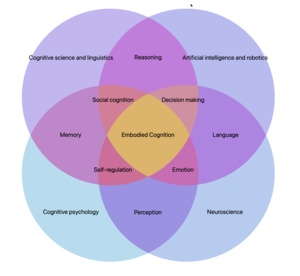
It's embodied cognition, which is so the emotions are always involved, and it's engaged.
Robert HarimanGUEST
It, it really is realized only through communication.
Robert HarimanGUEST
And so there can be a rhetorical dimension to it where...

Job FransenGUEST
The only way you can optimize cognitive performance is in the context of the task that you need it for.
Job FransenGUEST
Now, where do we stumble, and this is rightfully so a good criticism, is that you cannot train tasks in the context of embodied cognition all the time.
Job FransenGUEST
You can't train cognitively under the highest kind of representative environments.
Job FransenGUEST
So, and this is where this transfer taxonomy comes in, and this is also something we briefly touched on before, and I touch on in the original article in Sports Medicine, is that the best way to think about transfer, if you want to get to a application task that is dangerous, harmful, whatever it might be, is through the chaining of near transfers.

Tim LoganHOST
But just to highlight, the two particular places where they have brought these researchers and ideas together are in two co-edited volumes, both with MIT Press and both Open Access.
Tim LoganHOST
In 2020, they published Movement Matters, How Embodied Cognition Informs Teaching and Learning.
Tim LoganHOST
And in June this year, they released their second volume entitled Embodied Intelligence, Multidisciplinary Perspectives on Natural, Artificial and Hybrid Systems.
Tim LoganHOST
You can find links to both in the show notes.
Sheila MacrineGUEST
And I think in my head, I feel like sort of a philosopher and a phenomenologist, along with having a psychometric background.
Sheila MacrineGUEST
And that was really frictional for me in my career because, you know, universities really have their disciplinary silos there.
Sheila MacrineGUEST
And so doing research in one area and then trying to do the psychometrician stuff that I was trained to do, there was like a clash and I was trying to justify like, how did these two fit together? And of course, you know, eventually it got to the point where I started really writing more about embodied cognition in the early 2000s.
Sheila MacrineGUEST
Then I came to UMass in 2011, and I think it was around the time Jennifer came, but we really didn't click or meet and talk until maybe 2015, and we started talking and we both had this real interest in embodied cognition.