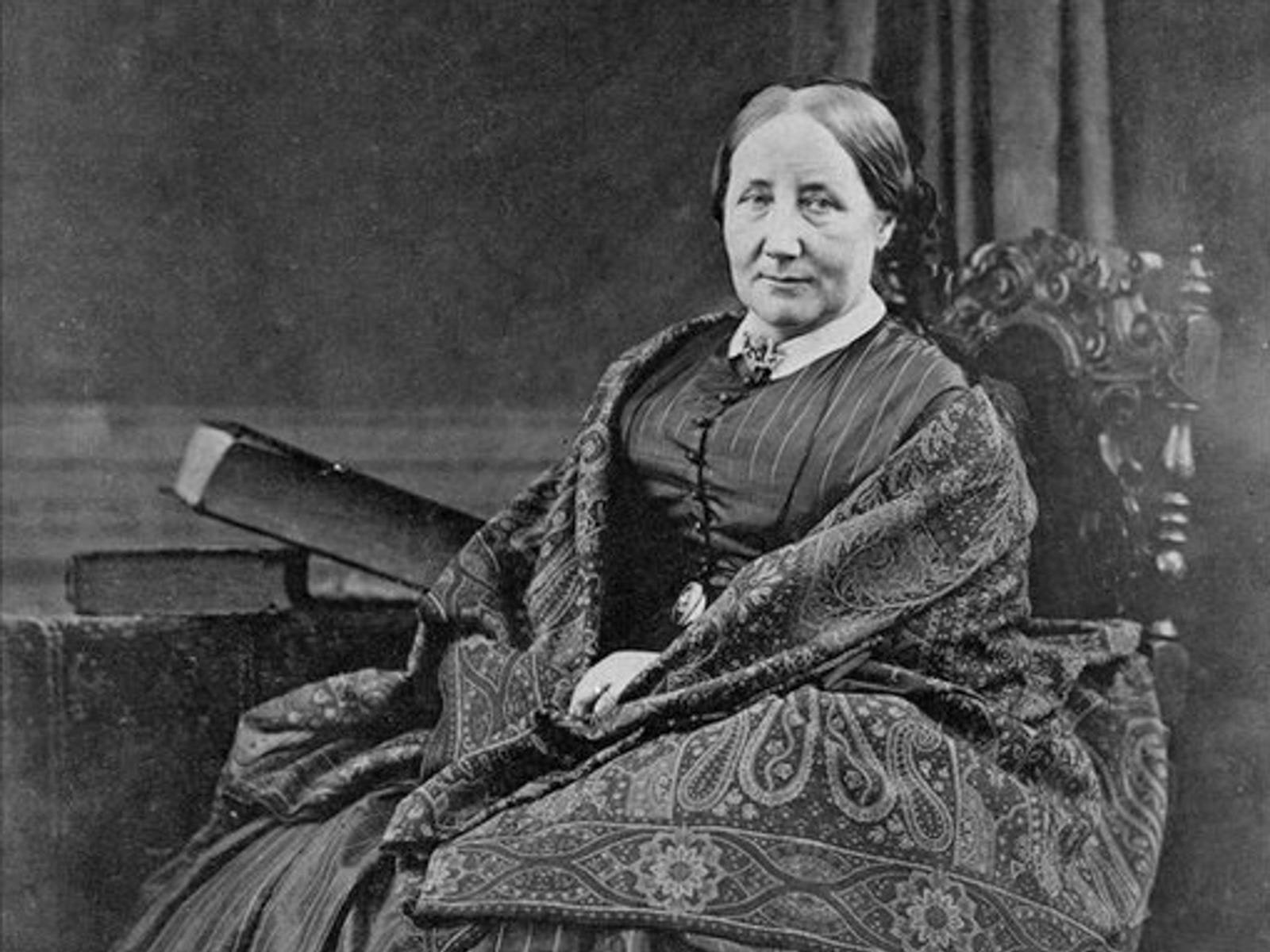
Elizabeth Gaskell
English novelist and biographerWikipedia
45
MENTIONS
24
EPISODES
23
PODCASTS
Search complete. 45 mentions across 24 episodes found for "Elizabeth Gaskell".
Oct 19, 2026

LouiseHOST
Right.
LouiseHOST
And coming on to yarn shops, Elizabeth's Haberdashery in Thurso is closing down.
LouiseHOST
She's retiring.
LouiseHOST
She had the business up for sale, but nobody has so far bought it.
LouiseHOST
And I was in there the other day buying stuff.
LouiseHOST
And most of the time when, or a lot of the time, not most of the time, but a lot of the time when a shop closes you, I feel a bit guilty about going in there and feel that I'm just going in there and eating out of their carcasses.
LouiseHOST
But Elizabeth has been there for 30 years, I think.
LouiseHOST
And I've shopped in it quite a lot.

Martha GimbelSOUNDBITE_SPEAKER
And she has to adjust to those.
Simon JackHOST
So that's North and South by Elizabeth Gaskell.
Simon JackHOST
Take us to another.
Martha GimbelSOUNDBITE_SPEAKER
Okay.

speaker_12NARRATOR
and this is the situation that has to be faced to-day by critics of charlotte bront who have either formed their opinions about her in the light of their impression that villette represents an autobiographical study or else who have founded their judgments of her personality and genius as a writer upon their conviction that it is a silly and offensive imputation to suppose that her sentiment for m was a warmer feeling than the esteem and gratitude a clever pupil owes an accomplished professor in connection with the tenacity of life of this last theory after the publication of the evidence which proves it is a mistake we have to consider with serious attention the account rendered in the times of the thirtieth july nineteen thirteen of an interview with mr clement known to be the most distinguished supporter in the past of the doctrine that Charlotte's sentiment for Professor Hager was literary enthusiasm, and nothing more.
speaker_12NARRATOR
And this serious attention is needed because, in Mr. Clement Shorver's case, it is not allowable to dismiss lightly the judgment of a critic who, after Mrs. Gaskell, has done more than anyone else to throw light upon the family history of the Brontes.
speaker_12NARRATOR
and also upon and around those three interesting and touching personalities emily anne and the greatest of them all charlotte amongst the familiar scenes and personages of their environment at hallward both before and after they had conquered their unique place in english literature one cannot for a moment suppose that mr clement shorter wilfully refuses to see things as they really are simply because it pleases him to see them differently no one realizes perfectly that as with mrs gaskell fifty-seven years ago so with this modern conscientious and generous critic to-day there exists an entirely noble and from a given point of view justifiable reason for refusing to handle or examine a matter with which so it is alleged historical and literary criticism has no concern a purely personal and intimate secret sorrow in the life of an admirable woman of genius the sanctuary of whose inner feelings it is by no means necessary to explore and still less necessary to throw open to the vulgar curiosity and malevolent insinuations of a generation of critics infected with hero phobia and the unwholesome delight of discovering a good deal to reprobate and even more to laugh at in the sensibility of men and women of genius who have honored the human race and enriched the world because they have possessed through power of feeling power also of doing fine work that the critics who find much in them to reprobate and more to laugh at have not the power even to appreciate Now, if the point of view of Mrs. Gaskell and Mr. Clement Shorter were a correct one, with all my heart and soul, I, for my part, should approve of their action in slamming the door in the face of invading facts that threaten to leave the way open for scandal-hunters and hero-phobists to enter with them, and to deal with the honored reputation of Charlotte Bronte in the same way that, more to the discredit of english letters than to that of two french writers of genius recent critics have dealt with the love-letters of madame de stal and this point of view however is a mistaken one in the present case because to commence with charlotte bront's romantic love for m heger affords no game to the scandal-hunter but on the contrary it is serviceable to the just appreciation of her character as well as of her genius, that is, her true sentiment for her professor, that explains her attitude of mind when writing Villette, should be rightly understood.
speaker_12NARRATOR
Then also, whilst Madame de Stael's infatuation for Benjamin Constant neither adds to nor diminishes her claims as the authoress of Corrine and d'Alemont to the rank of a fine writer and a great critic, and while Georges Sand's tormenting and tormented love for the ill-fated, irresistible, unstable child of his century, Demuset, is a poignant revelation of the passing weakness, through immense tenderness of a splendidly strong and independent spirit, that one is almost ashamed to be made the spectator of, Charlotte Bronte's various martyrdom undergone secretly and silently and rewarded openly fills one with an extraordinary sentiment of respect for her and justifies mr clement shorter's own fine and generous utterances upon the impression that the letters that betray the anguish she endured and overcome
speaker_2ADVERTISER
Big color, bigger savings.
2 HRS 20 MINS LATER
Amy GrimorNARRATOR
For me, too.
Amy GrimorNARRATOR
i make no claim either to great affection from those i love i should hardly know how to understand an exclusive and perfect friendship i have so little experience of it but once upon a time at bruxelles when i was your pupil you did show me a little interest and just this small amount of interest you gave me then i hold to and i care for and i prize as i hold to and care for life itself i will not re-read this letter i must send it as it is written and yet i know by some secret instinct that certain absolutely reasonable and cool-headed people reading it through will say she appears to have gone mad by way of revenge on such judges all i would wish them is that they too might endure for one day only the sufferings i have borne for eight months then one would see if they too did not appear to have gone mad one endures in silence whilst one has his strength to do it but when this strength fails one one speaks without weighing one's words i wish monsieur all happiness and prosperity haywood bradford yorkshire 8th january the letter obtained no answer and thus the end was reached we know now where in charlotte bronte's life lay her experiences that formed her genius and made her the great romantic whose quality was that she saw all events and personages through the medium of one passion the passion of a predestined tragical and unrequited love End of chapter 6 and end of part 1
speaker_24NARRATOR
THE HISTORICAL DIFFICULTY TO DISENTANGLE FACT FROM FICTION the purpose of the first part of the study was to show that with the knowledge of the secret of charlotte bront brought to us by dr paul heger's generous gift of these pathetic and beautiful love-letters the problem of charlotte bront as many very clever but inattentive psychological critics have stated it has lost all claim to serious attention The basis of the problem was the alleged dissonance between Charlotte's personality and her genius, between her dreary, desolate, dull, well-tamed existence, uncoloured, untroubled by romance, as Mrs. Gaskell painted it, and the passionate atmosphere of her novels, where all events and personages are seen through the medium of one sentiment, tragical romantic love.

David WalesNARRATOR
Because he took so much, of course he was capable of bringing back the more.
David WalesNARRATOR
Living memories of many places and things returned with him, delightful recollections of delightful persons, Mrs. Kemble, Mrs. Gaskell, Dean Milman in England, Motley in Vienna, Story in Rome, engaged upon the statue of Edward Everett, now standing in the Boston Public Garden, but then failing to impress the young traveler with its dignity, for he has only got one trouser on, to quote from a letter to Mr. Brooks' father, and is very much in the condition of diddle diddle dumpling my son John.
David WalesNARRATOR
Most serious, on the other hand, are the impressions made by certain sights.
David WalesNARRATOR
At Dresden, he sees the Madonna di San Sisto and writes home, "I will not say anything about it because there is no use trying to tell what a man feels who has been waiting to enjoy something for fifteen years and when it comes." Finds it as something unspeakably beyond what he had dreamed.

Paul FryHOST
Uh, perhaps, um, introducing a kind of, uh, uh, again, um, angel in the house, uh, cultural, um, uh, uh, benevolence and benignity into perspectives of men that can be sometimes rather militaristic and harsh, uh, but nevertheless hiding behind, uh, frequently male names, Currer Bell, Acton Bell, George Eliot, and so on, um, and, uh, not really, uh, not really, uh, entering into questions of, um, uh, of the place of women in society.
Paul FryHOST
Uh, Showalter then says this is a phase supplanted by, uh, a feminist moment in the history of the novel in which novels as the late work of Mrs. Gaskell, for example, and other such novels become tendentious, uh, and the place and role of women becomes the dominant theme of novels of this kind.
Paul FryHOST
Uh, supplant-- and by the way, uh, this takes, uh, Woolf's critak- critique of Charlotte Brontë a little bit out of chronology because presumably Charlotte Brontë belongs to what [laughs] Showalter is calling the female phase in the history of the novel.
Paul FryHOST
Um, but, uh, and, and so it's interesting that Woolf finds a kind of proto-feminism damaging to the texture of Jane Eyre already in Charlotte Brontë's novel.

speaker_1NARRATOR
For it is represented as a reciprocal and not a one-sided experience.
speaker_1NARRATOR
Mrs. Gaskell heard Charlotte Bronte say that it was based on an incident which had really happened.
speaker_1NARRATOR
Few families are without some such story in their archives, and all difficulties about the physical appearance of any real phantom, the dripping clothes, for instance, the accompanying horse, or any wild scene generally, which cannot be thought of as an objective present reality, even if the phantom itself could be so regarded, all difficulties of this kind vanish or are reduced to insignificance when once it is realized that the whole impression is a mental one, and that the surprised percipient has automatically constructed not only the phantom itself, but a number of accessory features too, as mental imagery appropriate to and aroused by the purely mental shock or stimulus which, through his unsuspected receptive power, he has been privileged to receive.
speaker_1NARRATOR
Such cases are far too numerous for chance coincidences to explain, a fact which a most carefully conducted and hypercritical census of inquiry has established.

Kate WilliamsHOST
I mean, this is a time of the great novelist in every way, but also the great female novelist.
Kate WilliamsHOST
You've got George Eliot, Charlotte Bronte, Mrs. Gaskell, the great female novelist.
Kate WilliamsHOST
So people are primed, I think, to read the words of women, and particularly that the Queen is writing a book.
Kate WilliamsHOST
So this is a bestseller.

Beth ThomasNARRATOR
Because he took so much, of course he was capable of bringing back the more.
Beth ThomasNARRATOR
Living memories of many places and things returned with him, delightful recollections of delightful persons, Mrs. Kimball, Mrs. Gaskell, Dean Millman in England, Motley in Vienna, Story in Rome, engaged upon the statue of Edward Everett, now standing in the Boston Public Garden, but then failing to impress the young traveler with its dignity, for he has only got one trouser on, to quote from a letter to Mr. Brooks' father, and is very much in the condition of diddle diddle dumpling my son John.
Beth ThomasNARRATOR
Most serious, on the other hand, are the impressions made by certain sights.
Beth ThomasNARRATOR
At Dresden he sees the Madonna di San Sisto.

Charlie HigsonHOST
There is one about Elizabeth Fry, who was a great social reformer in the 19th century.
Charlie HigsonHOST
There's one about Elizabeth Gaskell, the Victorian novelist and chronicler of all strata of society.
Charlie HigsonHOST
There's Marie Curie.
Charlie HigsonHOST
There's one about the radical preacher John Wesley, in some ways a sort of proto-socialist.

ChrisHOST
And number 10, The Battle of the Elizabeths.
ChrisHOST
Elizabeth Barrett Browning or Elizabeth Gaskell? I'll walk in.
NisiGUEST
I'll go Gaskell.
DerekGUEST
Same here.
14 more episodes mention Elizabeth Gaskell.
Create an account to see the whole feed, search across every transcript, and follow the entities you care about.