ELIZA
Computer programWikipedia
64
MENTIONS
13
EPISODES
13
PODCASTS
Search complete. 64 mentions across 13 episodes found for "ELIZA".
Sep 13, 2026

Michael SafiGUEST
And one of the things we, we learned making the series was that the first chatbot was created in 1966, I believe, at MIT.
Michael SafiGUEST
It was called ELIZA, and it was, it was like very bad.
Michael SafiGUEST
You know, you would sit and talk to it, and it would just mirror what you were saying back at you.
Michael SafiGUEST
And the guy who created it, this professor there, Joseph Weizenbaum, the thing he found most unnerving was that he would sit people in front of ELIZA and have them talk to it, and he talks about how his secretary at one point asked him to leave the room, and he asked her why, and she said, "I wanna have a conversation with it." And he just like he, he ends up writing later, he couldn't believe how this, again, quite crap chatbot-
Madeleine FinlayHOST
[laughs]
Michael SafiGUEST
... could, I think his words were, "evoke powerful delusions in otherwise normal people".
18 MINS LATER
Michael SafiGUEST
It, it's a cr- like... [lips smack] The idea that we would offload our ability to, like, empathize with each other, to think about what this person needs to hear in this moment, to, like, lose the ability to do that, and in fact to get instructions on how to do that from, like, from a machine, I don't know.
Michael SafiGUEST
I think y- you're kinda giving up something pretty essential.

ElizaSOUNDBITE_SPEAKER
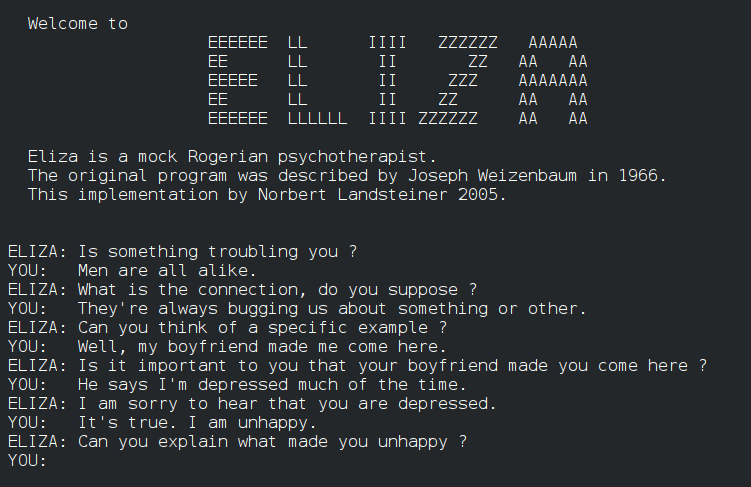
They're always bugging us about something or other.
Mark ChrislerHOST
Can you think of a specific example? Eliza was programmed around 1964, on an amount of memory that couldn't run Mega Man 2.
ElizaSOUNDBITE_SPEAKER
Well, my boyfriend made me come here.
Mark ChrislerHOST
Your boyfriend made you come here.
Mark ChrislerHOST
You can read her entire code base in less time than it will take to listen to this episode, even if you scrub through the ads.
Mark ChrislerHOST
Yet even today, Eliza is very impressive.
ElizaSOUNDBITE_SPEAKER
He says I'm depressed much of the time.
Mark ChrislerHOST
I'm sorry to hear that you're depressed.

Jeff SchragerGUEST
So he got interested in conversational programming, and the rest is very short history.
Jeff SchragerGUEST
In only a year or two at MIT, he built the original ELIZA, the one we found.
Ian MontHOST
ELIZA was the name Weizenbaum gave to the very first AI chatbot.
Ian MontHOST
Now ELISA, as a basic program, gave the computer the ability to receive written sentences and to respond in turn.
Ian MontHOST
But in order to function, ELISA needed a script to follow.
Jeff SchragerGUEST
You don't think the psychiatrist doesn't know about sailing boats, right? You know that the psychiatrist wants you to tell him or her what you think about sailing boats.
Ian MontHOST
It's pretty clever to give the computer the role of a therapist, constantly searching for a better understanding and only ever asking questions.
Ian MontHOST
What's more human of an interaction than a conversation between a patient and a therapist? But by the time Weissenbaum has built ELIZA, he's still just testing the waters, trying to understand the human-computer relationship.

TomHOST
Then, in 1959, the term machine learning was coined when talking about a computer that learned how to play a mean game of checkers.
TomHOST
But then, in 1966, we got Eliza, a natural language conversation program created by Joseph Weizenbaum, the world's first chatbot.
TomHOST
She was an incredibly rudimentary form of AI compared to what we're used to now.
TomHOST
The user would input some line of dialogue, then Eliza would scan the input for key words.
TomHOST
From those key words, she would then pick out a response through pattern matching.
TomHOST
However, despite her being a pretty unintelligent form of AI, Weizenbaum was shocked at how emotionally attached people got to the thing.
TomHOST
This became known as the Eliza effect, the tendency for...The humans have to falsely give human attributes to AI systems.
TomHOST
And as these computer models have gotten better, this effect has only gotten worse.

Mike HallHOST
And there are a few different touchstones in the history of these kind of chatbot interfaces.
Mike HallHOST
You've got ELIZA, which we've talked about before.
Mike HallHOST
You've got Eugene Goostman.
Mike HallHOST
You've got Siri and Alexa and the kind of voice-
Mike HallHOST
... assistant technology that came around, like, early 2010s.
Michael MarshallHOST
Mm.
Mike HallHOST
And then you've got the genesis of the large language models, which are based on this architecture called the transformer, and that's very much the path that we've trodden in the past, is go, "Oh, ELIZA and Eugene Goostman," and into large language models.
Mike HallHOST
But the term artificial intelligence, it turns out, is also really overloaded, and it means many, many different things in many different contexts, which does mean that it can be confusing to use the word AI or artificial intelligence without understanding the context.

Amy BuesingHOST
So the sycophancy combined with the human's tendency to anthropomorphize objects work in tandem.
Amy BuesingHOST
So have you ever heard of this Eliza effect?
Viking Cat LadyHOST
No.
Amy BuesingHOST
Okay.
Amy BuesingHOST
It's named after Eliza, which was an early 1966 chatbot that was created by Joseph Weisenbaum at MIT.
Amy BuesingHOST
And it describes this tendency of humans to anthropomorphize computers.
Viking Cat LadyHOST
You got to spell that word.

Luke StarkGUEST
So it's hard to tell, and I think, you know, there are some business reasons why that, that's the case, right? I think these companies would really like us to assume, to think that these tools are sentient.
Luke StarkGUEST
Um, they pick up on something that's called the Eliza effect, which is this, uh, is this, you know, a- an effect that was named after a chatbot actually back from the '70s, um, called Eliza.
Luke StarkGUEST
Uh, no fancy machine learning, nothing like that, um, but it was really enthralling.
Luke StarkGUEST
People would play with it, and they would think they were having these kind of, you know-
Bob McDonaldHOST
Mm
Luke StarkGUEST
... in-depth conversations with it.
Luke StarkGUEST
So the Eliza effect is when people, uh, project sentience, complexity, you know, emotions onto a chatbot.
Bob McDonaldHOST
Right.

Jason PalmerHOST
It's kind of amazing that a computer program from the 1960s still has such influence in what we talk about now, still in the dawn of the generative AI era.
Jason PalmerHOST
Eliza was, in essence, the first chatbot, the brainchild of a computer scientist at MIT in 1966.
Jason PalmerHOST
In today's terms, it was primitive, all list referencing and pattern matching and bouncing users' statements back rephrased as questions.
Jason PalmerHOST
The weird part was how those users often had the conviction they were typing to a machine that was thinking, conscious even.
Jason PalmerHOST
Since then, it's been called the Eliza effect, a reminder that humans are still kinda bad at determining what is conscious and what consciousness is.
Alok JhaGUEST
The idea that machines could have emotions, can talk to us, have their own desires, and maybe even take over the world, all of that is a classic of science fiction, but it's always felt really far away until now.
Jason PalmerHOST
Alok Jha is The Economist's science and technology editor and hosts Babbage, our sister show on science.

Giancarlo ErraGUEST
I mean, usually when I'm talking to, like, you know, a, a room full of employees or whatever, I always start with the same slide, which is a slide from showing the first chatbot.
Giancarlo ErraGUEST
The first chatbot was from 1966, so we are talking about quite a few years ago, and it was called Eliza, and that was ca-
Jay DhillonHOST
Ooh
Giancarlo ErraGUEST
... it's a, was a psychotherapist.
12 MINS LATER
Jay DhillonHOST
Right.
Giancarlo ErraGUEST
Now, if you keep thinking about this on everything we've ever been written, all of our knowledge, all right, you end up with a really, really big chest of drawers, of course, with all the drawers connected by words actually con- containing in more than one drawer.
Giancarlo ErraGUEST
Now, if you remember the example I've done before of Eliza, you know the first chatbot, the therapist.
Jay DhillonHOST
Yeah.

Joe PierreGUEST
But yes, I think that's a very natural tendency for us.
Joe PierreGUEST
And there is, in fact, a cognitive bias called the Eliza effect that's been known since the 1960s.
Joe PierreGUEST
That was when one of the, if not the first chatbot was invented.
Joe PierreGUEST
And users interacted with it.
3 more episodes mention ELIZA.
Create an account to see the whole feed, search across every transcript, and follow the entities you care about.