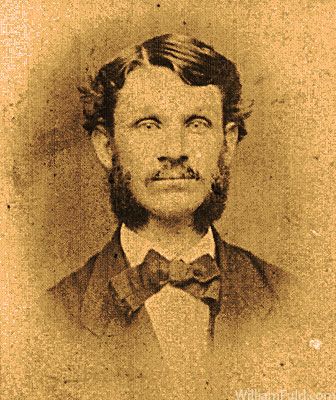
Elijah Bond
American lawyerWikipedia
38
MENTIONS
15
EPISODES
15
PODCASTS
Search complete. 38 mentions across 15 episodes found for "Elijah Bond".
Oct 31, 2026

Alison HorrocksHOST
But once an answer begins to spell itself out, the people at the table have something to argue about.
Alison HorrocksHOST
someone must be moving it Everyone insists they aren't For something with such a sinister reputation the board has a surprisingly commercial history In 1890, a group of Baltimore businessmen formed the Kennard Novelty Company to manufacture and sell talking boards Spiritualism had already made communication with the dead a popular pursuit The company offered something people could purchase and use at home Elijah Bond's patent, granted on February 10, 1891, described the device as a toy or game.
Alison HorrocksHOST
Its purpose was to amuse people by answering questions through letters indicated on a board.
Alison HorrocksHOST
The patent described how to operate it, without explaining what made the pointer move.

EdHOST
Spiritualists in the United States believed that the dead were able to contact the living and reportedly used a talking board very similar to the modern Ouija board at their camps in Ohio during 1886 with the intent of enabling faster communication with spirits.
EdHOST
Following its commercial patent by businessman Elijah Bond, or Boond, being passed on February 10, 1891, the Ouija board was regarded as an innocent parlor game unrelated to the occult, until American spiritualist Perel Curran popularized its use as a diving tool during World War I. Paranormal and supernatural beliefs associated with the Ouija board have been criticized by the scientific community and are criticized as pseudoscience.
EdHOST
The action of the board can be most easily explained by unconscious movements of those controlling the pointer.
EdHOST
A Psycho...

Patty A. WilsonHOST
who was uncompromisingly strong.
Patty A. WilsonHOST
Surrounding her were men of commerce, her brother-in-law, Elijah Bond, and an ambitious businessman by the name of Charles Kennard.
Patty A. WilsonHOST
They had built a wooden board painted with an alphabet, but they lacked an identity for it.
Patty A. WilsonHOST
They thought they had a winner because everybody was into spiritualism, but they didn't know how to market this board, how to sell it.
Patty A. WilsonHOST
Yeah.
Patty A. WilsonHOST
the chief patent officer was a severely skeptical bureaucrat.
Patty A. WilsonHOST
And what he wasn't expecting was Elijah Bond and Helen Peters to storm his office.
Patty A. WilsonHOST
But they did.

Marisa PinsonHOST
like it.
Jon GloverHOST
Let's get attorney Elijah Bond and his medium sister-in-law to join the enterprise.
Jon GloverHOST
The
Marisa PinsonHOST
name's Bond.
Marisa PinsonHOST
Elijah Bond.
Jon GloverHOST
Local attorney with a psychic sister.
Jon GloverHOST
Here's my card.

Chris SmithGUEST
It didn't look like the one we use.
Chris SmithGUEST
And then a guy, I think his name was Elijah Bond, he commercialized the Ouija board, made it look like what we look like, what we use today.
Chris SmithGUEST
And people see it, and they're like, I'm not touching that thing.
Chris SmithGUEST
But if you think about it, it's just like any other tool, in my opinion.

AndyHOST
And soon after, Kennard cuts Reich out of the deal altogether, and he gathers investors to start the Kennard Novelty Company.
AndyHOST
One of those investors was Baltimore attorney Elijah Bond.
AndyHOST
who made improvements to the device and filed a patent application in 1890, assigning the rights to Kennard and fellow investor William H.A. Maupin.
GregHOST
Coming from the believer's perspective, how do you take something, that was used by mediums or during seances and so on and so forth to commune with the dead and then businessmen improve on it.
12 MINS LATER
AndyHOST
Let's call back to our very first episode with the black-eyed kids.
AndyHOST
Yeah, don't listen to that one.
AndyHOST
And I can show you a picture of Mr. Elijah Bond's tombstone.
GregHOST
Oh, I have seen that before.

Christopher FeinsteinHOST
Then in 1890, Kennard moved to Baltimore and went looking for investors.
Christopher FeinsteinHOST
The most important one he found was Elijah Bond, a lawyer and a Confederate veteran.
Christopher FeinsteinHOST
And Bond brought something else to the table, his sister-in-law, Helen Peters.
Christopher FeinsteinHOST
Bond described her as a strong medium.
Christopher FeinsteinHOST
According to the way the story has been passed down, he walked away white-faced and visibly shaken.
Christopher FeinsteinHOST
Murch says that he's seen the patent file, and that a test really was required.
Christopher FeinsteinHOST
So something happened in that office, but Elijah Bond wasn't some guy off the street.
Christopher FeinsteinHOST
He was a patent attorney.

Linda HurdHOST
So the modern Ouija board that we know today was created by businessman Charles Kennard.
Linda HurdHOST
With the assistance of attorney Elijah Bond and a medium known as Helen Peters in Baltimore.
Linda HurdHOST
Now, Luigi was named in 1890.
Linda HurdHOST
What? No, go ahead.
Linda HurdHOST
In Baltimore, Maryland, by Helen Peters, who at the time was going by Helen Peters Nossworthy.
Linda HurdHOST
It was patented in Baltimore, Maryland in 1890 as a harmless parlor game and commercial novelty rather than an ancient occult device.
Linda HurdHOST
And on February 10th of 1891, the patent was approved for businessman Elijah Bond.
Linda HurdHOST
Not even the creator, Charles Kennard.

speaker_0HOST
In 1890, Kennard owned a company called Kennard Novelty in Baltimore, Maryland.
speaker_0HOST
He owned this with several partners and backers, including a guy named Elijah Bond, who was a lawyer.
speaker_0HOST
The company had heard about the Talking Boards and thought that they showed some business potential, so they set out to manufacture and market their own, which is where Mr. Reishi came in, who already worked with Wood.
speaker_0HOST
It was a business proposition, first and foremost.
speaker_0HOST
The board's first great mystery may be the least supernatural one, and that's who came up with the branding.
speaker_0HOST
Then there is the issue of the patent.
speaker_0HOST
Elijah Bond is named on the patent that was issued on February 10th, 1891 for a toy or game.
speaker_0HOST
That date is real and the patent is real.
5 more episodes mention Elijah Bond.
Create an account to see the whole feed, search across every transcript, and follow the entities you care about.