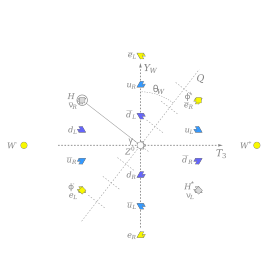
Electroweak interaction
35
MENTIONS
10
EPISODES
9
PODCASTS
Search complete. 35 mentions across 10 episodes found for "Electroweak interaction".
Sep 21, 2026

Katie MackGUEST
So the really interesting, weird thing transition was when we changed from having electricity and magnetism and the weak nuclear force being all aspects of the same thing to those separating out.
Katie MackGUEST
It's called the electroweak phase transition or the electroweak symmetry breaking.
Katie MackGUEST
So it used to be, back in the early times, back in the before times, there was no electricity, magnetism, and the weak nuclear force.
Katie MackGUEST
There was the electroweak force.
Katie MackGUEST
The electroweak force was something that acted like a combination of electricity, magnetism, and the weak nuclear force.
Katie MackGUEST
And there were different particles existing in the universe.
Katie MackGUEST
There were different forces, different particles.
9 MINS LATER
Katie MackGUEST
Like, it's hard to even measure that with, like, clocks, right? But we know a picosecond after the start of the universe, whatever it was, we know what was happening.

Fraser CainHOST
So what happened after that?
Pamela GayHOST
So initially, as near as we can tell, all the forces, gravity, electroweak, electrostrong, electromagnetic, uh, were a force.
Pamela GayHOST
And we're, we're still trying to figure out how you get gravity in there.
Pamela GayHOST
We're trying to figure out how to get quantum gravity to be a thing.
Pamela GayHOST
But as near as we can tell, the first thing that happened was gravity split off and went, "Yo, I'm different."
Fraser CainHOST
Right.
Pamela GayHOST
A- and then electroweak and electrostrong together split off from the electromagnetic force.
Fraser CainHOST
And tho- and, like, there are four fundamental forces-

Fraser CainHOST
So what happened after that?
Pamela GayHOST
So initially, as near as we can tell- All the forces, gravity, electroweak, electrostrong, electromagnetic, uh, were a force.
Pamela GayHOST
And we're, we're still trying to figure out how you get gravity in there.
Pamela GayHOST
We're trying to figure out how to get quantum gravity to be a thing.
Pamela GayHOST
But as near as we can tell, the first thing that happened was gravity split off and went, "Yo, I'm different."
Fraser CainHOST
Right.
Pamela GayHOST
A- and then electroweak and electrostrong together split off from the electromagnetic force.
Fraser CainHOST
And tho- and, like, there are four fundamental forces-

Fraser CainHOST
So what happened after that?
Pamela GayHOST
So initially, as near as we can tell, all the forces, gravity, electroweak, electrostrong, electromagnetic, uh, were a force.
Pamela GayHOST
And we're, we're still trying to figure out how you get gravity in there.
Pamela GayHOST
We're trying to figure out how to get quantum gravity to be a thing.
Pamela GayHOST
But as near as we can tell, the first thing that happened was gravity split off and went, "Yo, I'm different."
Fraser CainHOST
Right.
Pamela GayHOST
And then electroweak and electrostrong together split off from the electromagnetic force.
Fraser CainHOST
And tho- And, like, there are four fundamental forces-

Michael BorsGUEST
The Planck temperature also corresponds with what is called the cosmic dawn, which corresponds to ten to the negative forty-three seconds after the Big Bang, which is also called the Planck time, and this is when the cosmos is said to have been, uh, compressed into a space smaller than a single subatomic particle.
Michael BorsGUEST
This period is also called the electroweak epoch, when it was too hot for the forces of electromagnetism and the weak nuclear force to be-- to behave in separate ways.
Michael BorsGUEST
Therefore, they functioned as a single unified force.
Michael BorsGUEST
This is the domain in which the Planck temperature is said to be possible.

Matt O'DowdHOST
We'll come back to all of this in detail another time, but the one property that's relevant for today's episode is that these supersymmetric particles are all expected to be way more massive than their known partners in the standard model.
Matt O'DowdHOST
To solve the hierarchy problem perfectly, those particles would need to have masses at around what we call the electroweak energy.
Matt O'DowdHOST
That's the energy at which the electromagnetic and weak nuclear forces merge into the same force.
Matt O'DowdHOST
Physicists had hoped that by smashing particles together hard enough in the Large Hadron Collider, there'd be enough energy in those collisions to produce a supersymmetric particle and, in fact, there should have been, at least for the versions of SUSY that most neatly solve the hierarchy problem.

Jacob KoshyHOST
And in the 1990s, Frail, he was still working on high temperature superconductors.
Jacob KoshyHOST
The Electroweak was of course a summit, but he never stopped climbing.
Shobhana K NairHOST
Now, his personal life was a little unusual.
Shobhana K NairHOST
He married a second time, Lewis Johnson, a British citizen, who he had met in London in 1962 at all of the things, an anti-nuclear proliferation meeting.

speaker_1HOST
Think of the universe mere fractions of a second after the Big Bang.
speaker_1HOST
The cosmos was an intensely hot, incredibly dense state known as the electroweak vacuum.
speaker_1HOST
The fundamental forces of nature were unified, but as the universe rapidly expanded, it rapidly cooled.
speaker_0HOST
Yeah.
Jacob KoshyHOST
So his weapon was relentlessness and imagination, eventually building his own stage.
Jacob KoshyHOST
He presented the Electroweak theory, as it was called, at a big symposium in Sweden in 1968.
Jacob KoshyHOST
And for a while, it went unnoticed, clearly his amazing lecture skills.
Jacob KoshyHOST
And it took the CERN discovery to make the world look back and see what he, Glashow and Weinberg had done.

James FodorHOST
So, uh, this was, uh, very important work and it's kind of the most important work that's happened t-to finish out the Standard Model really, and was largely developed in the 1960s and into the 1970s.
James FodorHOST
Uh, this relates to the Higgs mechanism and the, the Higgs mechanism and associated electroweak force, the unification of the weak and electromagnetic forces.
James FodorHOST
So what's all this about? Let, let's introduce the players here.
James FodorHOST
I did say earlier that there was another type of boson, the Higgs boson, which is not a gauge boson.
17 MINS LATER
James FodorHOST
It was a hypothesis which then led to this prediction which was subsequently verified when we discovered the Higgs boson so that's very nice.
James FodorHOST
But there's still a problem and those of you familiar with this may have noticed that there's something that I've skipped over and again I did that deliberately because you can't, you can't introduce everything at once.
James FodorHOST
Uh, it's, it's an important but in some ways minor detail, um, but it does need to be explained and this relates to the unification of the electromagnetic and the weak nuclear force together into the electroweak force.
James FodorHOST
When this theory of the Higgs mechanism was being developed in order to resolve this, you know, problem with the, the weak bosons having mass and, and reconciling that with the gauge invariance, the way I initially described it in terms of like you have your massless gauge bosons then they acquire mass by interacting with the Higgs mechanism whereas the photon doesn't interact with the Higgs field so it doesn't get a mass.