Electronic warfare
56
MENTIONS
13
EPISODES
10
PODCASTS
Search complete. 56 mentions across 13 episodes found for "Electronic warfare".
Sep 24, 2026

Tim RenierHOST
Thanks for joining us.
Jen DeMarcoHOST
In this update, we're taking a look at some of the latest developments across the RF and microwave industry, along with a closer look at the technical content featured in our September EW Radar and MilCom supplement.
Tim RenierHOST
We've got some interesting news to cover, several upcoming events to highlight, and of course, a look at some of the technical articles and topics we think are worth your attention.
Jen DeMarcoHOST
So let's get started.
Tim RenierHOST
The second technical feature takes us directly into that changing threat environment.
Tim RenierHOST
It is a market report on the growth and direction of the RF defense industry from our friends at Yole Group.
Tim RenierHOST
The article describes the market as split between legacy radar and EW programs that follow long procurement cycles and the drone segment that operates on timelines measured in months.
Tim RenierHOST
This newer segment demands millions of units and is pulling RF technology straight from the Wi-Fi and telecom playbook.

Tom WithingtonHOST
Welcome to this Armada podcast sponsored by Patria.
Tom WithingtonHOST
I'm Tom Withington, editor of Armada's Electronic Warfare and Military Communications newsletters.
Tom WithingtonHOST
Joining me today is Keijo Mattila, Patria's Senior Product Manager for signals intelligence and electronic warfare.
Tom WithingtonHOST
Over the next few minutes, we'll be talking about Finland's strategic situation and how it influences the company's product portfolio, the impact of European geopolitics in the Scandinavian and Baltic regions, technology trends, and Patria's ongoing research and development efforts.
Tom WithingtonHOST
Keijo, welcome to the podcast.
Keijo MattilaGUEST
So this positions us very close to the Finnish Defense Forces.
Keijo MattilaGUEST
I think this is one of the main things.
Keijo MattilaGUEST
And then if we talk about the electronic warfare, we know that our opponent is, is very capable on these topics.

Larry MartinezGUEST
to allow the drone to fly to a target, use navigation satellites, et cetera, to find that target, and to evade defenses such as anti-aircraft artillery or other missiles and so forth.
Larry MartinezGUEST
The way in which you defend against a drone attack is to use that same technology in the form of electronic warfare against the drones.
Larry MartinezGUEST
The main problem for a drone is that it is dependent on those computers in the drone and the navigation signals that it is receiving from outer space or from terrestrial navigation signals.
Larry MartinezGUEST
If you are able to jam the drone with a very, very strong electromagnetic signal, you can prevent the drone's receiver from getting those navigation signals.
Larry MartinezGUEST
You can also use what's known as electronic warfare, and this is where you actually hack into the drone's computer.
Larry MartinezGUEST
or this network that is sending the drone, and by using the same sorts of computer warfare that is hacking, and that makes a chaos of some computer systems, is that you can do the same thing for drones, against drones, by using these forms of electronic hacking to ruin the software in the drone and thereby disable it.
Dave CongeltonHOST
Or, Larry, can't you just use another drone? Can't both sides have drones to use against each other?
13 MINS LATER
Larry MartinezGUEST
Well, yes.

Sam Cranny-EvansGUEST
They form a really important part of situational awareness and the overall targeting network.
Sam Cranny-EvansGUEST
There's EW systems that are used for target location and for suppressing of enemy drones and that kind of thing.
Sam Cranny-EvansGUEST
And then there's obviously the drone crews as well.
Sam Cranny-EvansGUEST
And across those three, you have a whole bunch of different attack services, right? And this is what you can kind of see Rubicon beginning to systematize or, you know, kind of bring into the fore is you will see them in certain axes.
Sam Cranny-EvansGUEST
You've seen a very focused effort against Ukrainian EW, which pushes the EW further back in the front line.
Sam Cranny-EvansGUEST
And that creates the problem of degrading Ukrainian situational awareness, but reducing their ability to jam Russian drones.
Sam Cranny-EvansGUEST
So it not only reduces their understanding of what's going on, but increases the Russian opportunities to act with different types of drones.
GerdesHOST
So that's the ship, and then there's debris.
GerdesHOST
But you know what I'm-- what we mean by debris at this point, right? Okay, happy day of the radio electronic warfare troops, that there's specialized day for everything, for the infantry, for the doctors, for the firemen, for you name it.
GerdesHOST
Uh, but these guys...
GerdesHOST
Yeah, happy day of the radio electronic warfare troops of the Armed Forces of Ukraine.
GerdesHOST
The work of electronic warfare is sometimes hard to show.
GerdesHOST
Its, its result is what didn't happen.
GerdesHOST
That's an interesting way of thinking about it.

Ira PastorHOST
Um, Matt Milas is President of Defense and Space at Honeywell Aerospace.
Ira PastorHOST
He leads their global business that generates over $7 billion annually across electronic solutions, navigation sensor systems, software and connected systems with electronic warfare capabilities and satellite systems.
Ira PastorHOST
And over the course of his remarkable career, he's led not just roles at Honeywell, L3Harris, Raytheon, Collins Aerospace, Spirit, and Lockheed Martin, contributing to some of the more sophisticated aerospace and defense ecosystems, including the F-35 joint strike fighter.
Ira PastorHOST
Uh, and at a time where, you know, AI and autonomy and cyber resilience and, uh, you know, the, the growing importance of, of space are reshaping both national security and modern civilization itself, Matt really finds himself at a center of one of the most consequential technological transitions in history, and we're gonna be exploring, you know, the future of aerospace and defense with him, as well as the evolution of a lot of these really cool technologies, uh, and what the next couple decades may hold.
Matt MilasGUEST
Um, and then, uh, the aftermarket services that we provide, so all the spares and repairs that keep aircraft flying, both commercial, business, and general aviation.
Matt MilasGUEST
And then for defense and space, what we do is we cover components that go into everything from missile system and aircraft into aircraft carriers, submarines, satellite systems.
Matt MilasGUEST
So some of our components would be avionics systems, things like radar altimeters, uh, things that do from, uh, uh, you know, detect and avoid, um, some of the, uh, radar componentry or electronic warfare on military aircraft.
Matt MilasGUEST
Uh, control systems, things like actuators, environmental controls, so power and thermal management types of systems.

TowerHOST
This is ATIS on Radio Hangar, and today we are talking about the retirement of one of the most effective and least publicly understood aircraft to ever carry American markings.
TowerHOST
44 years of electronic warfare, 44 years of making enemy communications fail at exactly the wrong moment for the adversary.
TowerHOST
And almost none of it ever made the news, because when this aircraft did its job right, nothing dramatic happened.
TowerHOST
That is a harder story to tell than a combat victory, but it is worth telling.
TowerHOST
The WC-130 flies hurricane reconnaissance for the Air Force Reserve, threading the needle into the eye walls of storms that nothing with any sense would approach.
TowerHOST
The C-130 touches nearly every mission the American military performs, and it has done so across more than six decades of continuous operational use.
TowerHOST
and then there was the EC-130H, the electronic warfare variant.
TowerHOST
The one that almost nobody ever photographed clearly because its mission systems were classified and its value was measured in outcomes that never appeared on any public scorecard.
TowerHOST
The threat environment? That changes fast.
TowerHOST
Let me explain what electronic warfare actually means for a tactical aircraft, because the term gets thrown around without much explanation.
TowerHOST
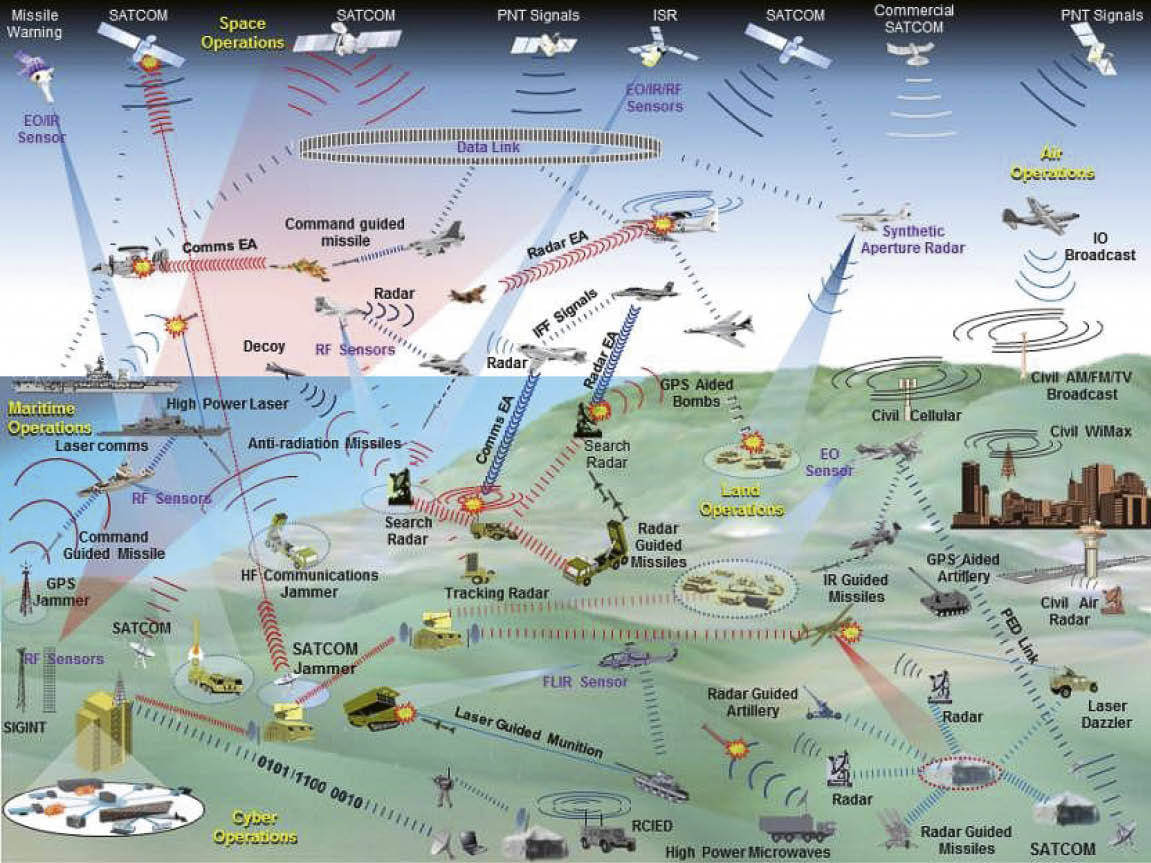
At its most basic level, electronic warfare is the use of the electromagnetic spectrum to gain an advantage over an adversary, or to deny that adversary the ability to use the spectrum against you.
TowerHOST
For a single-seat fighter, that breaks into three functions.
TowerHOST
The first is detection.
TowerHOST
Not all radar is a threat.
TowerHOST
Civilian air traffic control radar isn't going to get you killed.
TowerHOST
An enemy fire control radar, well, a capable electronic warfare suite can tell the difference.
Jen DeMarcoHOST
MWJ is involved in organizing the Defense Forum, which takes place Wednesday, October 7th.
Jen DeMarcoHOST
The forum brings together industry leaders to discuss the technologies and challenges shaping defense and security, including radar, EW, and communications.
Tim RenierHOST
We'll also be hosting industry sessions featuring experts from Corvo, Spinner, and Keysight.
Tim RenierHOST
Also, Jen and I just spoke with Stefan Harmon, this year's Chairman of European Microwave Week, so look for that video to be released soon.
Jen DeMarcoHOST
Visit MWJournal.com to sign up and explore the latest articles, videos, and industry updates.
Tim RenierHOST
That concludes this episode of Frequency Matters.
Jen DeMarcoHOST
Thank you for watching, and we'll see you next time when we highlight the September supplement featuring EW, Radar, and Milcom.

GerdesHOST
So I, I should have put this in blue because this is from what happened a couple of days ago, and I, I try to do that later.
GerdesHOST
But today, a BK-16 landing craft, electronic warfare system, an enemy UAV command post, and ammunition and UAV storage facilities have also been hit beyond what I just showed you.
GerdesHOST
Uh, also in blue because it's a couple days ago, uh, Ukraine's defense forces struck Novatek's Ust-Luga facility on September 1st.
GerdesHOST
The report damage, uh, reported damage includes fires at two hydrocracking columns, that's important, C200 section of the primary gas condensate processing unit, and pipelines near the pumping station.
8 MINS LATER
GerdesHOST
Everything else was in single digits.
GerdesHOST
Other stories.
GerdesHOST
Ukraine's Strix drone unit says it destroyed Russian Sfera electronic warfare complex and four communications antennas in the south Slobozhansky sector.
GerdesHOST
Like, destroying the communications, uh, radars or s- uh, the, uh, electronic, well, let's say communications antennas, that's important.
3 more episodes mention Electronic warfare.
Create an account to see the whole feed, search across every transcript, and follow the entities you care about.