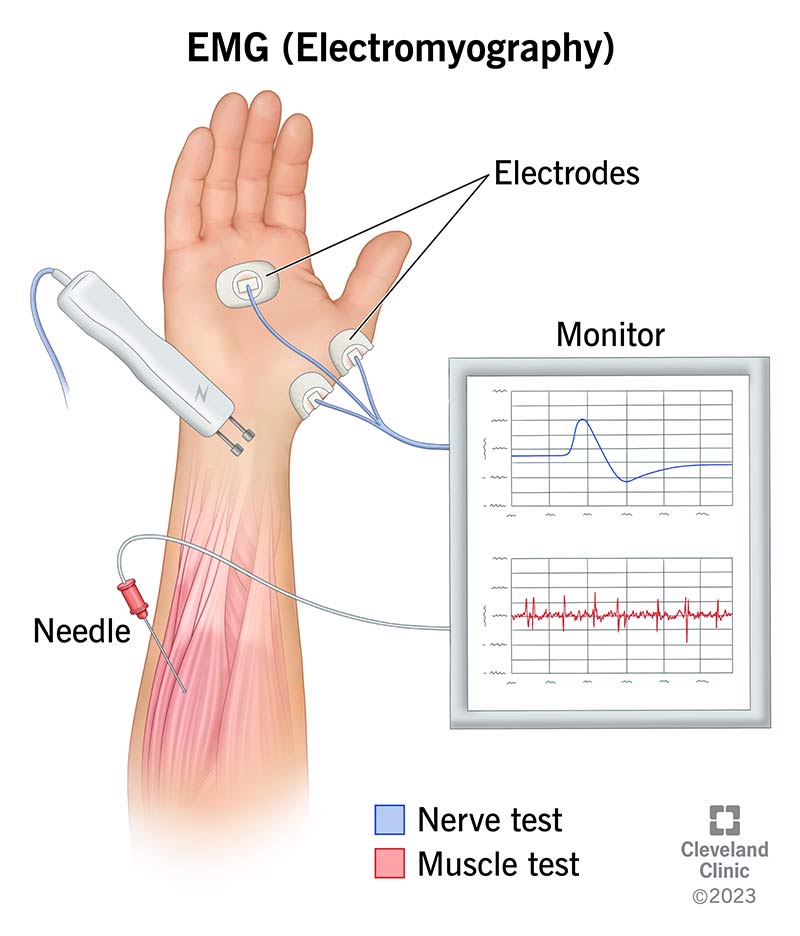
Electromyography
Medical evaluationWikipedia
244
MENTIONS
97
EPISODES
85
PODCASTS
Search complete. 244 mentions across 97 episodes found for "Electromyography".
Sep 12, 2026

David ScanduraHOST
I don't exactly remember what the test was.
David ScanduraHOST
I think it may have been like an EMG nerve conduction study.
David ScanduraHOST
I don't remember what it was called or what it was, but it was...
David ScanduraHOST
I remember them like putting a gel on me and like sticking me with needles.

Kyle KieselGUEST
He's like, how do you know it's contracting? I'm like, well, I can see it.
Kyle KieselGUEST
He's like, what's the gold standard measure for muscle activation and muscle contraction? I'm like, EMG.
Kyle KieselGUEST
He's like, you just found your first study.
Kyle KieselGUEST
Tell me that when it thickens on imaging, show me that the EMG goes up.
Gray CookHOST
That's a hell of a good question, too, because I've got two different ways to prove there's life here now.
Kyle KieselGUEST
Right? So it's not if they're interested or care or don't care about it.
Kyle KieselGUEST
Our model was to publish papers along the way.
Kyle KieselGUEST
So that was the first paper.

Mike ReinoldHOST
Who else wants to jump in here? Dave, what do you got?
Dave TilleyPANELIST
My just quick thought is that I think it's really important to do an objective strength assessment to figure out what specifically somebody has a deficit in and then use research with EMG activity to get a little more volume.
Dave TilleyPANELIST
Because like, if you want to get your quad stronger, so say like you're an Olympic lifter and you want to get your quad stronger to squat heavier in a competition, um, you wouldn't do one or one exercise, three sets of eight.
Dave TilleyPANELIST
And that's the only thing you do for your quads, maybe twice a week, right? And if you think about some of the shoulder programs that we give people, I think sometimes they know sidelining external rotation is important, but they're literally doing like one exercise that's generically seen online.
Dave TilleyPANELIST
If you really want to target the posterior cuff, I think it's good to have two to three exercises that are overlapping in EMG activity.
Dave TilleyPANELIST
So sidelining, if you're prone, you, if you can do it, like you can change the scaption angle, like I think it's important to mix in a couple of different exercises in different planes for like the highest EMG and do those in more volume because you're not going to add like to your guys point, you're not going to just be like, you know, only load ever is the only thing I think about.
Dave TilleyPANELIST
I think like volume density that doesn't really get thought about a lot with shoulder cuff exercises, but we give people programs that it's like five to six exercises all straight through in two or three sets in a row because we're trying to build a lot of volume in a short amount of time.
Dave TilleyPANELIST
And I think that like sometimes people just do like one set or one exercise sideline ER twice a week, three sets of eight.

Jim Del RossoHOST
Electromyogram.
Jim Del RossoHOST
Yeah, EMG.
Jim Del RossoHOST
No, you got it.
Jim Del RossoHOST
EMG.
Jim Del RossoHOST
Okay, thank you.
Joseph MerolaGUEST
So here's the thing.
Joseph MerolaGUEST
If they have classical skin features and they have elevated CKs, I'm often happy to stop there.
Joseph MerolaGUEST
The additional testing comes in if we're unsure, if we need to document it for other reasons, whether it's you know, God help us insurance access to a medication, which sometimes comes up with IVIG and some other things.

James MarkhamHOST
Is there things that mentally could be causing your pain, mentally that could be causing stress, mentally that could be causing inflammation, where when nerves are inflamed, there's not going to be a lab test that shows us that all the time.
James MarkhamHOST
There's EMG tests.
James MarkhamHOST
We can measure nerve conduction studies.
James MarkhamHOST
That gives us a little information about whether the nerves have been damaged.

Christopher LambGUEST
day
Devon RubinHOST
after day in the EMG lab.
Devon RubinHOST
And Chris, it's great to have you on this lessons.
Devon RubinHOST
So welcome.
Christopher LambGUEST
Yeah, it's a great one to work through.
Devon RubinHOST
Yeah.
Devon RubinHOST
You know, it made me think, and it was a challenging case, but it made me think about just when we educate in general and when we teach and we go through cases and you look at textbooks and or any EMG resource, most of the cases that are presented are classic.
Devon RubinHOST
They're the classic cases, the classic on and off, the classic carpal tunnel.

Emily SplichalHOST
So now we have a back-to-back study as far as which exercise is more effective at activating this very important intrinsic muscle, the abductor hallucis.
Emily SplichalHOST
And then the conclusion of this study was that short foot exercise, this was through EMG studies, electromyograph studies, short foot exercise is more useful strengthening the foot through the increased activation of the abductor hallucis and therefore it could be concluded to help in the prevention of lowering or falling of medial arches so that was a comparison of towel crunches versus short foot.
Emily SplichalHOST
So if you had to choose one, I would choose one that shows higher EMG activity to the abductor hallucis.
Emily SplichalHOST
Here's another study.
Emily SplichalHOST
This is looking at the effect of foot orthotics and short foot exercise at the hypertrophy of the abductor hallucis.
Emily SplichalHOST
This is something that is always looked at as used in combination with strengthening our feet.
Emily SplichalHOST
So here is a study that is actually just demonstrating through cadaver the actual effect of abductor hallucis on the medial arch.
Emily SplichalHOST
So does the abductor hallucis actually lift the medial arch? Meaning, if we've done an EMG study that showed that short foot strengthens abductor hallucis, could we then say short foot, because it strengthens abductor hallucis, can lift your arch? That's the conclusion we're trying to make.

Blake ForcieHOST
Let's have a brief discussion about this tube, just so that you can be more familiar with it.
Blake ForcieHOST
It provides real-time electromyography EMG feedback.
Blake ForcieHOST
The NIMS tube allows the surgical team to monitor electromyographic activity from the laryngeal muscles while they stimulate and identify the recurrent laryngeal nerve.
Blake ForcieHOST
The tube has surface electrodes that need to sit in direct contact with the vocal cords.
Blake ForcieHOST
That's why correct placement is so important and why video laryngoscopy is often used to confirm that the electrodes are sitting appropriately at the cords.
Blake ForcieHOST
Neuromuscular blockade is another consideration.
Blake ForcieHOST
Since the system depends on an EMG response, residual paralysis can interfere with monitoring.
Blake ForcieHOST
So after intubation, many teams avoid additional neuromuscular blockade or allow it to wear off completely, depending on the surgeon's monitoring strategy.

Laura BunsoGUEST
And, and you got a 50/50 shot on that.
Laura BunsoGUEST
But, um, we use surface EMG.
Laura BunsoGUEST
So-
Stefan EsserHOST
Oh, wow, okay
Laura BunsoGUEST
... you can also fake that, but it's a little bit easier for us to...
Laura BunsoGUEST
Uh, you, surface EMG, which is called p- biofeedback, and in this specific space, perineal biofeedback, which Medicare covers, Tricare cov- you know, a lot of these insurances do cover if you have it all...
Laura BunsoGUEST
You know, you gotta do it all correctly-
Stefan EsserHOST
Right, right, right

Jennifer Sivak-CallcottGUEST
And about 20 years ago, there was a study in ophthalmologists, not oculofacial surgeons, ophthalmologists, and they found that performing more than four cases a week or seeing more than 100 patients in a clinic a week was associated with increased neck, upper extremity, and lower back symptoms.
Jennifer Sivak-CallcottGUEST
And then the Surface EMG studies by Anna Kitzman and her colleagues really showed increased muscular activity in the anterior deltoid and the upper trapezius with slit lamp exam and indirect ophthalmoscopy.
Jennifer Sivak-CallcottGUEST
You know, the last thing I would add is that there are other activities
Jennifer Sivak-CallcottGUEST
that are influencing your risk for neck injury.
Kelsey RoelofsHOST
Visualization can be super difficult, right? So just walk me through a little bit of what you think are the unique inside the OR aspects for oculofacial surgeons when it comes to ergonomic risk.
Jennifer Sivak-CallcottGUEST
Well, you know, a number of years ago, we actually, similar to what Linda was talking about, objectively looked at postures in the operating room.
Jennifer Sivak-CallcottGUEST
And we collected 3D kinematic data, as well as surface EMG from three oculoplastic surgeons, all of different body habitus.
Jennifer Sivak-CallcottGUEST
short, tall, a female, two males, while they perform surgery.
87 more episodes mention Electromyography.
Create an account to see the whole feed, search across every transcript, and follow the entities you care about.