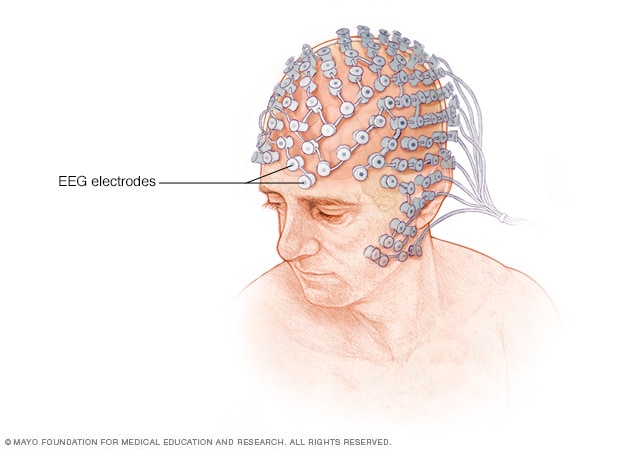
Electroencephalography

Electroencephalography

Diagnostic evaluationWikipedia

Search complete. 790 mentions across 358 episodes found for "Electroencephalography".

Sep 12, 2026

speaker_0HOST
0:14
The researchers asked 51 people to type words in a verbal fluency task and interrupted them at unpredictable moments to ask whether they were about to type the next word.
speaker_0HOST
0:23
Conscious intention became reportable more than one second before the estimated keystroke, and EEG showed readiness potential-like activity during that window.
speaker_0HOST
0:32
A lateralized signal also appeared in the hemisphere opposite the hand expected to type the first letter.
speaker_0HOST
0:39
The result speaks to the classic Libet debate, but it does not show that a decision is fully made before awareness.
speaker_0HOST
10:12
That is incredible.
speaker_1HOST
10:13
And simultaneously, their EEG brainwave monitors showed a massive shift.
speaker_1HOST
10:18
They moved entirely out of drowsy delta and theta waves and spiked directly into highly focused, alert beta and gamma waves.
speaker_0HOST
10:26
So their bodies were deeply, profoundly relaxed, but their brains were highly alert and sharp.
Daniel ShawHOST
52:46
That's, uh, [chuckles] there's e-epilepsy, for example.
Daniel ShawHOST
52:49
Um, we can do an EEG test.
Daniel ShawHOST
52:51
We can see that sort of pattern of activity that's associated with electricity of excitation.
Daniel ShawHOST
52:56
Um, and we can sort of diagnose that condition.
Adam CifuHOST
9:14
The neurology service was re-consulted.
Adam CifuHOST
9:18
EEG findings increased the suspicion for seizures.
Adam CifuHOST
9:23
ST was discharged on aspirin, a statin, and a seizure medication, as well as a 14-day cardiac monitor.
Lena CadeNARRATOR
68:57
I scrolled back frame by frame.
Lena CadeNARRATOR
68:59
Static, just ordinary system drift, except for three seconds of cranial patterning on the medbay EEG.
Lena CadeNARRATOR
69:06
A spiral, faint and erratic, blipping in the record of operator Cade.
Lena CadeNARRATOR
69:12
I shut the log in a flurry of nerves, trying not to think of what it meant to be so easily rewritten.
Lena VossNARRATOR
20:04
I find myself kneeling at the apparatus.
Lena VossNARRATOR
20:06
At first it looks like an EEG, the kind used for sleep studies.
Lena VossNARRATOR
20:11
But the longer I look, the wires looped for human scalps, tremor sensors, the closer it resembles a radio array built to broadcast a mind rather than a signal.
Lena VossNARRATOR
20:22
Worse, Eva's flashlight catches a detail, several circuits, repatched since the diagrams.
SoniaHOST
3:56
Beta waves are associated with a busy brain, being stimulated.
SoniaHOST
4:01
Talk to your team about whether sedation should be paused during the EEG and whether there are safety concerns with it being turned off.
SoniaHOST
4:07
Don't forget that sticky electrodes in the hair can lead to skin irritation and breakdown.
SoniaHOST
4:11
So wash that gunk out.

18 MINS LATER

Mike JackaGUEST
22:17
of which we do very seldom because there's only one physician in the city who can do somatosensory evoked potentials in a useful fashion for neurologic prognosis.
Mike JackaGUEST
22:29
Most of the rest of our signs are associated with poor outcome but not universally hopeless outcome.
Mike JackaGUEST
22:37
Extensor posturing, myoclonus, birth suppression on the EEG, loss of grey-white matter differentiation on the CT scan, these are all poor prognostic signs and taken in summary as independent data points may lead one to the conclusion that the prognosis is poor.
Mike JackaGUEST
22:55
And that has to be taken in the context of the rest of the patient.
BeaHOST
12:26
So lots of pressure to find an answer here.
BeaHOST
12:29
His project was intended to scrutinize the eye movements for amplitude, frequency, and consistency in patterns relative to a then accepted EEG classification of sleep stages.
BeaHOST
12:41
So match the movements with what's happening on the EEG in accordance to the sleep stages that were already being recognized.
BeaHOST
12:47
Specifically, based on his infant research, he intended to find a distinct and unique 20-minute period of sleep and be able to associate it with physiological variables, like the movement of your eyes.
SamHOST
12:59
Yeah.
BeaHOST
13:59
Yeah, I know.
SamHOST
13:59
Right?
BeaHOST
14:00
This highly versatile direct writing polygraph and recorder was eventually used as an EEG for NASA, fun fact.
Heather PutneyHOST
0:51
Ready to get unstuck? Let's get started.
Heather PutneyHOST
0:56
When you understand how EEG fits into clinical decision-making, you can begin to see the brain not as a mystery, but as a measurable, trackable system that reveals what clients truly need.
Heather PutneyHOST
1:06
Welcome, everyone.
Heather PutneyHOST
1:07
I'm Dr. Heather Putney, founder and executive director of Transformative Neurotherapy.
Michael PierceGUEST
2:21
So that means we've got to fix their liver and their pancreas as well as their guts first.
Michael PierceGUEST
2:25
And that process often takes three, four, six months.
Michael PierceGUEST
2:28
So that's a process that really does show really good changes in EEG.
Michael PierceGUEST
2:32
And it takes a little while.
Anthony BalduzziHOST
27:14
Like, this is one of those, you know, sacred, deep human rituals and, and, you know, these things have DMT, which is something the brain naturally produces in the pineal and is associated with dreaming in states like this.
Anthony BalduzziHOST
27:26
I've done brainwave training where I've been in Sedona, and they hooked my brain up to EEG electrodes, and I got to learn how to modulate my brainwaves to create different states.
Anthony BalduzziHOST
27:35
And so [lip smack] this is just my way of exploring these journeys.
Anthony BalduzziHOST
27:39
Um, I just wanna encourage you, if you have some genuine curiosity, this could be a great area for you to find a lot of motivation and direct your attention in because it can bring you really deep into some things that are wonderful in life and far deeper than just the surface.

348 more episodes mention Electroencephalography.

Create an account to see the whole feed, search across every transcript, and follow the entities you care about.

We value your privacy

We use cookies to understand how you use our platform and to improve your experience. Click “Accept All” to consent, or “Decline non-essential” to opt out of non-essential cookies. Read our Privacy Policy.