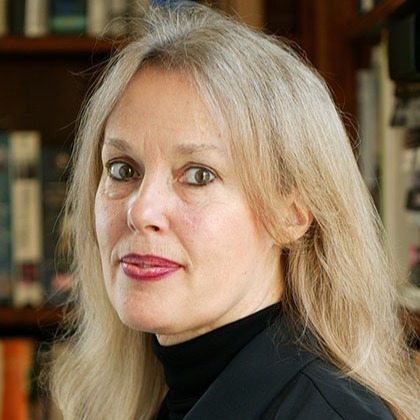
Elaine Scarry
American essayistWikipedia
7
MENTIONS
6
EPISODES
6
PODCASTS
Search complete. 7 mentions across 6 episodes found for "Elaine Scarry".
Sep 14, 2026

Justina ŠumilovaGUEST
It's not something that everyone wants to do, but thinking with pain actually helps to re-humanize this painful experience.
Justina ŠumilovaGUEST
And Elaine Scarry pointed out that Pain actually destroys a blow and at the same time it dehumanizes us, because we lose what it means to be human.
Justina ŠumilovaGUEST
And so in her work, Body and Pain, she suggested that we need to use rehumanization.
Justina ŠumilovaGUEST
And that we need to learn to make.

Sean ThompsonHOST
And in the meantime, everybody else is still strapped with the immediate ramifications of September 11th in this country.
speaker_27CORRESPONDENT
So I'll tell you one of my favorite quotes about the Patriot Act was from Elaine Scarry, who teaches English at Harvard.
speaker_27CORRESPONDENT
So she's a pretty good writer.
speaker_27CORRESPONDENT
I'm going to paraphrase, even though her language is much more eloquent.

David J. BaumanHOST
Interesting.
Chrissy MartinGUEST
yeah so when i got to study a field for my comprehensive exams when i got to really zoom into the literature i wanted to focus on i decided to study disability studies and mad studies and that kind of became my entry point i became really obsessive of disability studies and how to articulate pain and so that's why i have the epigraphs at the beginning of Elaine Scarry, Sonya Huber, who were thinking like, how do we articulate pain? Doesn't pain itself destroy language? And so I spent my PhD thinking about mental illness, thinking about disability and physical illness, doing this research, doing this creative work.
Chrissy MartinGUEST
And so I started trying to write about the experience of like being in an ill body.
Chrissy MartinGUEST
I don't know if I'm claiming disabled right now or then, but just trying to figure it out myself.

Micah KeelbonHOST
The pain, I mean, in my teeth.
Micah KeelbonHOST
I think of an Elaine Scarry line.
Micah KeelbonHOST
The first demand of beauty is to keep looking.
Micah KeelbonHOST
But when I go to look it up later, it's not there.

Gus T. RenegadeHOST
Then the witch hunts, like, you see, this was one.
Gus T. RenegadeHOST
Uh, "You utilize Elaine Scarry's framework to argue that the execution of roughly 100,000 people during the early modern Europe witch hunts constituted an institutional attempt to destroy the world of women." That is a direct quote.
Gus T. RenegadeHOST
That is a direct quote.
Gus T. RenegadeHOST
That is a direct quote.

Brian GlaveyHOST
[upbeat music] Elaine Scarry's nineteen ninety-nine book, On Beauty and Being Just, begins with this passage: "What is the felt experience of cognition at the moment one stands in the presence of a beautiful boy or flower or bird? It seems to incite, even to require, the act of replication.
Brian GlaveyHOST
Wittgenstein says that when the eye sees something beautiful, the hand wants to draw it.
Brian GlaveyHOST
Beauty brings copies of itself into being." On Beauty and Being Just is an idiosyncratic book, most famous, I think, as an inspiration for Zadie Smith, who shortened Scarry's title and used it for her third novel, On Beauty, which was published in two thousand and five.
Brian GlaveyHOST
It makes me think about the difference between writing about something that captures your attention and drawing it.
Brian GlaveyHOST
Both might be ways of replicating something that matters to us, but my sense is that we tend to value the intellectual seriousness of the first more than the second.
Brian GlaveyHOST
Anyway, Elaine Scarry and beauty are both pretty far removed from today's conversation, except for the fact that I seem to be Elaine maxing, because on today's episode of Some Marvelous Experience, I'll be talking to two brilliant writers, critics, and editors, Rainer Hamilton and Shiv Kotecha, about the work of the conceptual artist, Elaine Sturtevant.
Brian GlaveyHOST
Sturtevant is famous, though not as famous as she should be, for works that she started producing in the nineteen sixties that precisely recreate the works of other artists.
Brian GlaveyHOST
The chief example we'll be talking about today is Sturtevant's Fresh Widow, which is her nineteen ninety-two reproduction of a work originally produced by Marcel Duchamp in nineteen twenty.