Eisenach
Town in GermanyWikipedia
33
MENTIONS
13
EPISODES
12
PODCASTS
Search complete. 33 mentions across 13 episodes found for "Eisenach".
Oct 15, 2026

speaker_0NARRATOR
His next stop was the court of Duke Johann Wilhelm of Sexeisenach, where Teilemann served as concertmaster and eventually kapellmeister from around 1708.
speaker_0NARRATOR
Eisenach is famously the birthplace of Johann Sebastian Bach, and it was here that Teilemann's relationship with the Bach family deepened significantly.
speaker_0NARRATOR
Johann Bernhard Bach, Johann Sebastian's cousin, served as the town organist.
speaker_0NARRATOR
Through him, Teilemann and Bach developed a musical friendship that shaped both men.
speaker_0NARRATOR
Bach copied entire Teilemann cantatas in his own hand as study models, which is the most direct form of admiration one composer can show another.
speaker_0NARRATOR
Teilemann's Neumeister cantata cycles were among the direct influences on Bach's own early approach to sacred vocal music, and in 1714, Bach invited Teilemann to serve as godfather to his second son, who received Philip as his middle name in Teilemann's honor, giving us Carl Philip Emanuel Bach, who would go on to become one of the most important composers of the generation that followed.
speaker_0NARRATOR
During the Eisenach years, Teilemann finally married Amelie Eberlin on the 13th of October, 1709.
speaker_0NARRATOR
The happiness lasted barely a year.

Ruby HartHOST
His schooling began in Mansfeld, where instruction was strict and punishment could be harsh.
Ruby HartHOST
In 1497, he continued his education in Magdeburg, then moved to Eisenach the following year.
Ruby HartHOST
He learnt Latin, the language of scholarship and the church, and developed the intellectual skills that would eventually allow him to argue with some of Europe's most powerful institutions.
Ruby HartHOST
At this stage, however, there was little reason to imagine him leading a religious upheaval.

Bethany BarbreeHOST
So Frederick himself kind of could plausibly deny any kind of involvement by making it look faked.
Bethany BarbreeHOST
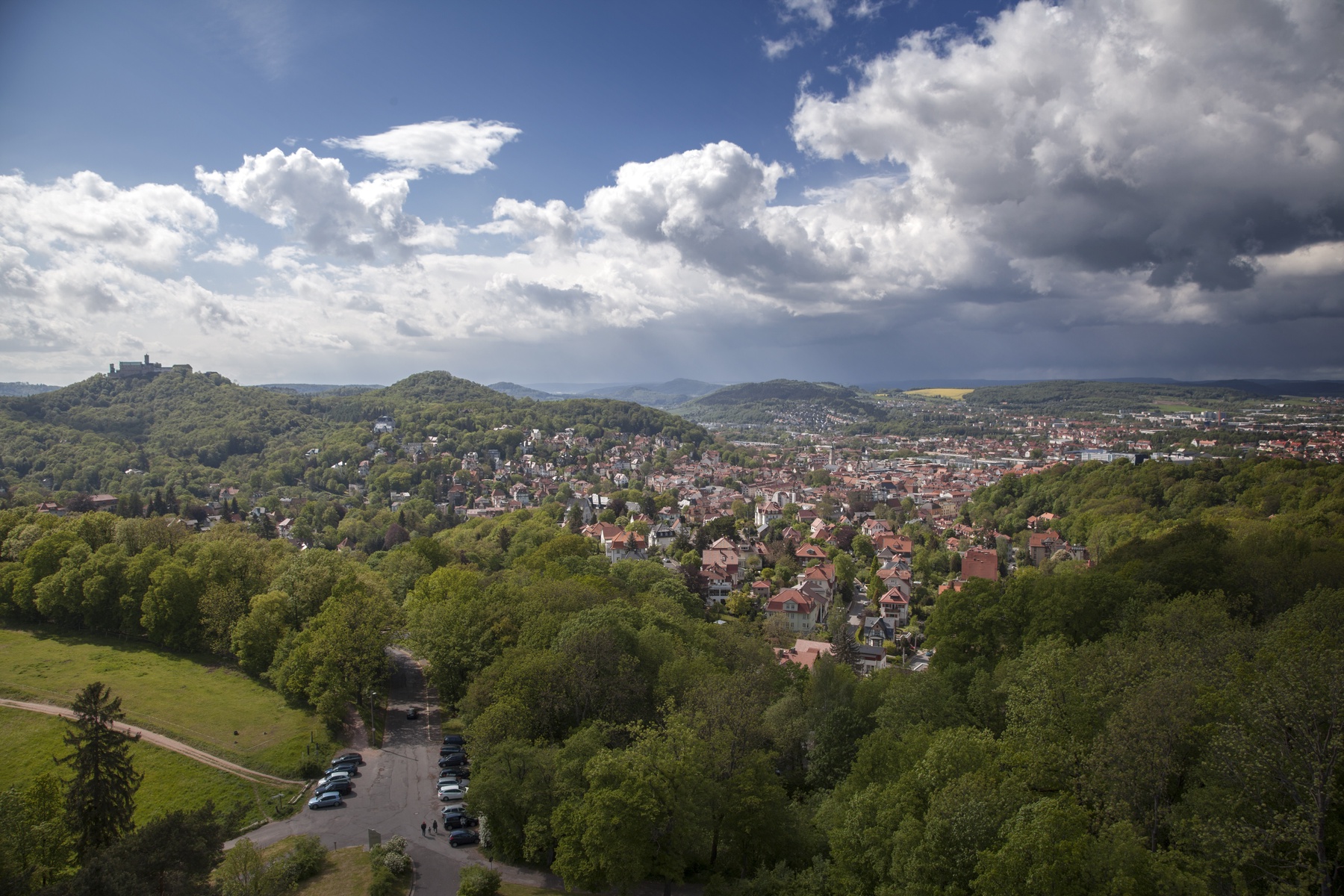
And then Luther spent about 10 months in hiding at Wartburg Castle, and that was near Eisenach.
Bethany BarbreeHOST
So this was disguised as a minor night, and he went by the name Junker Jorg.
Bethany BarbreeHOST
During this time, Luther started his translation and ended up translating the entire New Testament from Greek into German in roughly 11 weeks, which was an extraordinary pace, even by our modern standards.

David WalesNARRATOR
Seven generations thus stretch between the extremes of this genealogical phenomenon.
David WalesNARRATOR
The Thuringian countryside around Anstadt, Erfurt, Wechmar, Eisenach, and other communities of the region cradled the different branches of the family.
David WalesNARRATOR
Two traits, at least, all of them had in common, their love of music and their attachment to one another.
David WalesNARRATOR
Some became organists, some cantors, some town musicians, and their devotion to their craft was so proverbial that for years after all musicians in the town of Erfurt came to be known as the Bachs, even if totally unrelated.
David WalesNARRATOR
One of their favorite amusements was to extemporize choruses out of popular songs, and these lusty medleys, or as they called them, quadlibets, they would bellow for hours on end with great good humor while the listeners laughed till their sides ached.
David WalesNARRATOR
son of a court musician.
David WalesNARRATOR
Johann Sebastian Bach was born in Eisenach on March 21, 1685, according to the old-style reckoning, which is ten days behind the Gregorian calendar.
David WalesNARRATOR
His father, Johann Ambrosius Bach, had married an Elizabeth Limmerhirt nearly twenty years earlier in Erfurt, where he was town player.

Michael ToulouseSOUNDBITE_SPEAKER
Such was the luck of Ernst August I, Duke of Saxe-Weimar, whose uncle passed away in 1741.
Michael ToulouseSOUNDBITE_SPEAKER
Ernst took possession of his uncle's estate in Eisenach.
Michael ToulouseSOUNDBITE_SPEAKER
and the music director, sadly, was out of a job.
Michael ToulouseSOUNDBITE_SPEAKER
Don't worry, though.

speaker_0NARRATOR
After the Unity Congress has been held, Engels and I will publish a short statement to the effect that our position is altogether remote from the said programme of principle, and that we have nothing to do with it.
speaker_0NARRATOR
This is indispensable because the opinion, the entirely erroneous opinion, is held abroad and assiduously nurtured by enemies of the party, that we secretly guide from here the movement of the so-called Eisenach party.
speaker_0NARRATOR
In a Russian book, Statism and Anarchy, that has recently appeared, Bakunin still makes me responsible, for example, not only for all the programs, etc., of that party, but even for every step taken by Liebknecht from the day of his cooperation with the People's Party.
speaker_0NARRATOR
Apart from this, it is my duty not to give recognition, even by diplomatic silence, to what in my opinion is a thoroughly objectionable programme that demoralises the party.
speaker_0NARRATOR
Every step of a real movement is more important than a dozen programmes.
speaker_0NARRATOR
If, therefore, it was not possible, and the conditions of the item did not permit it, to go beyond the Eisenach programme, one should simply have concluded an agreement for action against the common enemy.
speaker_0NARRATOR
but by drawing up a program of the principles, instead of postponing this until it had been prepared for by a considerable period of common activity, one sets up before the whole world landmarks by which it measures the level of the party movement.
speaker_0NARRATOR
The Lasallian leaders came because circumstances forced them to.

Jeremy BoreingHOST
The ship returned back to Europe and 254 of its passengers were murdered in the Holocaust.
Jeremy BoreingHOST
One week before the St. Louis sailed, on May 6th, 1939, 11 German churches founded in Eisenach, the Institute for the Study and Eradication of Jewish Influence on German Church Life.
Jeremy BoreingHOST
The Institute's mission was, quote, to obliterate the Jewish roots of Christianity, to delete every positive reference to the people of Israel and Judaism from the Holy Scripture.
Jeremy BoreingHOST
The Institute produced a de-Judaized New Testament and hymnal, and it taught that Jesus was a Gentile.

Jason HassettHOST
He had run Monte Carlo, the RAC and the Thousand Lakes.
Jason HassettHOST
On the 17th of January, he was at the wheel of a TT Roadster near Eisenach and the car left the road and hit a tree.
Jason HassettHOST
He was killed.
Jason HassettHOST
So Audi started the first stage of a fix in 1999.

David WalesNARRATOR
Rightly or wrongly, the composer always harbored a dislike for the burlesque, though when he created it, his original instinct led him aright, if more or less unconsciously.
David WalesNARRATOR
Not till four years later did the pianist Eugen Daugher give it a public hearing in Eisenach.
David WalesNARRATOR
At that, Strauss himself never brought himself to dignify the burlesque with an opus number, and insisted he would not have consented to its publication but for his need of funds.
David WalesNARRATOR
Today the saucy little score seems more alive than certain other early efforts which were rather closer to their composer's heart.
14 MINS LATER
speaker_10ADVERTISER
See our seven-day return policy at Carvana.com.
David WalesNARRATOR
The date deserves to be noted, November 11, 1889.
David WalesNARRATOR
That same year, he had composed another tone poem, Death and Transfiguration, and on June 21, 1889, he permitted an audience in nearby Eisenach to hear it.
David WalesNARRATOR
the work is program music if you will but the idea that it originally set out to illustrate the poem about the man dying in a necessitous little room and after his death struggles translated to supernal glories is wrong moreover the long-accepted notion that the music is based on lines by alexander ritter is fallacious for in the first place the composer did not aim to illustrate his friend's word picture and in the second ritter wrote the poem only after becoming acquainted with the score this is what explains a certain incongruity between ritter's verses and the tones which in reality were never conceived in slavish illustration of them hanslick wrong as usual was to write misleadingly once again a previously printed poem makes it certain that the listener cannot go awry for the music follows this poetic programme step by step quite as in a ballet scenario and he spoke of the score as a gruesome combat of dissonances in which the wood-wind howls in runs of chromatic thirds while the brass growls and all the strings rage by this time accustomed to such critical nonsense the composer did not suffer himself to be troubled what disturbed him much more was that his old champion von beulau gave indications of no longer seeing eye to eye with him at bulow's suggestion strauss had revised and newly instrumented macbeth but the piece was to continue a step-child soon he was increasing his output of songs and enriching leader-singers with such treasures as rua minezela cecily heimliche aufforderung and morgan while only a few short years ahead lay traum durch die dämmerung nachtsgesang and schlagende herzen to delight nearly two generations of recitalists strauss had always been blessed with a robust health unlike wagner for instance he never suffered from exacerbated nerves and violent extremes of unbalanced mood but at the period of which we speak he did experience one of his rare periods of illness what between his guest engagements his rehearsals the strain of composing, attending to details of publication, and myriad other obligations of a traveling conductor and virtuoso, he came down, in May 1891, with a menacing grip which sent him to bed and threatened serious complications.
3 more episodes mention Eisenach.
Create an account to see the whole feed, search across every transcript, and follow the entities you care about.