Edward the Confessor
Former King of EnglandWikipedia
453
MENTIONS
133
EPISODES
91
PODCASTS
Search complete. 453 mentions across 133 episodes found for "Edward the Confessor".
Oct 5, 2026

Tom WilkinsonHOST
Heir, a person with the right to receive a title, position, or property.
Tom WilkinsonHOST
For example, "Edward the Confessor had no obvious heir to the English throne".
Tom WilkinsonHOST
Claimant.
Tom WilkinsonHOST
Claimant, someone who says they have a right to something.
Tom WilkinsonHOST
Cnut ruled a North Sea empire.
Tom WilkinsonHOST
His empire included England, Denmark, and Norway.
Tom WilkinsonHOST
The political situation in England became particularly complicated when Edward the Confessor became King of England in 1042.
Tom WilkinsonHOST
Edward was an Anglo-Saxon king, but he had spent much of his early life in Normandy.

Tom WilkinsonHOST
A person with the right to receive a title, position or property.
Tom WilkinsonHOST
For example, Edward the Confessor had no obvious heir to the English throne.
Tom WilkinsonHOST
Claimant, claimant.
Tom WilkinsonHOST
Someone who says they have a right to something.
Tom WilkinsonHOST
Cnut ruled a North Sea empire.
Tom WilkinsonHOST
His empire included England, Denmark, and Norway.
Tom WilkinsonHOST
The political situation in England became particularly complicated when Edward the Confessor became King of England in 1042.
Tom WilkinsonHOST
Edward was an Anglo-Saxon king, but he had spent much of his early life in Normandy.

speaker_0NARRATOR
After solidifying his control over Norway and having accepted that Sweyn would continue to rule Denmark, Harald turned his attention in the mid-1060s to England.
speaker_0NARRATOR
After the death of King Harthacnut back in 1042, when Magnus had become King of Denmark, the rule of England had reverted back into the hands of the Royal House of Wessex with Edward the Confessor succeeding to the throne.
speaker_0NARRATOR
He was an Anglo-Saxon ruler, at least to the extent that we can still speak of Anglo-Saxons and Danes as distinct entities in England by this time.
speaker_0NARRATOR
Such was the level of intermarriage which had occurred between the two groups over two centuries by the mid-11th century.
speaker_0NARRATOR
King Edward responded by sending Tostig’s brother, Harold Godwinson, the Earl of Wessex, northwards to negotiate with the Northumbrian rebels.
speaker_0NARRATOR
Having appraised the situation there, Harold refused to support his own brother, a move which led the humiliated Tostig into exile and to request the aid of Harald Hardrada in Norway.
speaker_0NARRATOR
By this time, Edward the Confessor was gravely ill, and Harald saw an opportunity not just to reestablish Tostig in Northumbria and acquire a major ally in England in the process, but also to potentially put himself in a position to succeed Edward as King of Norway, a move which would go some way to reestablishing the North Sea empire of Cnut the Great.
speaker_0NARRATOR
Events were moving very quickly as 1066 dawned.

Jeremy AshbeeGUEST
We also, the place where the Normans landed, the caption on the tapestry talks about the place, Pevensey, and that's now Pevensey Castle, the first place where the Normans set foot in this country and where they set up their first fortification, which is the, you know, the ancestor of what we have now.
Jeremy AshbeeGUEST
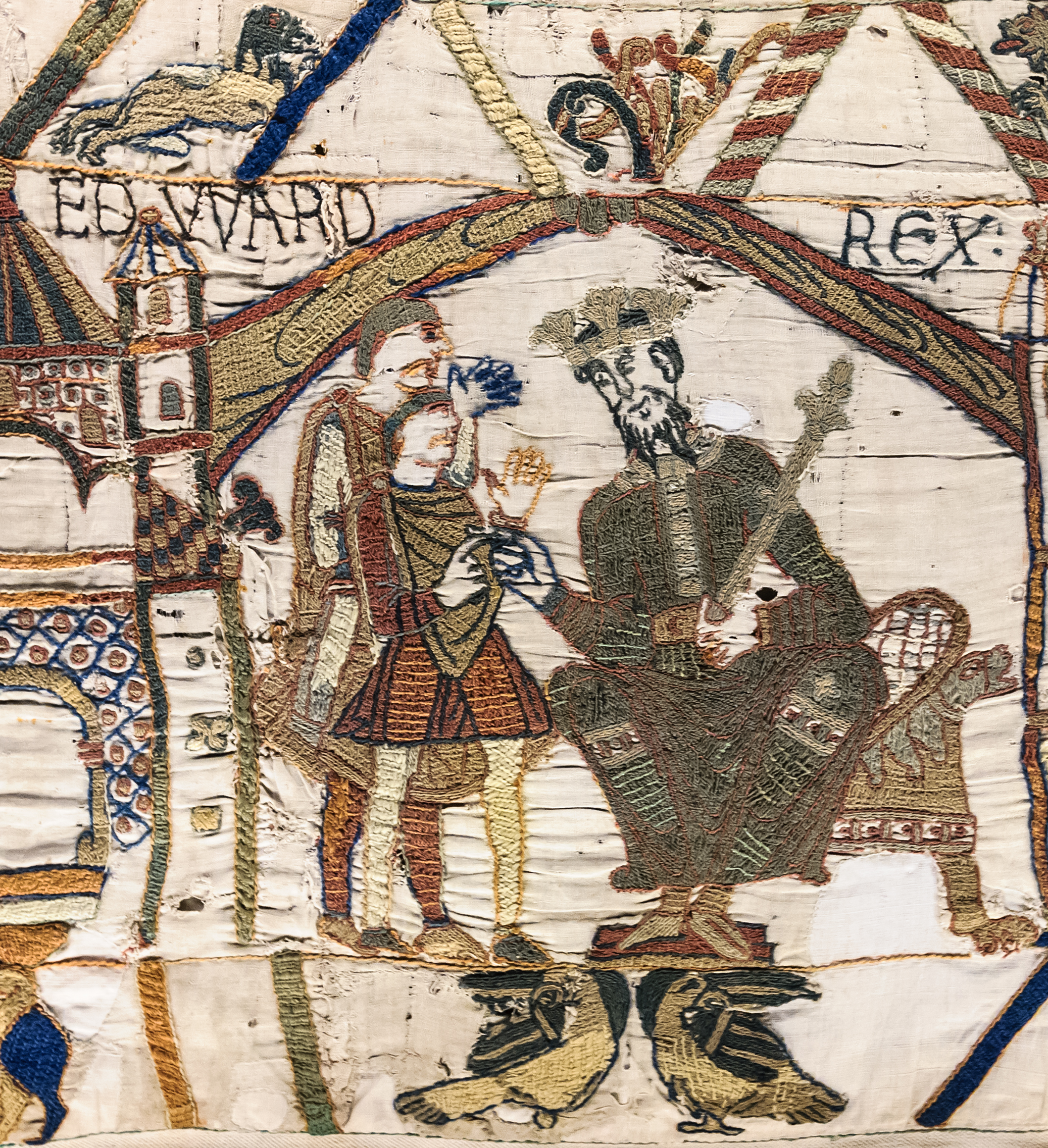
The tapestry shows Edward the Confessor's finally finished Westminster Abbey, and we have the Pyx Chamber, one of the, the early bits of that abbey complex, and all these other sites.
Jeremy AshbeeGUEST
So, you know, we, it, this is exactly the kind of opportunity that we really needed to be involved in.
Jeremy AshbeeGUEST
I just also want the, the opportunity to say that just as, you know, the fact that it's sold out is an in- indication, and I think we all knew it was gonna be like this, that this is the greatest cultural event of the year by a very long chalk, and it's a real honor for English Heritage to be partnering with the British Museum to be a part of it.
19 MINS LATER
Jeremy AshbeeGUEST
I have now won." And into London he goes and gets crowned.
Jeremy AshbeeGUEST
And I think Michael, I hope, would agree with this, that, that everyone's favorite idea of the last scene that we've lost would be William probably sitting on a throne crowned.
Jeremy AshbeeGUEST
And why do we say that? Because the tapestry starts with Edward the Confessor crowned.
Jeremy AshbeeGUEST
Roughly in the middle of it you've got Harold crowned as King of the English.

Pamela NagamiNARRATOR
It made converts throughout Italy, and especially in the armies, with the result that the first outbreak due to its efforts assumed a military complexion.
Pamela NagamiNARRATOR
Morelli and Salvati, two sub-lieutenants in the Neapolitan army, raised the standard of rebellion at Nola, vaguely demanding the Spanish Constitution, a catchword which meant to those who used it as much and as little as the laws of Edward the Confessor meant to the agitators of 12th century England.
Pamela NagamiNARRATOR
The weakness of the government prevented the movement from being nipped in the bud, and when it had been joined by Pepe, the general commanding at Naples, the king made unconditional surrender.
Pamela NagamiNARRATOR
The Constitution was duly proclaimed, the political persecution of the Muratists ceased, and Ferdinand IV, while he waited for a chance of revenge, was loud in his professions of ardent devotion to the popular cause.

Eleanor BarracloughGUEST
The Walker, yeah.
William DalrympleHOST
And in the next episode, we are going to see what happens when a storm blows a ship off course in the channel, and it lands on the coast of Ponthieu, and out of it, wet and furious, climbs the most powerful man in England, the Earl of Essex, brother-in-law of the king, and the man everyone in England expects to rule when the childless Edward the Confessor dies.
William DalrympleHOST
And this changes the entire course of William the Bastard's life and changes the entire course of English history.
William DalrympleHOST
That is very familiar stuff, uh, but what you've told us, Eleanor Barraclough, is not.

speaker_8NARRATOR
She might even be a flashback to a past episode.
speaker_8NARRATOR
Her identification has not been helped by the fact that Elfgeiver was a relatively commonplace name, a partly Latinized version of the Old English Elfgifu, and even used by people not originally called Elfgeiver, including Edward the Confessor's mother, Emma of Normandy.
speaker_8NARRATOR
This is a rare moment in which a woman takes centre stage in the narrative, and it stands out all the more for that.
speaker_8NARRATOR
Displayed alongside the tapestry in the British Museum is a manuscript held in Oxford's Bodleian Library, designated Junius XI.
11 MINS LATER
speaker_8NARRATOR
When you get to the end of the tapestry, you'll no doubt conclude that something is missing.
speaker_8NARRATOR
The embroidery is clearly damaged in the final scene, which shows the English fleeing the field of Hastings in disarray.
speaker_8NARRATOR
Most experts agree that the ending has been lost, and that the last panel would likely have shown William being crowned in Westminster Abbey, a deliberate echo of the opening scene in which his predecessor Edward the Confessor is shown on the throne.
speaker_8NARRATOR
While you're mulling that over, you might reflect on what else isn't shown in the tapestry.

Tony RobinsonHOST
This is an illustration of what seems to have been an extraordinarily impractical arrangement.
Tony RobinsonHOST
The king and his advisors got on barges at the Tower of London and sailed to Rotherhithe to where the peasants were massing.
Tony RobinsonHOST
The idea was that they'd have a safe stretch of water between them and the mob.
Tony RobinsonHOST
And according to the chronicles, the king told them to go home.
Tony RobinsonHOST
Although I can't actually imagine that the king said it himself.
Tony RobinsonHOST
Presumably, one of the aristocrats said, what shall we do, my lord? And the king said, tell them to go home.
Tony RobinsonHOST
And the aristocrat went, the king says go home.
Tony RobinsonHOST
But that does seem to be a pretty pathetic tactic.

Larry WilsonNARRATOR
It is only in one of these, the fine but fruitless victory at Ashdown, that we first see in the dim struggle, in a desperate and secondary part, the figure who has given his title to the ultimate turning of the tide.
Larry WilsonNARRATOR
for the victor was not then the king but only the king's younger brother there is from the first something humble and even accidental about alfred he was a great understudy the interest of his early life lies in this that he combined an almost commonplace coolness and readiness for the ceaseless small bargains and shifting combinations of all that period with the flaming patience of saints in times of persecution while he would dare anything for the faith he would bargain in anything except the faith he was a conqueror with no ambitions an author only too glad to be a translator a simple concentrated wary man watching the fortunes of one thing which he piloted both boldly and cautiously and which he saved at last he had disappeared after what appeared to be the final heathen triumph and settlement and is supposed to have lurked like an outlaw in a lonely islet in the impenetrable marshlands of the parrot towards those wild western lands to which aboriginal races are held to have been driven by fate itself but alfred as he himself wrote in words that are his challenge to the period held that a christian man was unconcerned with fate he began once more to draw to him the bows and spears of the broken levies of the western shires especially the men of somerset and in the spring of eight seventy eight he flung them at the lines before the fenced camp of the victorious danes at ethandume his sudden assault was as successful as that at ashdown and it was followed by a siege which was successful in a different and very definite sense guthrum the conqueror of england and all his important supports were here penned behind their palisades and when at last they surrendered the danish conquest had come to an end guthrum was baptized and the treaty of wedmore secured the clearance of wessex the modern reader will smile at the baptism and turn with great interest to the terms of the treaty in this acute attitude the modern reader will be vitally and hopelessly wrong he must support the tedium of frequent references to the religious element in this part of english history for without it there never would have been any english history at all and nothing could clinch this truth more than the case of the danes in all the facts that followed the baptism of guthrum is really much more important than the treaty of wedmore the treaty itself was a compromise and even as such did not endure a century afterwards a danish king like canute was really ruling in england but though the dane got the crown he did not get rid of the cross it was precisely alfred's religious exaction that remained unalterable and canute himself is actually now only remembered by men as a witness to the futility of merely pagan power as the king who put his own crown upon the image of christ and solemnly surrendered to heaven the scandinavian empire of the sea end of chapter four this is a librivox recording all librivox recordings are in the public domain for more information or to volunteer please visit librivox.org a short history of england by g. k. chesterton chapter five saint edward and the norman kings the reader may be surprised at the disproportionate importance given to the name which stands first in the title of this chapter i put it there as the best way of emphasizing at the beginning of what we may call the practical part of our history an elusive and rather strange thing it can only be described as the strength of the weak kings it is sometimes valuable to have enough imagination to unlearn as well as to learn i would ask the reader to forget his reading and everything that he learnt at school and consider the english monarchy as it would then appear to him let him suppose that his acquaintance with the ancient kings has only come to him as it came to most men in simpler times from nursery tales from the names of places from the dedications of churches and charities from the tales in the taverns and the tombs in the churchyard let us suppose such a person going upon some open and ordinary english way such as the thames valley to windsor or visiting some old seats of culture such as oxford or cambridge one of the first things for instance he would find would be eton a place transformed indeed by modern aristocracy but still enjoying its medieval wealth and remembering its medieval origin if he asked about that origin it is probable that even a public schoolboy would know enough history to tell him that it was founded by henry the sixth if he went to cambridge and looked with his own eyes for the college chapel which artistically towers above all others like a cathedral he would probably ask about it and be told it was king's college if he asked which king he would again be told henry the sixth If he then went into the library and looked up Henry VI in an encyclopedia, he would find that the legendary giant, who had left these gigantic works behind him, was in history an almost invisible pygmy.
Larry WilsonNARRATOR
Amid the varying and contending numbers of a great national quarrel, he is the only cipher.
Larry WilsonNARRATOR
The contending factions carry him about like a bale of goods.
Larry WilsonNARRATOR
His desires do not seem to be even ascertained, far less satisfied.
Larry WilsonNARRATOR
And yet his real desires are satisfied in stone and marble, in oak and gold, and remain through all the maddest revolutions of modern England, while all the ambitions of those who dictated to him have gone away like dust upon the wind.
Larry WilsonNARRATOR
Edward the Confessor, like Henry VI, was not only an invalid, but almost an idiot.
Larry WilsonNARRATOR
It is said that he was wan, like an albino, and that the awe man had of him was partly that which is felt for a monster of mental deficiency.

Pamela NagamiNARRATOR
Ethelred, when driven out, took refuge at the Duke's court.
Pamela NagamiNARRATOR
Later, Emma again fled thither, taking her sons with her, of whom one was later Edward the Confessor.
Pamela NagamiNARRATOR
From the time of Ethelred's marriage, Englishmen and Normans became closely associated.
Pamela NagamiNARRATOR
On the death of Swegen, his son Canute had not been strong enough to obtain the English kingdom which had been restored to Ethelred.
Pamela NagamiNARRATOR
All laws had to receive the sanction of its members, who formed the advisory council of the king, and all important actions were submitted to them for approval.
Pamela NagamiNARRATOR
In the Witenagemote, the bishops and nobles sat together.
Pamela NagamiNARRATOR
On the death of Canute in 1035, his two sons ruled in succession, but after their death, the Witenagemote in 1042 elected Edward the Confessor, son of Ethelred and the Norman Emma.
Pamela NagamiNARRATOR
He had been educated in Normandy and brought with him to England many Normans, who were given important offices and had great influence.
123 more episodes mention Edward the Confessor.
Create an account to see the whole feed, search across every transcript, and follow the entities you care about.