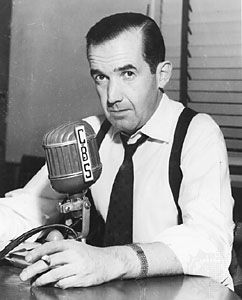
Edward R. Murrow
American broadcasterWikipedia
147
MENTIONS
86
EPISODES
77
PODCASTS
Search complete. 147 mentions across 86 episodes found for "Edward R. Murrow".
Sep 13, 2026

Lisa D. SmithHOST
So there's lots of times.
Lisa D. SmithHOST
Edward R. Murrow was
Jo ClarkGUEST
buried.
Lisa D. SmithHOST
I don't know, but I do know that name.
Jo ClarkGUEST
Edward R. Murrow also was born in Greensboro, and he was the one who brought World War II to life in people's living rooms during the war.
Jo ClarkGUEST
And then he is also the announcer, the television announcer, who took a stand against McCarthy.
Jo ClarkGUEST
Oh, wow.

Kathryn TolbertMODERATOR
That lasted until 1952.
Kathryn TolbertMODERATOR
So there aren't a lot of public figures who come out looking very good in those decades, or even journalists for that matter, right? Edward Murrow predicted in early 42 that if Seattle were attacked, Japanese pilots would probably be found wearing University of Washington sweaters.
Kathryn TolbertMODERATOR
I mean, everybody was kind of on the bandwagon.
Kathryn TolbertMODERATOR
So what happened after World War II? What changed?

Dan CoverleySOUNDBITE_SPEAKER
This is CBS.
Dan CoverleySOUNDBITE_SPEAKER
We're Edward R. Murrow, and hear it now.
Dan CoverleySOUNDBITE_SPEAKER
Come to you Friday evenings.
Dan CoverleySOUNDBITE_SPEAKER
The Columbia Broadcasting System.

David WalesNARRATOR
Finally, in 1954, the so-called Harry Hop was projected into the living rooms of people all over the country.
David WalesNARRATOR
When Hurricane Edna was headed up the coast toward New England, Edward R. Murrow and a camera crew of the Columbia Broadcasting System flew to Bermuda and the Air Force succeeded in getting the entire group, Murrow, three assistants, and 1,500 pounds of camera equipment in the front of the plane.
David WalesNARRATOR
While everybody on the crew held his breath and Murrow used up all the matches aboard and wore out the flint on a lighter, the big plane was skillfully piloted through the squall bands and pushed over into the center.
David WalesNARRATOR
The cameras ground away and Murrow asked endless questions.

David WalesNARRATOR
As Fielding said at the end of his notes, "We had been eleven hours in the air, much of it in violent weather, and the constant strain tells on you." Finally, in 1954, the so-called Harry Hop was projected into the living rooms of people all over the country.
David WalesNARRATOR
When Hurricane Edna was headed up the coast toward New England, Edward R. Murrow and a camera crew of the Columbia Broadcasting System flew to Bermuda, and the Air Force succeeded in getting the entire group, Murrow, three assistants, and one thousand five hundred pounds of camera equipment, in the front of the plane.
David WalesNARRATOR
While everybody on the crew held his breath, and Murrow used up all the matches aboard and wore out the flint on a lighter, the big plane was skillfully piloted through the squall bands and pushed over into the center.
David WalesNARRATOR
The cameras ground away, and Murrow asked endless questions.

Jim AcostaGUEST
He was a colleague of mine too at CBS a long time ago.
Jim AcostaGUEST
If for Scott Pelley to come out and, you know, he is as hard news and straight news as it comes, like in the tradition of Walter Cronkite, Edward R. Murrow, and so on.
Jim AcostaGUEST
If he comes out and says that Barry Weiss is trying to murder 60 Minutes, you have to believe that.
Jim AcostaGUEST
You have to take that as gospel.

Amin ElhassanHOST
no.
Amin ElhassanHOST
You see, when you win an Edward R. Murrow award, you get a second validation.
Amin ElhassanHOST
That's what happened there.
Anthony MaysHOST
Damn it.

Brian ReedHOST
Here's The News from Seen on Radio.
speaker_1SOUNDBITE_SPEAKER
Now speaking to you from the control room of Studio 41 is the editor of See It Now, Edward R. Murrow.
Edward R. MurrowSOUNDBITE_SPEAKER
Good evening.
Edward R. MurrowSOUNDBITE_SPEAKER
Last week, they handed out the Pulitzer Prizes.

Monica PackerHOST
If you guys listen to NPR, this is a big deal, okay? Morning Edition and All Things Considered.
Monica PackerHOST
Her feature and news reporting when multiple national and regional Edward R. Murrow, Murrow? Muro, Muro, awards, and she hosted BYU radio podcast Top of Mind and Uncomfy.
Monica PackerHOST
Both shows aim to help people become better citizens, kinder neighbors, and more effective advocates.
Monica PackerHOST
Julie's latest hobby is a civic project called Julie's Provo Notes, which are so good.

Jeff BlissHOST
Let me, let me throw this at you.
Jeff BlissHOST
Um, I had a cousin, uh, who preceded me by a number of years, who was Edward R. Murrow's chief writer editor, and then moved over with him from, you know, This is London, to, uh, or not This is London, but, uh, to, um, to CBS at New York, and then in radio and then in TV.
Jeff BlissHOST
And I, matter of fact, I think that when ...
Jeff BlissHOST
And then with Cronkite, and when Cronkite was handed that dispatch, I think he was the one that either wrote it or w- was handing it to him.
76 more episodes mention Edward R. Murrow.
Create an account to see the whole feed, search across every transcript, and follow the entities you care about.