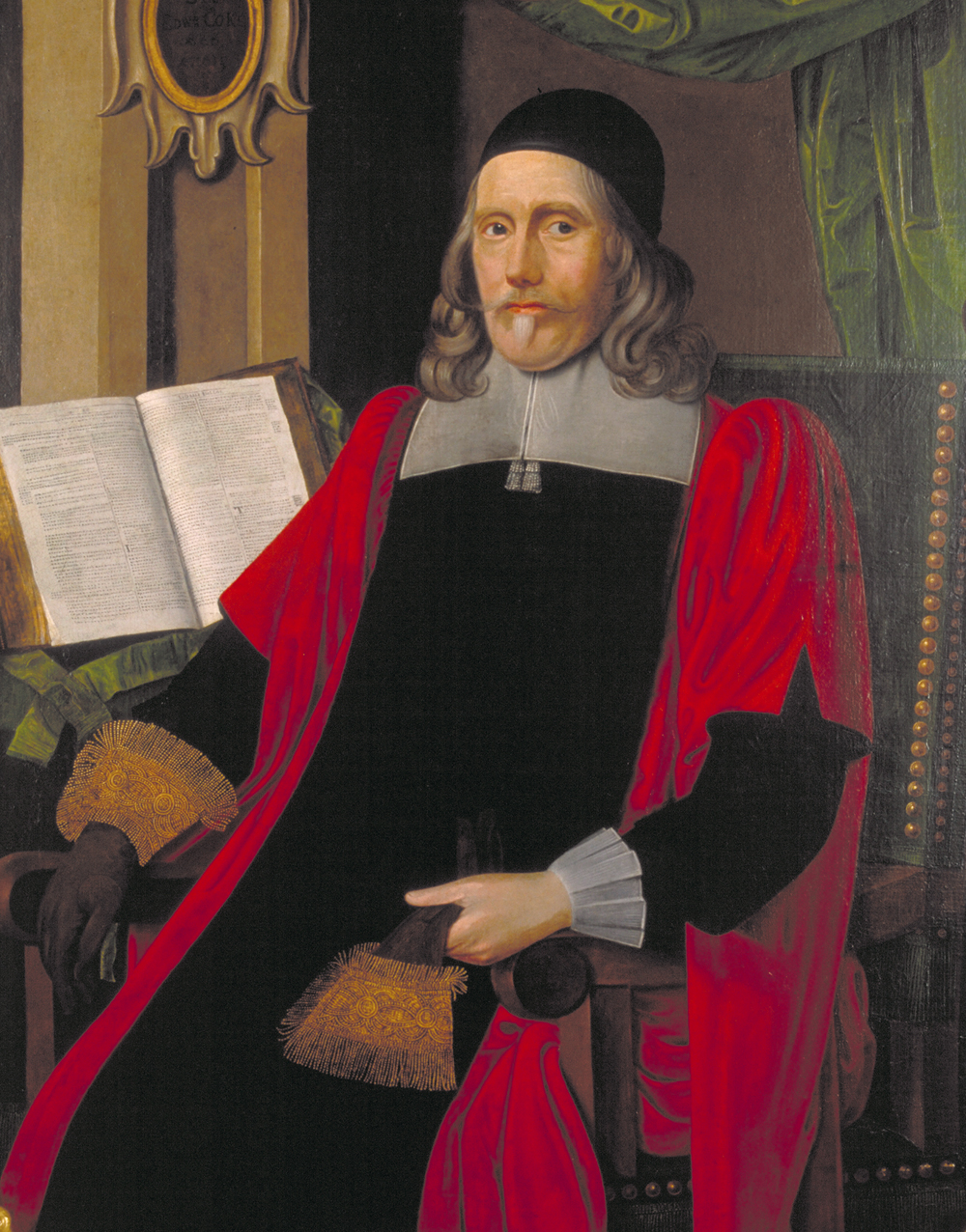
Edward Coke
Barrister and former United Kingdom Solicitor General for England and WalesWikipedia
12
MENTIONS
10
EPISODES
8
PODCASTS
Search complete. 12 mentions across 10 episodes found for "Edward Coke".
Oct 7, 2026

Alice LevineHOST
January the 20th, 1606, Palace of Whitehall, London.
Alice LevineHOST
Attorney General Sir Edward Coke pauses before the ornate doors of the King's privy chamber.
Alice LevineHOST
He straightens his richly embroidered black robes and strides in.
Alice LevineHOST
At 53, Coke cuts an imposing figure, tall, broad-shouldered, with penetrating dark eyes that miss nothing.
8 MINS LATER
Alice LevineHOST
Whatever awaits him in that courtroom, he still has one last act of defiance left in him.
Alice LevineHOST
A few hours later, Westminster Hall, London.
Alice LevineHOST
Sir Edward Coke's keen eyes survey the grand chamber.
Alice LevineHOST
Ornate tapestries adorn the stone walls.
Dan HollawayHOST
Changing things up causes friction.
Dan HollawayHOST
Friction creates problems, right? So the doctrine that gives English conservatism its spine is the idea of the ancient constitution, okay? The claim worked up by Sir Edward Coke and the common lawyers in the early 1600s, sometime after Hooker, is that England has an immemorial system of common law and parliamentary government that predates the Norman conquest even, and that the system constrains the king, even the king.
Dan HollawayHOST
Coke's move on the conquest is clever and almost certainly wrong historically.
Dan HollawayHOST
He argues that William agreed to maintain the existing Anglo-Saxon law in place of imposing new law.

Bev StevensNARRATOR
that much we know from the lives or shall we say under the painful circumstances the existences of public men who have been cursed with scolding wives but what as modius shall unveil the private conjugal tyrannies the hectorings and the curtain lectures that make miserable the undistinguished lives of men of no importance for good or evil in the state how many women in fine wear the breeches through the strength of mind which may be justly defined as readiness of that impassioned invective which in its turn may be reduced like a vulgar fraction to its lowest common denominator of nagging not a pretty word is it and it is a practice even less pretty than that cross-grained definition would warrant We cannot, however, lift the veil that hides the domestic infelicities of the lieges, but must be content to recount the troubles and oppressions that have befallen historic quarrels, who bulk a great deal larger in the history of England than they did, in their own homes, to their wives.
Bev StevensNARRATOR
sir edward coke the great law officer of james i s reign the revered coke upon littleton of the law student was little enough of an authority in his own household after he married his second wife herself a widow the relict in fact of sir william newport hatton He married her but a few months after his wife's death, privately and in haste, probably urged to such an indecent speed by the necessity of forestalling the Lord Keeper Bacon in the lady's affections.
Bev StevensNARRATOR
But he had not been wise in his haste.
Bev StevensNARRATOR
For affection, for him at least, she had none.
Bev StevensNARRATOR
One wonders indeed why she married him at all, who was old enough to be her father.
Bev StevensNARRATOR
It was not ambition, for she was by birth a cecil and daughter of the second Lord Burleigh, nor the want of money, nor the need of a protector, for she was very well able to take care of herself, as Sir Edward presently discovered, and she was sufficiently wealthy.
Bev StevensNARRATOR
they quarrelled incessantly about property about the marriage of their daughter about anything and everything sir edward coke was only suffered to enter her house in london by the back door and she plundered his residence in the country She sent her daughter away to Oatlands to prevent a marriage with Sir John Villiers, which Sir Edward was pressing forward, and he, with his son and ten or eleven servants, weaponed in violent manner, repaired thither, broke open the door, and took her away.
Bev StevensNARRATOR
Lady Hatton intrigued at court against the distracted Coke, who was already in disfavour at St. James's.

Dan HollawayHOST
Changing things up causes friction.
Dan HollawayHOST
Friction creates problems, right? So the doctrine that gives English conservatism its spine is the idea of the ancient constitution, okay? The claim worked up by Sir Edward Coke and the common lawyers in the early 1600s, sometime after Hooker, is that England has an immemorial system of common law and parliamentary government that predates the Norman conquest even, and that the system constrains the king, even the king.
Dan HollawayHOST
Coke's move on the conquest is clever and almost certainly wrong historically.
Dan HollawayHOST
He argues that William agreed to maintain the existing Anglo-Saxon law in place of imposing new law.

Ralph LeonardGUEST
And even like further English jurists like Francis Bacon.
Ralph LeonardGUEST
Yes, that Francis Bacon, Edward, Edward Koch, William Blackstone, who was influential on the American founding fathers, said that any body who was born of an alien on the English soil is to be determined as an English subject.
Jason MylesHOST
You wrote in the article that empire messes with identity.
Ralph LeonardGUEST
I

Christine RuckerNARRATOR
He remained at Cambridge until 1640, when his father, in crossing the Humber, was drowned in company with a Miss Skinner.
Christine RuckerNARRATOR
Fuller says that this Miss Skinner was the daughter of Sir Edward Coke, but possibly he mistook her for her mother, who was also related to Cyriac Skinner, Milton's friend.
Christine RuckerNARRATOR
It is said that Mrs. Skinner, who adopted Andrew on the death of the elder Marvell, left him the little property she had, and he also appears to have inherited a small estate.
Christine RuckerNARRATOR
Somebody must have provided him a fair amount of money, for he spent the next four years wandering through France, Holland, Spain, and Italy, a gallant young gentleman with scholarly tastes and of a merry, open nature, who aired his skill in Latin verses when he mixed with the wits of Paris, bettered himself in the art of fencing in company with the Spaniards of Madrid, and did not care to hear Flecknoe read his poems at Rome when he might have been taking life more gaily among the Romans himself.