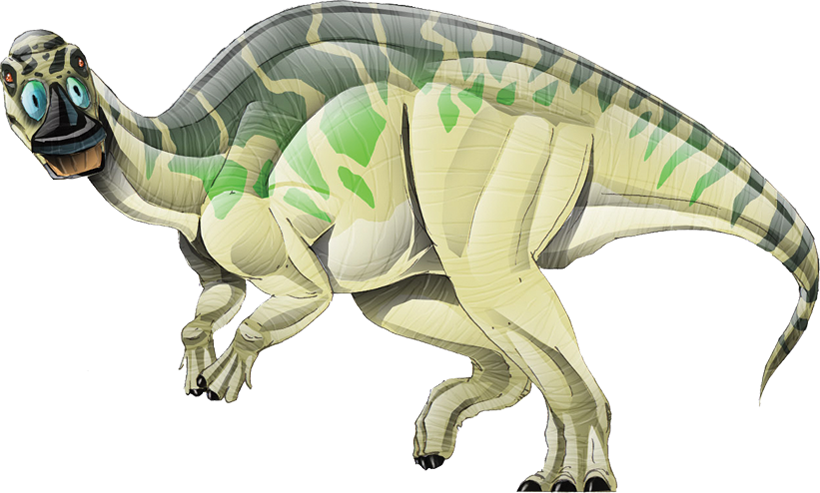
Edmontosaurus
DinosaurWikipedia
15
MENTIONS
8
EPISODES
8
PODCASTS
Search complete. 15 mentions across 8 episodes found for "Edmontosaurus".
Oct 15, 2026

SabrinaHOST
And on a related note, how the shape of gastroliths can help us figure out dinosaur digestion.
SabrinaHOST
There's also a hatchling Allosaurus that got eaten, and tooth marks on Edmontosaurus that shows a T-rex was feeding on it.
SabrinaHOST
Now's a good time to catch up on shows too, so we're also reviewing Netflix's The Dinosaurs and the movie The End of Oak Street.
SabrinaHOST
And we've got dinosaur of the day, Stygovenator, a dubious dinosaur with a lot of similarities to Nanotyrannus, and it also kind of sparks some more debate around Nanotyrannus.
12 MINS LATER
SabrinaHOST
[laughs]
GarretHOST
[laughs]
SabrinaHOST
Well, speaking of teeth, tooth marks on Edmontosaurus bones likely show a T-rex that was feeding or scavenging.
GarretHOST
Hmm.

AnthonyHOST
"What is your smallest dinosaur fossil ever?" My fos- s- the smallest dinosaur fossil that I have, hmm, hmm.
AnthonyHOST
Maybe an Edmontosaurus tooth.
AnthonyHOST
It just a little, tiny tooth.
AnthonyHOST
Tiny, tiny.

Sam DenbyNARRATOR
A crew of fossil hunters pulled together by the Black Hills Institute of Geological Research had been searching through a ranch in South Dakota for months.
Sam DenbyNARRATOR
They'd found some good stuff, some Edmontosaurus bones, and were getting ready to wrap up and return to Hill City to get the artifacts ready for display.
Sam DenbyNARRATOR
But then their truck got a flat tire, then their spare was flat, then their pump's rubber hose was broken too, so they slowly nursed the truck from their camp to the nearby town of Faith to get it fixed.
Sam DenbyNARRATOR
But there was no sense in them all going, at least according to paleontologist Sue Hendrickson, who decided to stay back and search some more.

David BoldemanHOST
james as we approach the closer for this podcast i'll ask a few closing out questions and what you see the future of dinosaur models but i'll be missing me not to ask you What's your favorite dinosaur? And tell me how you got into studying dinosaurs.
James RonanGUEST
So my favorite dinosaur is Edmontosaurus.
James RonanGUEST
It's a duck-billed dinosaur, very big.
James RonanGUEST
These dinosaurs grow up to 30 feet, possibly bigger.

Anna NorthcuttGUEST
Ritzer said he based Dynaniche specifically on the Hill Creek Formation, which are fossils from Wyoming, South Dakota, and Montana about 66 million years ago.
Anna NorthcuttGUEST
And that was because within that geological timeframe, you have T. rex, Triceratops, Ankylosaurus, Edmontosaurus, and a lot of the dinosaurs that everybody knows and loves.
Anna NorthcuttGUEST
And so if you are starting something with dinosaurs, you have to have those.
Anna NorthcuttGUEST
But he also mentioned that in the future, he would love to expand to other geological ages and cover more dinosaurs.

Roger BensonGUEST
So T. rex never would've met a living Stegosaurus, so it wouldn't have eaten it.
Roger BensonGUEST
But it could have eaten Triceratops, and it could have eaten duck-billed dinosaurs, the Hadrosaurs, like Edmontosaurus, that were also alive at the same time.
Robert CarpenterHOST
Let's get to a couple fascinating questions.
Robert CarpenterHOST
[upbeat music]
7 MINS LATER
Robert CarpenterHOST
[dinosaur growling] And over there, there's a family of funny-looking dinosaurs.
Robert CarpenterHOST
They kind of look like they have a beak like a duck.
Roger BensonGUEST
That includes dinosaurs that you might have heard of, like Triceratops and the duck-billed dinosaurs like Edmontosaurus.
Robert CarpenterHOST
Are there really big predators other than the T-Rex that we need to watch out for here, Dr. Roger?

MarciaNARRATOR
But a recent discovery by paleontologist and National Geographic explorer Paul Serino is unveiling a new way that dinosaur tissue might have gotten mummified, one that could help scientists find even more of the exceptional fossils.
MarciaNARRATOR
Twenty years ago, Serino and his team found two Edmontosaurus anectens, a species of hadrosaur.
MarciaNARRATOR
in an arid stretch of eastern Wyoming.
MarciaNARRATOR
But it wasn't until 2023, when they were carefully cleaning the specimens, that they realized that what they thought was skin was actually clay sandwiched between harder layers of sandstone.
MarciaNARRATOR
Both animals had been preserved in a clay mask that adhered to their bodies as they decayed, creating a three-dimensional rendering of everything it coated, bones, skin, muscles, and all.
MarciaNARRATOR
It's a complete fleshy profile the team wrote in a study published recently in the journal Science.
MarciaNARRATOR
It reveals new clues about how the Edmontosaurus looked and moved from a neck to trunk crest that transitions directly to what Serino calls dragon-like tail spikes to detailed impressions of what appear to be hind hooves, which could be the first time such hooves have been discovered in reptiles.
MarciaNARRATOR
Scientists have long suspected these hooves existed, but the clay impressions detail one twice as large as they had previously imagined.

LisaNARRATOR
one that could help scientists find even more of the exceptional fossils.
LisaNARRATOR
20 years ago, Sereno and his team found two Edmontosaurus anectens.
LisaNARRATOR
a species of hadrosaur in an arid stretch of eastern Wyoming.
LisaNARRATOR
But it wasn't until 2023, when they were carefully cleaning the specimens, that they realized that what they thought was skin was actually clay sandwiched between harder layers of sandstone.