Eastern Zhou
DynastyWikipedia
6
MENTIONS
5
EPISODES
4
PODCASTS
Search complete. 6 mentions across 5 episodes found for "Eastern Zhou".
Oct 10, 2026

William JonesHOST
... same, yeah.
Kevin WilsonHOST
Bawang is an old term that goes all the way back to like I guess, um, the Eastern Zhou period.
William JonesHOST
Mm-hmm.
Kevin WilsonHOST
Uh, and you had, um, bawangs like, uh, like most famously probably Shang Yang, um, who are just like c- who, who kind of like i- in this view sort of exceeded the, uh, the kind of like traditional authority that these authors were imagining, like, uh, existed in the, in the golden ages that sometimes-

Scott PruittHOST
Shaogong proved remarkably versatile.
Scott PruittHOST
He helped suppress rebellions led by the Shang prince Wugong and allied tribes, conducted diplomatic missions in the southern regions, participated in the construction of the Eastern Zhou capital, and administered justice among the local communities.
Scott PruittHOST
According to legend, when he traveled to hear legal disputes, he sometimes rested under a pear tree while hearing cases.
Scott PruittHOST
The people respected him so deeply that afterward they refused to cut down those trees, commemorating him in a poem known as Gan Tang.
Laszlo MontgomeryHOST
It went from north to south, but not in a straight line.
Laszlo MontgomeryHOST
Between the time of the spring and autumn period of the Eastern Zhou to this time of Emperor Yang in the early 7th century, a lot of canals had already been dug throughout the watered world of South and Central China.
Laszlo MontgomeryHOST
Many of these I mentioned in past episodes and all were maintained during Emperor Wen's time.
Laszlo MontgomeryHOST
China got the short end of the geographical stick when it came to rivers that ran longitudinally.

Theo WrenfieldNARRATOR
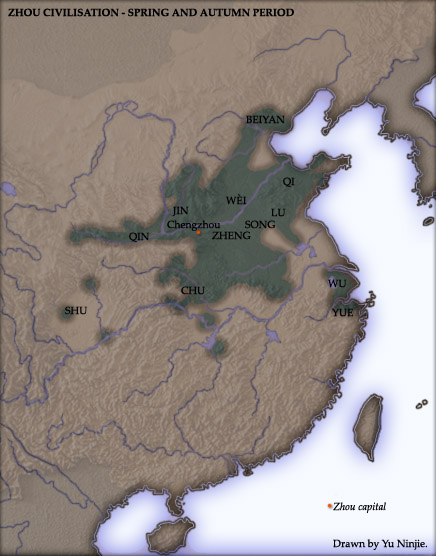
His son and heir fled eastward, establishing a new capital at a place called Luoyang, further from the old heartlands, and perhaps symbolically, further from the full strength of royal power as well.
Theo WrenfieldNARRATOR
This moment marks the beginning of what historians call the Eastern Zhou period, And within it, a time known as the spring and autumn period, named after a chronicle that recorded the events of those years.
Theo WrenfieldNARRATOR
Close your eyes and imagine this eastward journey, the royal procession moving slowly across the landscape, carrying with it not just people and treasures, but the weight of a kingdom in transition.
Theo WrenfieldNARRATOR
Though the Zhou kings continued to rule, at least in name, their actual power began to resemble something more like a comforting old story that everyone still told, rather than a living reality backed by military might.

Laszlo MontgomeryHOST
Unlike some emperors' dowagers who have been vilified for a number of reasons, Empress Dou was quite capable.
Laszlo MontgomeryHOST
She put together a solid team of ministers who got things done, and the military adventurism that had plagued the land since the Eastern Zhou was discouraged.
Laszlo MontgomeryHOST
And being a solid follower of Huang-Lao Taoism, she filled the court with other believers in this Chinese homegrown religion.
Laszlo MontgomeryHOST
And we'll see this throughout the entirety of Chinese history.
Laszlo MontgomeryHOST
And the most important among them, the one who was most pointed to as the one who built the foundation of Confucianism at the imperial court and throughout the empire, was Dong Zhongshu.
Laszlo MontgomeryHOST
He was a noted scholar of the Spring and Autumn Annals.
Laszlo MontgomeryHOST
The Chunqiu, this book that gave the Spring and Autumn period of the Eastern Zhou Dynasty its name, was the official chronicle of the state of Lu, Confucius' home state, and it covered the years seven twenty-two to four eighty-one BC.
Laszlo MontgomeryHOST
Some say it was written by Confucius himself, which, if true, smothers the work with plenty of gravitas, and later on it became one of the Wu Jing, or Five Classics of Confucianism.