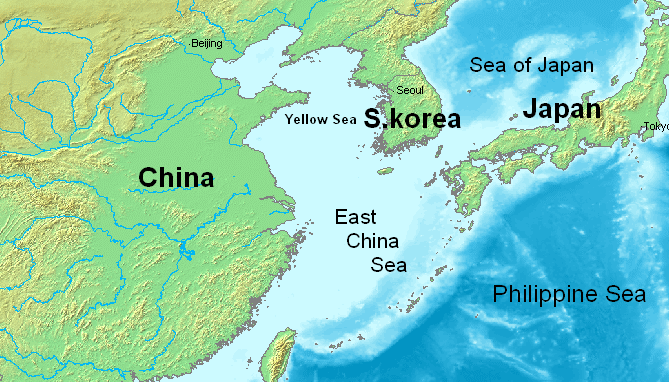
East China Sea
SeaWikipedia
50
MENTIONS
40
EPISODES
36
PODCASTS
Search complete. 50 mentions across 40 episodes found for "East China Sea".
Nov 4, 2026

Matt HayesHOST
Japanese aircraft also photographed at least one Chinese mission during the exercise's opening period, according to reporting on a Ministry of Defense release.
Matt HayesHOST
A Y-9 and a BVK-005 drone moved through the Okinawa-Miyakajima gap from the East China Sea, and Japan Air Self-Defense Force fighters intercepted for visual confirmation.
Matt HayesHOST
Officials did not state that territorial airspace was violated.
Matt HayesHOST
The missions occurred near international waters commonly used for reconnaissance routes.
Matt HayesHOST
The Okinawa-Miakajima gap forms a narrow passage between the East China Sea and the Western Pacific.
Matt HayesHOST
Chinese aircraft using that lane can watch Allied ships and air traffic moving to and from the Philippine Sea.
Matt HayesHOST
The reported Y-9 routes match task patterns that seek to observe exercises, logistics, and radar responses.

Gordon ChangGUEST
The risk is greater now because I think China is becoming a little bit desperate now.
Gordon ChangGUEST
We are seeing much more provocative Chinese activity, not only South China Sea, East China Sea against Taiwan, but we're also seeing China being more open in support of Iran and Russia.
Gordon ChangGUEST
I'll just give you an example.
Gordon ChangGUEST
Targeting data that Iran used to kill six American service members on March 1st in Kuwait, that came from a Chinese satellite.
32 MINS LATER
Gordon ChangGUEST
So China's not stopping at Taiwan.
Gordon ChangGUEST
And we know that it has territorial ambitions elsewhere.
Gordon ChangGUEST
And it's now trying to take the global commons beyond the South China Sea and East China Sea and Yellow Sea and declare it to be Chinese.
Gordon ChangGUEST
I mean, where are we going to where's this going to stop and where are we going to stop them?

Gordon ChangHOST
Second of all, you mentioned the 20th anniversary of the incident where a Chinese Song class diesel sub popped up within firing range of the USS Kitty Hawk.
Gordon ChangHOST
And this was in the East China Sea.
Gordon ChangHOST
The Song class is a very quiet submarine.
Gordon ChangHOST
All diesel subs are.
Gordon ChangHOST
Has, in general, the U.S. Navy been able to deal with diesel subs in middles of carrier groups or wherever? Can we detect them?
James FanellGUEST
Well, that's an issue that's very delicate in terms of talking about it openly in the public sphere.
James FanellGUEST
But to say, in general, it's very difficult for diesel submarines to operate in the East China Sea.
James FanellGUEST
It's very shallow.

Mohammad MarandiSOUNDBITE_SPEAKER
If we were to look at what this conflict meant to the U.S. global status quo beyond Iran and beyond the Middle East, it is believed that this is also seen as an indirect conflict reshift or shifting the balance of power between Beijing and D.C., given that the U.S. arguably is the regional hegemon in the Western Hemisphere.
Mohammad MarandiSOUNDBITE_SPEAKER
And if it were to reflect its inability to be the global hegemon economically and militarily in this part of the world, it makes it almost an equivalent power to China, given that China is the regional hegemon in the East China Sea.
Mohammad MarandiSOUNDBITE_SPEAKER
An empire
Damien WilleyHOST
need not run out of aeroplanes to understand that it cannot dictate to everyone.

speaker_0NARRATOR
According to Japan's joint staff, the activity prompted the Air Self-Defense Force to scramble fighter aircraft.
speaker_0NARRATOR
The movements took place amid heightened monitoring in the East China Sea and the Western Pacific.
speaker_0NARRATOR
The region is strategically important and sees military operations involving several countries, so authorities keep a close watch on aircraft and their flight paths.
speaker_0NARRATOR
Although this is a defense story, it also highlights the importance of managing airspace.

Gordon ChangGUEST
The question is whether they're able to replicate that at a lower level in the ranks of the People's Liberation Army.
Gordon ChangGUEST
So I just there are a lot of things that can go wrong in East Asia, among them, you know, some incident in the South China Sea or East China Sea that, you know, can't be contained.
Gordon ChangGUEST
Right.
Gordon ChangGUEST
So I think the probability of war is actually pretty high.

Daniel ChoiHOST
According to the U.S. State Department, the three ministers reaffirmed their commitment to North Korea's complete denuclearization and the enforcement of U.N. Security Council resolutions aimed at preventing the regime from generating revenue for its nuclear and ballistic missile programs.
Daniel ChoiHOST
The three sides also emphasized the importance of maintaining peace and stability across the Taiwan Strait, while Rubio expressed concerns over China's attempts to assert control over the South China Sea and its coercive actions in East China Sea and the Yellow Sea.
Daniel ChoiHOST
The ministers also signed a memorandum of cooperation, establishing a trilateral Arctic-Pacific partnership to explore maritime cooperation and economic opportunities in the Pacific Arctic.
Daniel ChoiHOST
North Korea reported on the outcome of ministerial talks with Switzerland's top diplomat, who visited Pyongyang this week, to mark the opening of the country's diplomatic office.

ShirvanHOST
And this dominance isn't just economic, it's political.
ShirvanHOST
In 2010, China halted rare earth exports to Japan following a sovereignty dispute in the East China Sea.
ShirvanHOST
The embargo sent shockwaves through global supply chains, forcing America, Japan, Australia, and others to reassess their dependence on Chinese rare earths.
ShirvanHOST
A more recent incident occurred in April 2025 during the trade war.

Gordon ChangGUEST
I think that's clear.
Gordon ChangGUEST
I mean, we see very provocative Chinese activity along its periphery, whether we're talking East China Sea in Japan, Taiwan, South China Sea, Vietnam and Philippines, or in the Himalayas against India.
Gordon ChangGUEST
And these are dangerous, I think, because I think that Xi Jinping cannot act constructively.
Gordon ChangGUEST
You know, the law of averages says something goes wrong in one of these.
Brandon WeichertHOST
Is China becoming more aggressive or not? Go ahead.
Peter AlexanderGUEST
So I'll begin with what I mentioned before.
Peter AlexanderGUEST
Ask the question, why? And again, I find that the activities that you will see in the East China Sea, the South China Sea, or anywhere else...
Peter AlexanderGUEST
are the basis of projection.

Scott ManleyHOST
It's the first time a private rocket has actually flown the 1,000 sails or Qianfan satellites.
Scott ManleyHOST
And then, hours later, in the East China Sea for Orion space, the Gravity-1 launched off a barge.
Scott ManleyHOST
And it, too, carried a bunch of satellites for the Qianfan Thousand Sails constellation.
Scott ManleyHOST
So this was the first maritime launch of an LEO broadband constellation, if you're paying attention to those kind of sports statistics.
30 more episodes mention East China Sea.
Create an account to see the whole feed, search across every transcript, and follow the entities you care about.