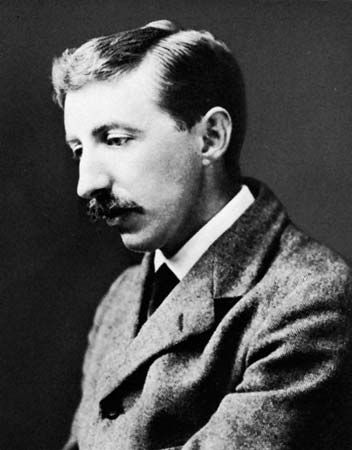
E. M. Forster
English authorWikipedia
58
MENTIONS
6
EPISODES
6
PODCASTS
Search complete. 58 mentions across 6 episodes found for "E. M. Forster".
Oct 6, 2026

speaker_2ADVERTISER
Discover it all in Nordstrom stores and at nordstrom.com.
Andy MillerHOST
Hi, it's E.M. Forster.
John MitchinsonHOST
Hi, it's John.
Nikki BirchPANELIST
[laughs]
Andy MillerHOST
... to a rerun of...
Andy MillerHOST
We're, we're giddy today.
Andy MillerHOST
It's not really, uh, E.M. Forster and Iain Banks, it's me, Andy, and...
John MitchinsonHOST
Uh, Nikki.

Myq KaplanGUEST
Yeah, Don Corleone, he's a good guy, right? [upbeat music]
Randy CohenHOST
"How do I know what I think until I see what I say?" is attributed to EM Forster.
Taylor AshtonSOUNDBITE_SPEAKER
The rail gonna love this Friday night.
Randy CohenHOST
This episode of Person Place Thing was produced with Little Field and distributed by WAMC Northeast Public Radio.

Blake LefrayGUEST
This on beauty is...
Blake LefrayGUEST
She's taking the premise or like a central premise from the EM Forster novel, uh, Howard's end.
Blake LefrayGUEST
And she's taking kind of a plot device from that and then building this book on top of it.
Blake LefrayGUEST
Uh, It's the story of a family in a fictionalized Cambridge, Massachusetts, where the professor dad is a professor at like a fictionalized Harvard daughter attends.

Meg RosenthalHOST
I read this book in college.
Meg RosenthalHOST
It is called Aspects of the Novel by E.M. Forrester.
Meg RosenthalHOST
I did look at the front and it was published in 1920s.
Meg RosenthalHOST
So it's a little bit obviously dated.

Keith HoctonHOST
So this mix of a group got on extremely well.
Keith HoctonHOST
Other members were E.M. Forster, the novelist who was known for his works like A Passage to India and Howard's End.
Keith HoctonHOST
He was actually very closely associated with the group and, of course, shared their liberal and humanistic values.
Keith HoctonHOST
But he was very much on the fringes.
13 MINS LATER
Keith HoctonHOST
And of course, time's moved on.
Keith HoctonHOST
So who's still a part of this group then? So at this stage, the group includes still Virginia Woolf, Leonard Woolf, whom she married, E.M.
Keith HoctonHOST
Forster, Lytton Strachey, Vanessa Bell, Clive Bell, John Maynard Keynes, Roger Fry, Desmond McCarthy, and Saxon Sidney Turner.
Keith HoctonHOST
And on the fringes of the group, people who might attend every once in a while were incredible personalities like Vita Sackville-West and Harold Nicholson and Adrian Stephen and Adrian Stephen, the younger brother of Virginia and Vanessa.

Paul BloomfieldHOST
raise the issue and one is likely to hear very quickly repeated Samuel Johnson's famous barb that patriotism is the last refuge of a scoundrel.
Paul BloomfieldHOST
Or you might even hear, if the person's read a little bit more, E.M. Forster's famous statement that if he had to choose whether to betray his friend or his country that he, Forster, wished he had the courage to betray his country.
Paul BloomfieldHOST
Forster, the famous English novelist, author of Howard's End and other important books, Forster presents the choice between friendship over country, of private over public goods, as a kind of tragic and even noble decision that one has to make.
Paul BloomfieldHOST
But Forster, in some respect, has given us, I would suggest, a false dilemma.
Paul BloomfieldHOST
Loyalty is a moral habit just as betrayal is a moral vice.
Paul BloomfieldHOST
People who practice one are less likely to indulge in the other.
Paul BloomfieldHOST
Consider the following example.
Paul BloomfieldHOST
A few years after Forster made his statement at Cambridge, three young Cambridge undergraduates in the 1930s by the names of Kim Philby, Donald Maclean and Guy Burgess.