Dunbar's number
19
MENTIONS
6
EPISODES
6
PODCASTS
Search complete. 19 mentions across 6 episodes found for "Dunbar's number".
Oct 8, 2026

Sarah WilsonGUEST
You need between 100 and 150 people to k-keep a community going at a level where you're gonna have security, food systems, water systems that are gonna actually sustain and keep a, keep a family, an extended family alive.
Sarah WilsonGUEST
That also happens to be the Dunbar number.
Sarah WilsonGUEST
You know, many of you would be familiar with the Dunbar number.
Sarah WilsonGUEST
The Dunbar number is the number of people that we can kind of keep in our orbit.
Jon AlexanderHOST
You can keep track of, yeah.
Sarah WilsonGUEST
Right? It's also, I found out the other day, um, from doing a, a presentation to Meg Wheatley's-

Dark EnlightenmentGUEST
Please do
Pete QuiñonesHOST
... start pr- start approaching Dunbar's number, and I mean, you can have your own finance.
Pete QuiñonesHOST
You can have your own banking.
Dark EnlightenmentGUEST
Yes.
Dark EnlightenmentGUEST
And this is why that laptop job is so important, right? 'Cause then you can have that, you know, that source of capital from outside that comes in, in substantial numbers, to circulate internally.
Dark EnlightenmentGUEST
And once that money comes in, it shouldn't go back out again.
Dark EnlightenmentGUEST
So is the HVAC guy gonna make as much as the laptop guy? Probably not, but what he can do is he can do all the HVAC for all the different guys who are working the laptop jobs, and he can make a decent living, you know, maybe doing HVAC, and then maybe a little plumbing or what have you, within this, you know, Dunbar's Number community.
Dark EnlightenmentGUEST
And maybe there's a guy who's the farmer who has, you know, 20 head of cattle, and every year, you know, like, everyone just gets their cattle from that guy.

Dark EnlightenmentPANELIST
Please do
Pete QuiñonesHOST
... approaching, start pr- start approaching Dunbar's number.
Pete QuiñonesHOST
And I mean, you can have your own finance.
Pete QuiñonesHOST
You can have your own banking.
Dark EnlightenmentPANELIST
And once that money comes in, it shouldn't go back out again.
Dark EnlightenmentPANELIST
So, is the HVAC guy gonna make as much as the- A laptop guy? Probably not.
Dark EnlightenmentPANELIST
But what he can do is he can do all the HVAC for all the different guys who are working the laptop jobs, and he can make a decent living, you know, maybe doing HVAC and then maybe a little plumbing or what have you within this, you know, Dunbar's Number community.
Dark EnlightenmentPANELIST
And maybe there's a guy who's the farmer who has, you know, 20 head of cattle, and every year, you know, like everyone just gets their cattle from that guy.

Chris BurcherHOST
Don't, you know, stay in line to sort of discourage that sort of behavior.
Chris BurcherHOST
Anyway, all that for that first half of this episode to say There's a guy named Robin Dunbar, I think he was an archaeologist or anthropologist in the 90s, came up with what was now commonly referred to as Dunbar's number that said after a village size or like a city state, if you will, or civilization or town size of 150 individuals, mechanisms like shame and shutting for regulating behavior broke down because you could no longer know everybody.
Chris BurcherHOST
There was anonymity.
Chris BurcherHOST
People, you know, supposedly, supposedly this is how Dunbar and others think this works, is that if we think we can get away with something, then we'll do it.
Chris BurcherHOST
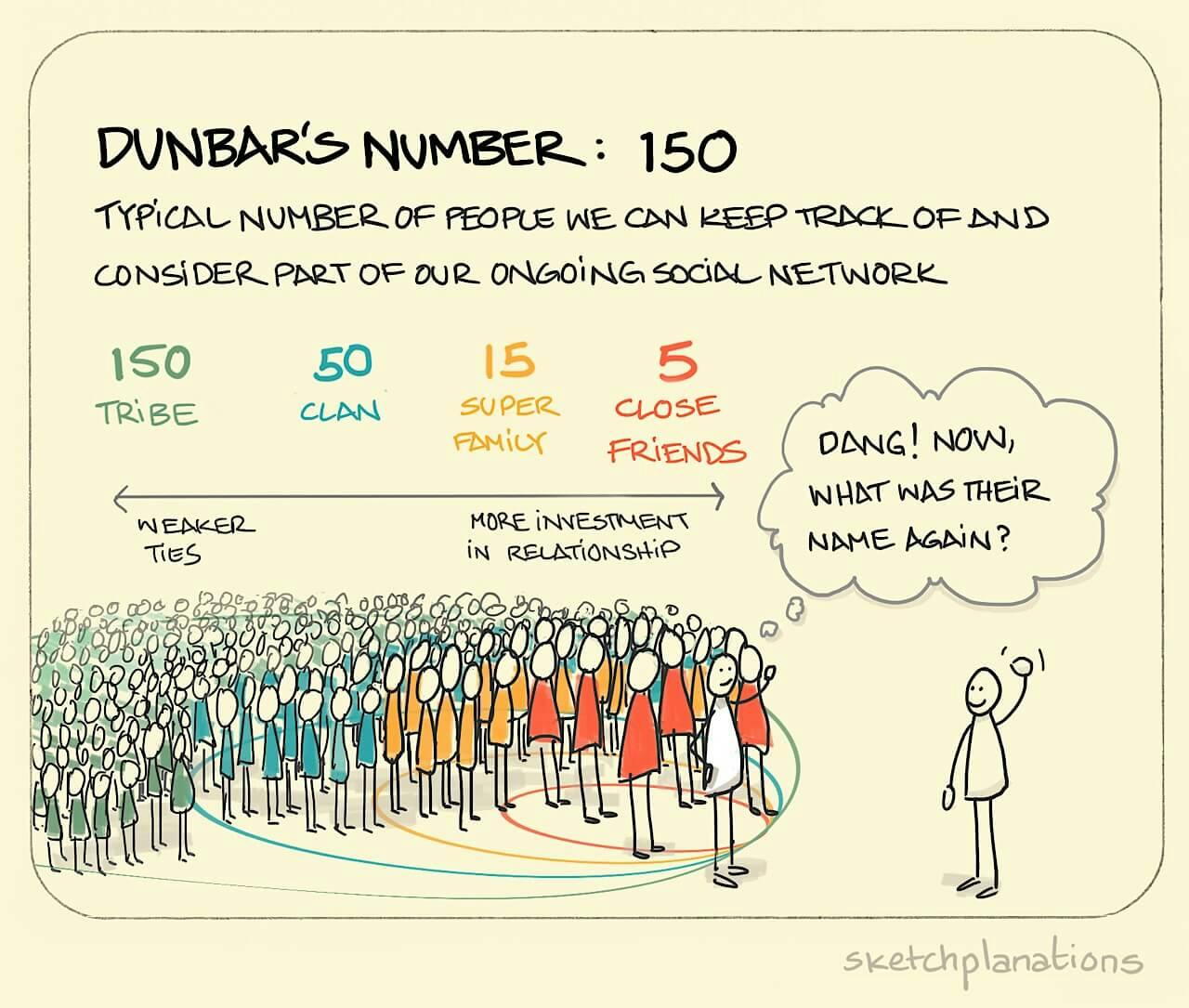
Government and other societal structures, villages, you know, you think about like a family, an individual, a family, a group, a tribe, a clan.
Chris BurcherHOST
You know, as you get sort of increasingly larger and add more members, it gets more complicated.
Chris BurcherHOST
But as we moved from these groupings of 50 to 150 into like the 1,000, 10,000 range, I think we, our ancestors, knew Dunbar's number was going to take effect.
Chris BurcherHOST
And therefore we had to develop these sort of constructs, these systems like governments, like democracies or whatever to compensate.

Paul Louis ColeHOST
Oh, yeah.
Mark MatlockGUEST
Have you ever heard of Dunbar's number?
Paul Louis ColeHOST
Yeah, 149.
Mark MatlockGUEST
Yeah.
Paul Louis ColeHOST
Yeah.
Mark MatlockGUEST
This is something we never talk about in evangelism.
Mark MatlockGUEST
We always want people to go out and evangelize the world, but the, the reality is if you think, if Dunbar's number's real-
Paul Louis ColeHOST
Right

Oliver ParsonsGUEST
Dr. Robert Dunbar from Oxford University is best known for his exploration of human relationships, and specifically the kind of limits and layers of relationships we have.
Oliver ParsonsGUEST
His work is often summarized as Dunbar's Number because he argued that our relationships can be categorized by group size and a depth of vulnerability or intimacy with each group.
Oliver ParsonsGUEST
And he argued that our closest, most intimate friends and relationships, the very s- closest inner circle of our lives, are typically one to five people max, people that you can share deeply, vulnerably with.
Oliver ParsonsGUEST
The next circle would be our close friends, people who you kind of share life with more broadly.
14 MINS LATER
Oliver ParsonsGUEST
That's just the world we live in.
Oliver ParsonsGUEST
You can belong to a, a church community at large and not be known at all.
Oliver ParsonsGUEST
Interestingly enough, the researcher Jeffrey Hall from the University of Kansas did a study in 2018 based on Dunbar's numbers and his circles of friends that he titled, and I love...
Oliver ParsonsGUEST
This is an academic, um, research paper called How Many Hours Does It Take to Make a Friend? [laughs] He wanted to know, given these circles of relationships, how do we move into these smaller circles? What does it take, what does it require to get closer and closer? And here's what he found.