Dred Scott v. Sandford
Court caseWikipedia
70
MENTIONS
26
EPISODES
24
PODCASTS
Search complete. 70 mentions across 26 episodes found for "Dred Scott v. Sandford".
Nov 1, 2026

Mark LevinGUEST
It's not only an independent body, which it should be, but it is supreme in the sense that it rules supreme over the entirety of society.
Mark LevinGUEST
So if the court puts out a bad decision in Dred Scott or Plessy or Korematsu or Roe v.
Mark LevinGUEST
Wade or on a same-sex marriage or whatever, whether
Michael BerryHOST
you

Julie C. SukGUEST
In Austria, for example, Hans Kelsen, the legal philosopher, and many of his predecessors, they were looking at the United States, actually.
Julie C. SukGUEST
They were looking at Dred Scott, which was a decision that basically said that Black people who had, because they were descended from slaves in the United States, could never actually become citizens of the United States.
Julie C. SukGUEST
And that led to the Civil War and 14th Amendment overruling all of that.
Julie C. SukGUEST
But Dred Scott and even decisions after the Civil War in which the Supreme Court protected property rights so strongly that it basically was striking down any labor legislation.
Julie C. SukGUEST
Property and contract rights were protected so that labor legislation became unconstitutional during what was known as the Lochner era.
Julie C. SukGUEST
And to a lot of legal philosophers in The European context, these decisions showed the dangers of judicial review.

SarahHOST
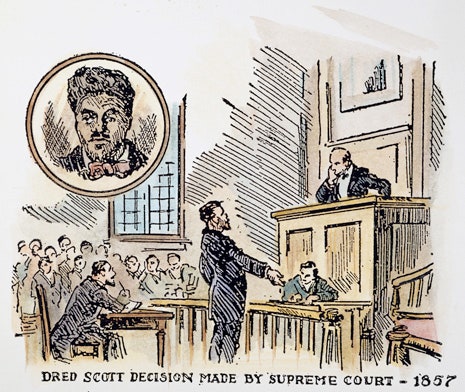
Then, in 1857, the Supreme Court made a decision that pushed the country even deeper into conflict.
SarahHOST
That case was Dred Scott v. Stanford.
SarahHOST
Dred Scott was an enslaved man who sued for his freedom after living in places where slavery was prohibited.
SarahHOST
But the Supreme Court ruled against him.
SarahHOST
Even worse, the court declared that black Americans descended from enslaved people could not be citizens of the United States under the Constitution.
7 MINS LATER
SarahHOST
States cannot simply decide that an entire group of people born in the United States do not belong to the nation.
SarahHOST
The clause established birthright citizenship for people born in the United States and subject to its jurisdiction with limited exceptions.
SarahHOST
Most importantly, in the context of Reconstruction, it rejected the central citizenship ruling in Dred Scott.

Leeja MillerHOST
And this idea goes along with the concept of originalism as a psyop, which I discussed in a recent video.
Leeja MillerHOST
Originalism is based on a cherry-picking of history and is inherently anti-democratic, because why are we allowing old white racist misogynists from 250 years ago dictate how we should run our country in the year of our lord, 2026? Should it not be up to the people currently alive and actively making up the electorate to determine how to interpret our guiding text? And the reason Frederick Douglass was talking about this is because the first true exercise of the newly established judicial supremacy of the Supreme Court wasn't until the 1857 Dred Scott decision.
Leeja MillerHOST
Not off to a great start.
Leeja MillerHOST
In that opinion, the Supreme Court gutted a law passed by Congress and signed into law by the president, so approved by the other two branches, that banned slavery in the new territories.

Scott KestersonHOST
when the promise that, quote, all men are created equal was questioned when it involved black Americans, especially black Americans with guns near the end of the Civil War.
Scott KestersonHOST
From there, we have to follow the case with Dred Scott and the black codes, and then we have to move to Colfax Massacre and the Cruikshank Ruling.
Scott KestersonHOST
ultimately arriving at the Supreme Court's decision in 2022, which is the Bruin Test.
Scott KestersonHOST
And under that test, the laws that once disarmed slaves are now being cited as precedent.
10 MINS LATER
Scott KestersonHOST
In 1873, the court shut that door too.
Scott KestersonHOST
And we'll get to that.
Scott KestersonHOST
So 1857, Dred Scott versus Sanford.
Scott KestersonHOST
And this is where they narrowed the declaration.

Aaron McCallHOST
Reconstructionist Democrats fought to not have him seated as a senator, claiming that he was only a carpetbagger.
Aaron McCallHOST
And on top of that, he wasn't even eligible to become a senator because, according to the Supreme Court, the Dred Scott decision of 1857 said that Black Americans could not be citizens of regardless of if they were born in America.
Aaron McCallHOST
And so technically, Revels would have only been a citizen for three years and not the required five years in order to be a senator.
Aaron McCallHOST
This challenge would fail, and Hiram Revels would be seated as the first Black senator of the United States.

GregHOST
Wasn't he an ESPN too? He was an ESPN anchor.
Keith OlbermannSOUNDBITE_SPEAKER
Today, the Supreme Court of Chief Justice John Roberts, in a decision that might actually have more dire implications than Dred Scott v. Sanford, declared that because of the alchemy of its 19th century predecessors in deciding that corporations had all the rights of people, any restrictions on how these corporate beings spend their money on political advertising are unconstitutional.
Keith OlbermannSOUNDBITE_SPEAKER
In short, the First Amendment, free speech for persons, which went into effect in 1791, applies to corporations, which were not recognized as the equivalents of persons until 1886.
Keith OlbermannSOUNDBITE_SPEAKER
In short, there are now no checks on the ability of corporations or unions or other giant aggregations of power to decide our elections.

Kevin SwansonHOST
But the federal government and Supreme Court often treated these states' protections as interference with federal fugitive slave enforcement.
Kevin SwansonHOST
At the end of the day, free states had very little power to insist on freedom for slaves brought into their states, as in the case of the Dred Scott decision of 1857.
Kevin SwansonHOST
Okay, so that's history on the slavery issue, and it turned out that the federal government actually did very little to stand by the free states.
Bill JackGUEST
Right.

Clint SmithHOST
For Black people in the nineteenth century, the question of whether they were or could ever be citizens of the United States was part of a decade-long court battle that centered on the circumstances of a Black man named Dred Scott.
Clint SmithHOST
Though Scott's case, which ultimately ended up in the Supreme Court as Scott v. Sanford, was initially about whether one man would be able to live his life as free or enslaved, it became something much larger, centered on the very prospect and possibility of Black citizenship.
Clint SmithHOST
Let's check it out.
Clint SmithHOST
[rock music] The person at the center of this case, Dred Scott, was an enslaved Black man who was living in Missouri.
6 MINS LATER
Clint SmithHOST
This decision created a new legal precedent that solidified Black Americans' status as an underclass.
Clint SmithHOST
It kept them from being able to vote, from being able to defend themselves against explicit discrimination, or even domestic terrorism at the hands of white Americans.
Clint SmithHOST
Black Americans were sometimes successful in court after Scott v. Sanford, but that wasn't the norm, and Black people were now legally barred from filing suits at the federal level.
Clint SmithHOST
What this did was limit the mobility of their cases.
16 more episodes mention Dred Scott v. Sandford.
Create an account to see the whole feed, search across every transcript, and follow the entities you care about.