Dragonfly
Space missionWikipedia
53
MENTIONS
13
EPISODES
12
PODCASTS
Search complete. 53 mentions across 13 episodes found for "Dragonfly".
Oct 12, 2026

speaker_3NARRATOR
And the next visitor is being built now.
speaker_3NARRATOR
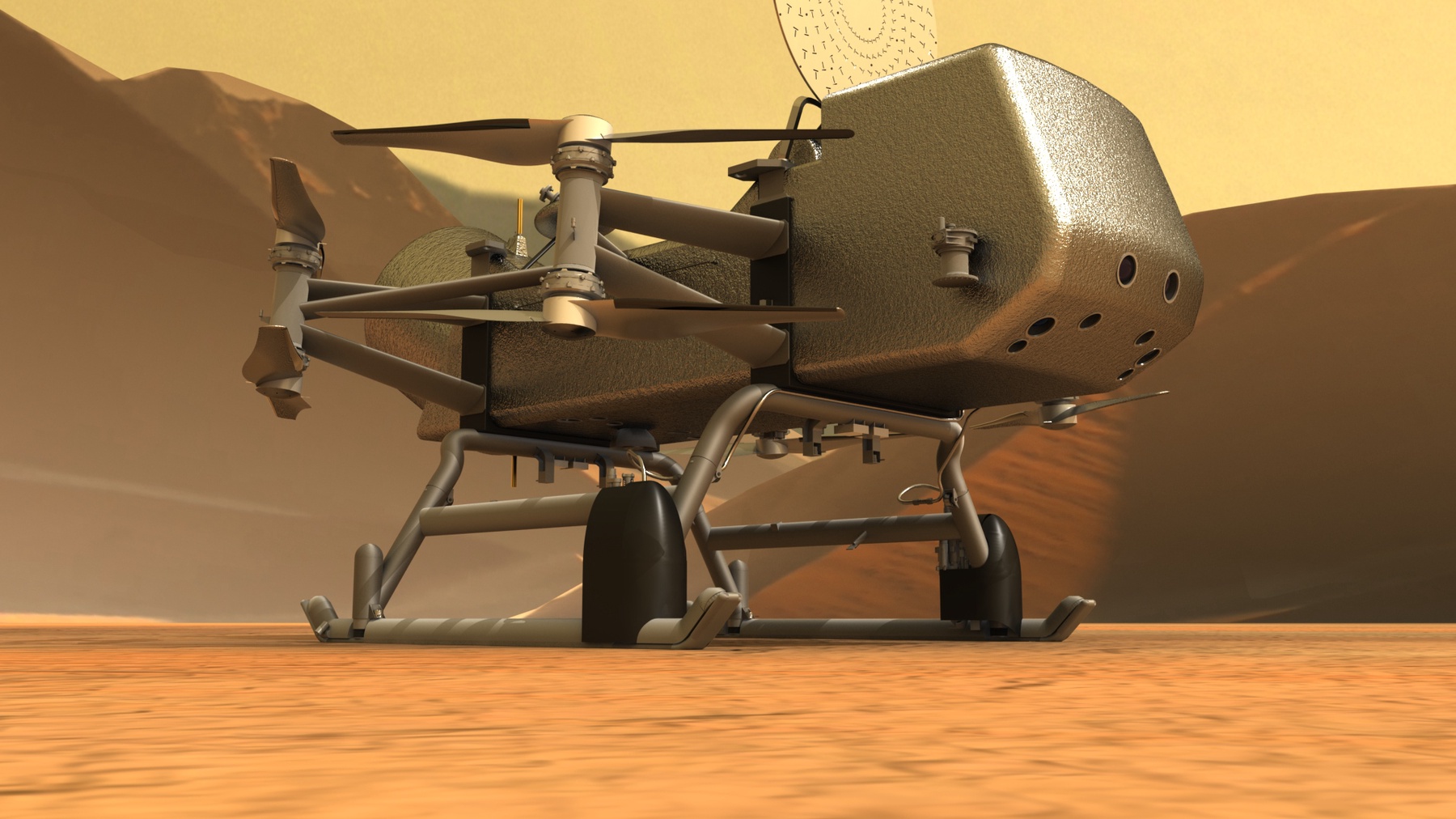
NASA's Dragonfly, a flying robot with eight rotors, is due to launch in 2028 and to arrive in the mid-2030s, hopping from place to place across Titan.
speaker_3NARRATOR
So, tonight, on Titan, under an orange sky, a slow methane drizzle may be falling softly onto a quiet shore.
speaker_3NARRATOR
Beyond Saturn, the Sun is far away, and the planets are cold and blue.

Stuart GaryHOST
Coming up on Space Time...
Stuart GaryHOST
NASA names Dragonfly's landing site on the Saturnian moon Titan, new clues about the Earth's moon's ancient magnetic field, and why galaxies in the early universe look so weird.
Stuart GaryHOST
All that and more coming up on Space Time.
Alex Zaharov-ReuttCORRESPONDENT
Welcome to Space Time with Stuart Gary.
Stuart GaryHOST
NASA has identified the landing site where its Dragonfly rotorcopter will first touch down on the surface of the Saturnian moon Titan.
Stuart GaryHOST
The target area comprises a large dune field with some inter-dune terrain south of Silic Crater and stretches along the edge of a range of mountains or hills.
Stuart GaryHOST
The International Astronomical Union, the global body responsible for officially designating objects in space, has approved naming the region Amakik Undae.
Stuart GaryHOST
The name literally translates into the one who locks up the wind.

Stuart GaryHOST
This is Space Time, series 29, episode 117, for broadcast on the 30th of September, 2026.
Stuart GaryHOST
Coming up on Space Time, NASA names Dragonfly's landing site on the Saturnian moon Titan, new clues about the Earth's moon's ancient magnetic field, and why galaxies in the early universe look so weird.
Stuart GaryHOST
All that and more coming up on Space Time.
Alex Zaharov-ReuttGUEST
Welcome to Space Time with Stuart Gary.
Stuart GaryHOST
NASA has identified the landing site where its Dragonfly rotorcopter will first touch down on the surface of the Saturnian moon Titan.
Stuart GaryHOST
The target area comprises a large dune field with some inter-dune terrain south of Silic Crater and stretches along the edge of a range of mountains or hills.
Stuart GaryHOST
The International Astronomical Union, the global body responsible for officially designating objects in space, has approved naming the region Amakik Unde.
Stuart GaryHOST
The name literally translates into the one who locks up the wind.

Ben BrambleGUEST
Well, it's all the sort of things that w- that Alice and I have been talking about, um, the scientific missions.
Ben BrambleGUEST
You know, this wonderful, um, clipper mission to, uh, Europa in, in, and, um, the, the Dragonfly mission, um, to, to Saturn's moon, Titan.
Ben BrambleGUEST
I mean, to learn more about these.
Ben BrambleGUEST
These places are so beautiful, so fascinating, so alien.

Seven RasmussenGUEST
What I'm most excited about is the Titan Dragonfly mission.
Seven RasmussenGUEST
Um, I'm very optimistic that we will find evidence of something on Titan, perhaps microbial life as we see it here on Earth, or perhaps some kind of rudimentary thing that is the methane, ethane equivalent of, uh, of microbial life.
Seven RasmussenGUEST
That's what I'm most excited about, honestly, is the mission to Titan, because I do believe that that is the most promising environment for us to discover life elsewhere, even just in our solar system.
36 MINS LATER
Seven RasmussenGUEST
And what we need to do is get a Martian sample return going so that we can really figure out whether those are fossil structures or some kind of geological phenomenon that we just aren't aware of yet.
Seven RasmussenGUEST
So I w- do believe that once we get Martian, once we get Martian sample return, we, I believe that we will find evidence of past microbial life on Mars.
Seven RasmussenGUEST
What I'm most excited about is the Titan Dragonfly mission.
Seven RasmussenGUEST
Um, I'm very optimistic that we will find evidence of something on Titan, perhaps microbial life as we see it here on Earth, or perhaps some kind of rudimentary thing that is the methane/ethane equivalent of, uh, of microbial life.
Seven RasmussenGUEST
That's what I'm most excited about, honestly, is the mission to Titan, because I do believe that that is the most promising environment for us to discover life elsewhere, even just in our solar system, and that's in the next 10 years, I think.

Daniel DrewGUEST
So I'll have a lot of balloons in my lab with ion thrusters strapped to them.
Sarah Al-AhmedHOST
Have you considered collaborating with Johns Hopkins Applied Physics Lab, who built a Titan chamber, essentially, for the Dragonfly mission that's upcoming?
Daniel DrewGUEST
Yeah, I think that was in use and expensive with the NIAC phase one budgets, but that's something that we would pitch.
Daniel DrewGUEST
I mean, phase two, we're not going to be able to reach 94 Kelvin for the test chamber in phase one.
Daniel DrewGUEST
And that's 2028, so the timing might line up well.
Sarah Al-AhmedHOST
That would be really exciting.
Sarah Al-AhmedHOST
I mean, it wasn't even in my brain that you could potentially try to work with the Dragonfly team on this.
Sarah Al-AhmedHOST
It would be so cool to have a pairing of something like that with Dragonfly, the way that we had ingenuity with Perseverance.

Alex McColganHOST
Two other proposed missions will explore Saturn's moons in new ways.
Alex McColganHOST
The Dragonfly mission to Titan will take advantage of the thick nitrogen atmosphere and use a drone for the first time on a natural satellite.
Alex McColganHOST
Outside of the national space agencies, a privately funded mission called Breakthrough Enceladus is also planned, though currently this project appears to be dormant.
Alex McColganHOST
But the mission I'm most excited about is the Enceladus Explorer, a project funded by the German Aerospace Center that proposes to send a nuclear ice mole, yes, you heard that correctly, to melt its way deep into the crust and expose untouched niches within the ice to search for life.
25 MINS LATER
Alex McColganHOST
There have been plenty of mission proposals in the past, but all of them were canceled before they came to fruition.
Alex McColganHOST
What would be incredible is a probe that could either make its way into Enceladus' ocean somehow, or at the very least, search the plumes for signs of life.
Alex McColganHOST
There is already a mission called Dragonfly going to the nearby moon of Titan.
Alex McColganHOST
However, this won't have anything to do with Enceladus.

Pamela GayHOST
Unfortunately, it does not currently have any new missions at it.
Pamela GayHOST
It will eventually get Dragonfly.
Pamela GayHOST
So it's going to be a while before we can get satellite images of this particular wonderful geometric shape.
Pamela GayHOST
But there is other spacecraft out there that we've been paying attention to.

Daniel DrewGUEST
It's great.
Daniel DrewGUEST
Propellers, like on Dragonfly, function about maybe 40 times more efficiently on Titan, just based on the atmospheric density.
Daniel DrewGUEST
But the caves themselves are small, potentially, and tortuous.
Daniel DrewGUEST
And we think that these ion thrusters, that this is propelled by these atmospheric ion thrusters, which have been like the bulk of my research for many years now, should function well.
19 MINS LATER
Daniel DrewGUEST
And in phase one, hopefully the bench level experiments will just say like, yes, we understand how temperature and gas composition affect performance of these thrusters.
Daniel DrewGUEST
And it's as we predicted.
Daniel DrewGUEST
And then in phase two, which is a larger, longer vehicle, we would, ideally, Dragonfly is already gone, and we can maybe use the Dragonfly test chamber.
Daniel DrewGUEST
Hopkins,

Nicola FoxGUEST
We've sent Europa Clipper out to study the moon Europa, which we know has a giant ocean underneath this incredibly thick ice crust.
Nicola FoxGUEST
We'll send Dragonfly to Titan to a moon of Saturn.
Nicola FoxGUEST
to study there.
Nicola FoxGUEST
We know there's a lot of organic chemicals there.
3 more episodes mention Dragonfly.
Create an account to see the whole feed, search across every transcript, and follow the entities you care about.