Drag reduction system
23
MENTIONS
8
EPISODES
7
PODCASTS
Search complete. 23 mentions across 8 episodes found for "Drag reduction system".
Sep 22, 2026

DickHOST
And oh, by the way, while they're doing all this, The drivers are sitting there racing against each other, trying to pass each other or defend against the pass.
DickHOST
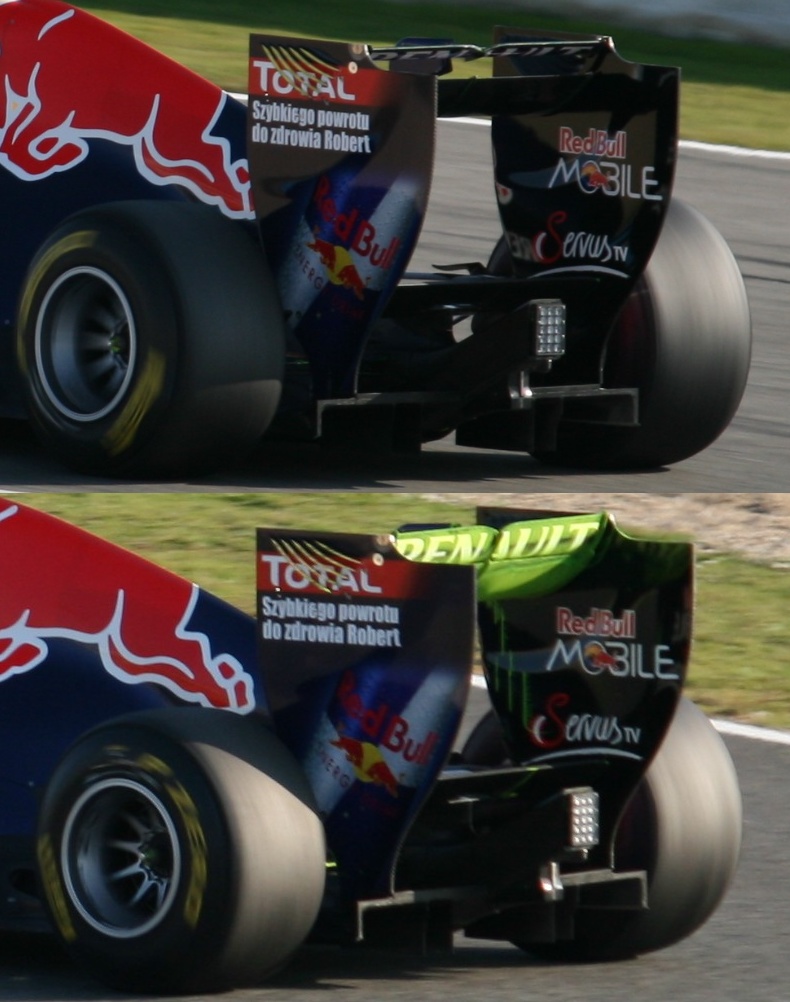
There's this thing called the DRS, which is called the drag reduction system.
DickHOST
Basically what that does is that it flattens out the top element of the rear wing and reduces drag very significantly to allow a car that is within a second of the car in front of it to flatten out that rear wing and go much faster to a straight line to aid then in making a pass down a long straightaway.
DickHOST
So there's certain designated areas where you can open that DRS system up.
DickHOST
And so the drivers, the moment they get into that DRS zone, as they call it, they they pop open the rear wing and line down the straightaway.
SabrinaHOST
So how is that related to slipstream?
DickHOST
Slipstream is basically where the car in front of another car is basically punching a hole in the air and it's creating a vacuum behind it.

Gary AndersonGUEST
You know, we talk about this probably needing a car that's one and a half seconds to two seconds a lap faster to overtake somebody.
Gary AndersonGUEST
I don't know where that number comes from, but all I know is that, you know, with what we have now, with being able to use the extra power or as it was DRS in the past, you had to be within one second of the car in front of you.
Gary AndersonGUEST
By the time you get to one second of the car in front of you, you're destroying your tires.
Gary AndersonGUEST
That's the problem.
35 MINS LATER
Gary AndersonGUEST
It's, um, it's a, a nice short question compared to our last one.
Gary AndersonGUEST
But, um, yeah, the...
Gary AndersonGUEST
If you imagine the, the conventional design, in other words, the, the DRS solution as such that, that the majority of teams started the season with, um, when, when the, the flaps open up as they do on, you know, as I say, quite a few of the cars in the normal stance, that flap arrangement, those two flaps opening up, still generates a flow, a turning flow that gives you some downforce on it.
Gary AndersonGUEST
And what we've always talked about is the wings talking to each other, whenever the, the main wing talks to a beam wing or back in the days whenever we used to have a little mid wing in there.

Cleo AbramHOST
Yahoo! You can actually hear this in a race.
Cleo AbramHOST
Listen for DRS here.
speaker_0SOUNDBITE_SPEAKER
Now, Charles Leclerc is gonna have DRS to try and fight it back.
Cleo AbramHOST
Taken together, an F1 car is just a symphony of aerodynamics.
Cleo AbramHOST
[upbeat music]I actually got to see them up close and personal when I was in Miami.
Edd StrawHOST
The fact that this movable aero stuff is such a significant thing now since it's come back into Formula One, it's quite interesting to imagine what would have happened if it stayed legal, because it was outlawed basically a few years before you started in Formula One in 1973.
Edd StrawHOST
And there'd have been a lot of things learned, wouldn't there, in terms of movable aero and legal flexible arrow you could argue over the years I also feel that would have come at the risk of well the certainty of probably quite a lot of dreadful accidents so it was probably inevitable it was going to get banned but it's an example of how the regulation in Formula One has left some areas untapped hasn't it because although going as far back as 2009, we had a bit of movable aero with that front wing flap adjustment that you could do a couple of times a lap, and then DRS.
Edd StrawHOST
It's never been a kind of full-blown fact of life in Formula 1, has it?
Gary AndersonGUEST
It's never been a full-blown fact.

Jolyon PalmerGUEST
With active aero, you've kind of got the best of both worlds now.
Jolyon PalmerGUEST
You hit the straight mode and you press your active aero and you have DRS open effectively, but it's active aero now.
Jolyon PalmerGUEST
So you've got the low downforce on the straights, your front wing, your rear wing both open, but then they shut when you hit the corners.
Jolyon PalmerGUEST
So having... that downforce trade-off isn't quite as big as it used to be forever because you kind of now with with f1 are getting getting it all the time low downforce in the straights high downforce in the corners which is perfect
Christian HewgillHOST
kathy pause we'll come back to you because i want to go to dave in canada who is fascinated by something you've just mentioned in your previous answer joely an active aero let's just pop back to that a second because we should mention it's a big feature of the new formula one cars in 2026 Just, you touched upon this, Julian, but to go into a bit more detail, explain what Active Aero is and how its use varies between high and low speed areas of a track.
Jolyon PalmerGUEST
So Active Aero is just some, it's a, right, what it does is it opens up the rear wing.
Jolyon PalmerGUEST
In the rear, it's more or less like DRS.
Jolyon PalmerGUEST
The difference is it's not mandated to be the centre gap opening, which was always the slot opening like we've seen for the last, I've lost track of how many years we've had DRS, 15 years or something before it.

Ed StrawHOST
I also feel that would have come at the risk of, well, the certainty of probably quite a lot of dreadful accidents, so it was probably inevitable it was going to get banned.
Ed StrawHOST
But it's an example of how the regulation in Formula 1 has left some areas untapped, hasn't it? Because Although going as far back as 2009, we had a bit of movable aero with that front wing flap adjustment that you could do a couple of times a lap and then DRS.
Ed StrawHOST
It's never been a kind of full blown fact of life in Formula One, has it?
Gary AndersonHOST
It's never been a full-blown fact.

Danny O'DwyerHOST
And then that overtake button, the activation is at the exit of the turn.
Danny O'DwyerHOST
So no DRS, obviously, in the traditional sense.
Danny O'DwyerHOST
But we'll see how the cars fare.
Danny O'DwyerHOST
I'm interested in the weather because this is, it's not a track I feel like this time of year when it gets laid out is particularly crazy hot.
Rob ZacnyHOST
Sure, that works.
Drew ScanlonHOST
All right, Rob, shall we kick it off?
Rob ZacnyHOST
All right, Mark writes, is F1 too proud slash stubborn to accept that push to pass is a much more fun system than DRS and whatever the hell the season is calling it? Oh, boy.
Rob ZacnyHOST
Love the podcast.

speaker_2HOST
distributing it between four temperature-sensitive tires, and keeping it predictable while the vehicle moves through a constantly changing three-dimensional flow field.
speaker_2HOST
DRS and Active Aerodynamics Movable surfaces trade load for lower drag only under tightly controlled conditions because a mistimed change can upset vehicle balance.
speaker_2HOST
DRS and Active Aerodynamics Movable surfaces trade load for lower drag only under tightly controlled conditions because a mistimed change can upset vehicle balance.
speaker_2HOST
At racing speed, the body is not merely passing through air.
speaker_2HOST
It is manufacturing a pressure field that becomes part of the suspension system.