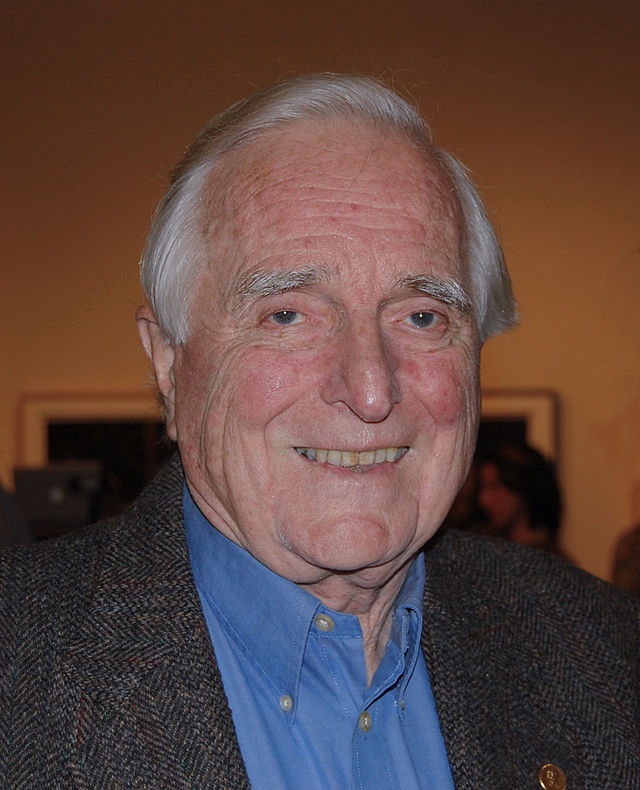
Douglas Engelbart
American engineer and inventorWikipedia
18
MENTIONS
7
EPISODES
7
PODCASTS
Search complete. 18 mentions across 7 episodes found for "Douglas Engelbart".
Sep 4, 2026

Walter IsaacsonGUEST
This is not the way the personal computer revolution was.
Walter IsaacsonGUEST
Personal computer revolution, Steve Jobs, Doug Engelbart, it linked us to our computers so that our computers became a tool.
Walter IsaacsonGUEST
I think what you're seeing with the AI revolution is they're creating agents that are starting to frighten all of us, and that makes the backlash against not only data centers but AI.
Scott WapnerHOST
Walter, appreciate it as always.

GephardtHOST
[upbeat music] I want to leave you today with a thought from someone who was thinking about this problem long before we had anything resembling modern AI.
GephardtHOST
Douglas Engelbart, one of the pioneers of interactive computing, wrote in 1962 about creating a system in which hunches cut and try intangibles and the human feel for a situation usefully coexist with powerful electronic tools That, in a rather beautiful way, gets to the he point was never to make the human disappear.
GephardtHOST
It was to build a system in which the things humans are good at and the things machines are good at reinforce each other.
GephardtHOST
And perhaps that is still the more interesting question about AI.

speaker_5SOUNDBITE_SPEAKER
Etoys was the basis of early work on Scratch
John MarkoffMODERATOR
So I, I wanted to bring a little bit of context here, um, to this question of education and Smalltalk because, you know, Alan as a graduate student, um, received a visit from Doug Engelbart.
John MarkoffMODERATOR
Engelbart was working on this system called The Online System in, uh, 19-- in 1967.
John MarkoffMODERATOR
And Engelbart had a view of, um, a metaphor for computing, which was based on the car.
John MarkoffMODERATOR
I mean, it was a radical break from IBM, which was railroads.
John MarkoffMODERATOR
Um, Engelbart saw a computer as, uh, an automotive kind of metaphor where you drove through cyberspace.
John MarkoffMODERATOR
And I think one of the most important contributions that Alan made is he actually understood that computing was gonna be a medium, a media, and it was gonna be a universal media.
John MarkoffMODERATOR
And, um, he wrote in an early history of, uh ...

Matthew CrawfordGUEST
And I, I don't know if that's a name you're familiar with, um, but he had connections with military and intelligence, um, and he worked, uh, with Hal Puthoff, who also had connections to military intelligence.
Matthew CrawfordGUEST
And in the ARPANET program, you've got a guy named Douglas Engelbart, and Douglas Engelbart was involved with naval intelligence himself.
Matthew CrawfordGUEST
He was a, a Navy, um, uh, technical officer.
Matthew CrawfordGUEST
He's the guy who invented for submarines the tracking ball so that you could, you know, when you're underwater in a submarine and, and you need something that moves a dot around a screen, you know, having a tracking ball i- is, is a, you know, is better than having buttons and levers or, or something like that.
1 HR 30 MINS LATER
Matthew CrawfordGUEST
I, I don't believe this is true, but this is the story.
Matthew CrawfordGUEST
He invented the optical mouse while he was at MIT.
Matthew CrawfordGUEST
Oh, well, he just happened to be there at, at ARPANET with Douglas Engelbart, who invented the mouse.
Matthew CrawfordGUEST
And, you know, his interview, his interview about inventing the mouse, "Oh, I was just always inventing things and, and, uh, and this helped me invent things faster," or whatever.

Matthew CrawfordGUEST
And I, I don't know if that's a name you're familiar with, um, but he had connections with military and intelligence, um, and he worked, uh, with Hal Puthoff, who also had connections to military intelligence.
Matthew CrawfordGUEST
And in the ARPANET program, you've got a guy named Douglas Engelbart, and Douglas Engelbart was involved with naval intelligence himself.
Matthew CrawfordGUEST
He was a, a Navy, um, uh, technical officer.
Matthew CrawfordGUEST
He's the guy who invented for submarines the tracking ball so that you could, you know, when you're underwater in a submarine and, and you need something that moves a dot around a screen, you know, having a tracking ball is, is a, you know, is better than having buttons and levers or, or something like that.
1 HR 30 MINS LATER
Matthew CrawfordGUEST
I, I don't believe this is true, but this is the story.
Matthew CrawfordGUEST
He invented the optical mouse while he was at MIT.
Matthew CrawfordGUEST
Oh, well, he just happened to be there at, at ARPANET with Douglas Engelbart, who invented the mouse.
Matthew CrawfordGUEST
And, you know, his interview, his interview about inventing the mouse, "Oh, I was just always inventing things, and, and, uh, and this helped me invent things faster," or whatever.

Erik BrynjolfssonGUEST
But it requires a different architecture.
Erik BrynjolfssonGUEST
You know, Doug Engelbart years ago, you know, talked about how We should make machines that amplify humans.
Erik BrynjolfssonGUEST
Steve Jobs called it, you know, bicycles for the mind.
Erik BrynjolfssonGUEST
And that philosophy has kind of been lost out a little bit.

Jonathan McCoyHOST
What I think is really powerful is the multimodality inputs of these things and, you know, if we have augmented reality type of interfaces that can know what we're seeing, and the machine can see the same thing, they know what we're saying, the machine can talk with us, I think that creates new interface designs.
Jonathan McCoyHOST
You know, it like goes back to the mother of all demos with Doug Engelbart, this, this idea of the two-handed mouse and being more integrated with the human condition.
Jonathan McCoyHOST
I think the more multimodal experience and th- these user interfaces offer, like the more immersive the interfaces are gonna be.
Jonathan McCoyHOST
I'm really curious to see what OpenAI has in store for hardware, and I think you're gonna see the same thing from Meta, you know, with their coming from the glasses approach.