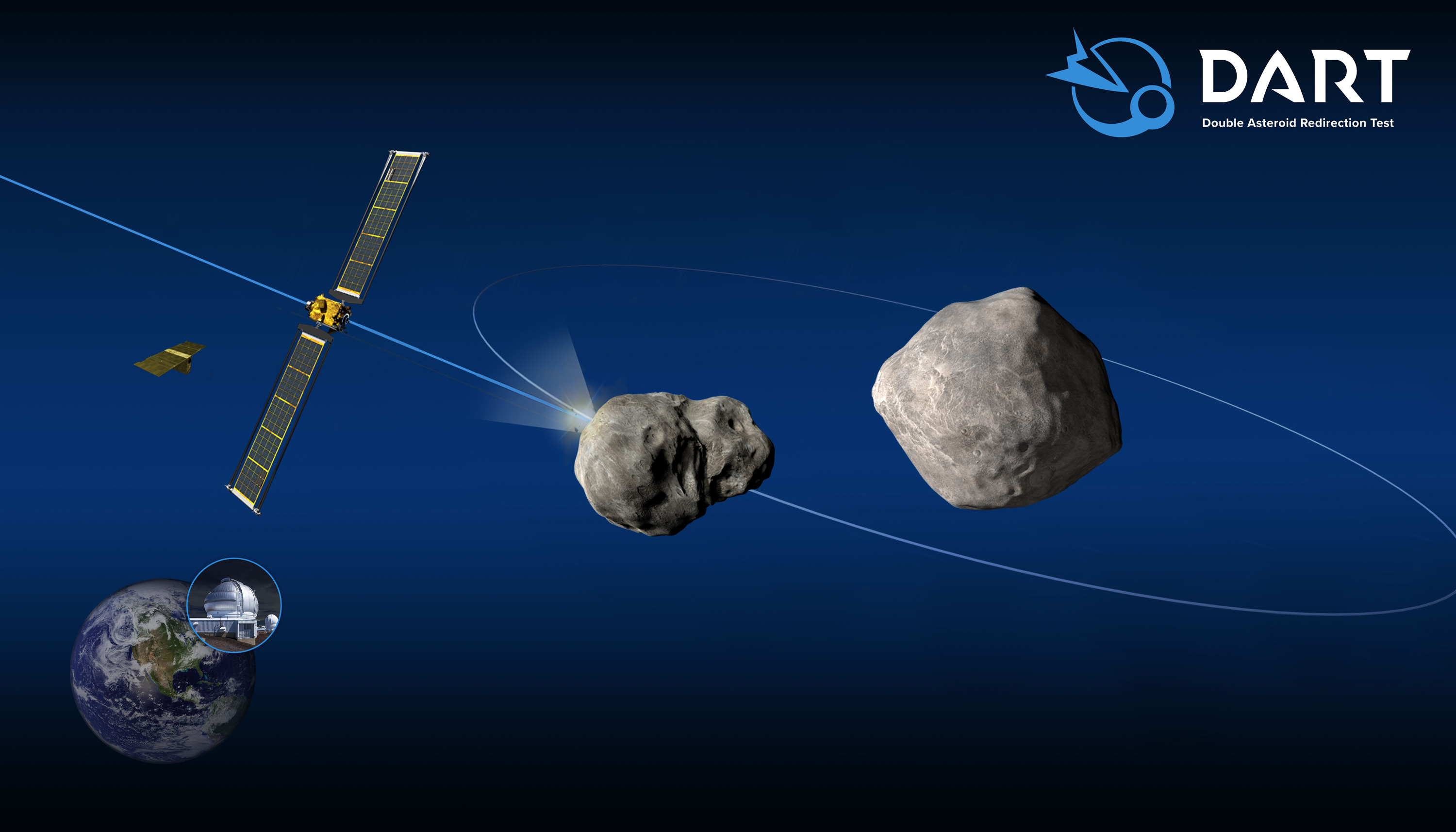
Double Asteroid Redirection Test
26
MENTIONS
11
EPISODES
10
PODCASTS
Search complete. 26 mentions across 11 episodes found for "Double Asteroid Redirection Test".
Oct 7, 2026

Steve StocktonHOST
According to a press release, Hicks' main area of focus was the physical properties of comets and asteroids.
Steve StocktonHOST
He worked on the DART, the Double Asteroid Redirection Test, NEAT, which is the Near-Earth Asteroid Tracking Teams, as well as the Dawn mission and the NASA Deep Space 1 mission.
Steve StocktonHOST
By all accounts, Hicks was a well-established and well-accomplished scientist with over 80 papers to his name.
Steve StocktonHOST
Then in 2023 something changed.

Seth AndrewsHOST
What have we done when we landed on the asteroid? It seems like we set off some sort of a detonation, right, as an experiment when we landed on a comet?
Aaron AdairGUEST
Um, you might be, uh, mixing that with another mission, because there was the Philae mission where we actually had a lander, and then there was what was called the DART mission, where we actually sent impactor on purpose.
Aaron AdairGUEST
This was actually two asteroids orbiting each other, and this was actually a test of a defense mechanism for Earth.
Aaron AdairGUEST
The idea is we can hit one asteroid, and we can see how much it deflects it from that impact by seeing what happens to the orbit of these two bodies around each other.
Aaron AdairGUEST
And since they're orbiting, we can do lots of good measurements.
Aaron AdairGUEST
So this was an experiment to basically see, hey, if we use impactors, will that save the world? And that was the DART mission from a couple of years ago at this point, and successful mission, I should say.
Aaron AdairGUEST
It was actually even more successful than expected.
Seth AndrewsHOST
I just realized I did it.

Ben CarterHOST
The asteroid fills the camera frame.
Ben CarterHOST
On September 26th, 2022, DART closed on Dimorphos, a small asteroid moonlet that did not threaten Earth.
Ben CarterHOST
Its camera transmitted images until the planned collision interrupted the signal.
Ben CarterHOST
Now, in a fictional inland community in the southeastern United States, a warning says a catastrophic impact is 72 hours away.
Ben CarterHOST
The safest first action is to confirm current official instructions for this location.
Ben CarterHOST
The dangerous mistake is fleeing toward an unverified destination simply because it is farther away.
Ben CarterHOST
DART was a test.
Ben CarterHOST
This countdown is hypothetical.

Richard CampbellHOST
We're going to have a map of all these planets long before we can get there.
Richard CampbellHOST
In September, the DART mission, so this is the Double Asteroid Redirect Test, Called that because it's actually a binary asteroid system.
Richard CampbellHOST
So Didymos is this asteroid that flies relatively close to the Earth.
Richard CampbellHOST
It's not huge, 780 meters across.

Richard CampbellHOST
We're going to have a map of all these planets long before we can get there.
Richard CampbellHOST
In September, the DART mission, so this is the Double Asteroid Redirect Test, Called that because it's actually a binary asteroid system.
Richard CampbellHOST
So Didymos is this asteroid that flies relatively close to the Earth.
Richard CampbellHOST
It's not huge, 780 meters across.

Richard CampbellHOST
We're going to have a map of all these planets long before we can get there.
Richard CampbellHOST
In September, the DART mission, so this is the Double Asteroid Redirect Test, Called that because it's actually a binary asteroid system.
Richard CampbellHOST
So Didymos is this asteroid that flies relatively close to the Earth.
Richard CampbellHOST
It's not huge, 780 meters across.

Kevin LeaGUEST
And actually, I said, I talked to you two years ago in preparation for a Real Science Radio interview.
Kevin LeaGUEST
I talked to her about the DART project.
Kevin LeaGUEST
And I said, I talked to you two years ago on this.
Kevin LeaGUEST
Well, we talked about it.
Kevin LeaGUEST
She's an MIT engineer for planetary science.
Kevin LeaGUEST
And so I said, it aerobrakes, and it all comes together as a loosely held rock pile.
Kevin LeaGUEST
And in the case of her project, which is the DART project, the Didymus Dimorphos, there's a Didymus mother asteroid.
Kevin LeaGUEST
Dimorphos was a moon that we smacked into with the DART mission probe that smacked into it to change its orbit.

Sarah Al-AhmedHOST
Since then, Paul has served as a bridge between JAXA and NASA, helping the Hayabusa 2 and OSIRIS-REx teams share some really hard-won lessons about landing on boulder-covered worlds.
Sarah Al-AhmedHOST
He's been on both of those science teams, on the Double Asteroid Redirection Test or DART investigation team, and he has an asteroid named after him, 8139 Paul Abel.
Paul AbellGUEST
Hi, Paul.
Sarah Al-AhmedHOST
Thanks for joining us.
24 MINS LATER
Paul AbellGUEST
or after the ordinary chondrite-type meteorite.
Paul AbellGUEST
So it's a very common type of material that we find on Earth in our terrestrial meteorite collections.
Paul AbellGUEST
We see this in some of the materials from our own DART mission that went to Didymos and Dimorphos It's very similar to the type of material type that is thought to be making up the asteroid Apophis, which is going to pass by here in 2029.
Paul AbellGUEST
Right.
Richard CampbellHOST
Uh, couple more space launches.
Richard CampbellHOST
In November, the DART mission.
Richard CampbellHOST
This was the mission to see, can we actually change the orbit of a, s- of an asteroid? Uh, and we, this is when it launches, so I'll talk about it when it actually gets there, 'cause it takes a while, uh, to get out to the, um, Didymos, um, complex.
Richard CampbellHOST
It's, uh, an asteroid a- orbiting an asteroid.

Steve NerlichHOST
Well, sort of, maybe.
Steve NerlichHOST
The age of asteroid deflection is really with us now after the success of NASA missions like DART and Deep Impact.
Steve NerlichHOST
China is planning to launch an as-yet-unnamed asteroid deflection mission, and otherwise there are a lot of good ideas out there about how to either deflect or fragment an asteroid on a seeming collision course with Earth, and none of them involve attaching rocket engines.
Steve NerlichHOST
And here's a fun fact for you.
Steve NerlichHOST
However, like painting, this method will only very slightly modify an asteroid's trajectory, so you have to start with a lot of lead time, particularly for larger asteroids.
Steve NerlichHOST
So if you don't have a lot of lead time, there's the kinetic impact method, where you crash something into the asteroid, imparting a kinetic energy which is derived both from the mass and the velocity of the thing that hits the asteroid.
Steve NerlichHOST
This was measurably successful with the DART mission in twenty twenty-two.
Steve NerlichHOST
So with this method, you can be confident of achieving a change in the asteroid's trajectory, but it's still not ideal for steering the asteroid onto a particular trajectory, since the effect of each impact will be a bit unpredictable.
1 more episode mentions Double Asteroid Redirection Test.
Create an account to see the whole feed, search across every transcript, and follow the entities you care about.