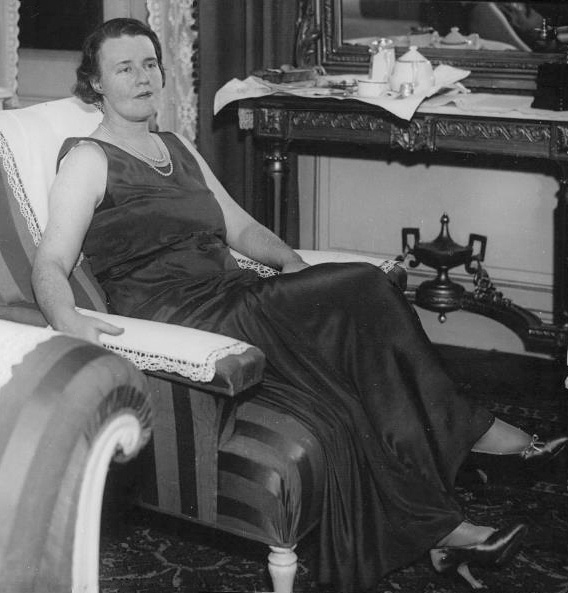
Dorothy Thompson
American journalist and radio broadcasterWikipedia
24
MENTIONS
14
EPISODES
12
PODCASTS
Search complete. 24 mentions across 14 episodes found for "Dorothy Thompson".
Sep 12, 2026

Andrew KeenHOST
Adam, going back to my conversation with Hitchcock, he reminded me that one of the remarkable things about FDR was his broad tent of advisors.
Andrew KeenHOST
Dorothy Thompson, for example, who was a Republican, was very influential in the way he thought about the world.
Andrew KeenHOST
And of course, there were many people on the left who were part of his inner circle, too.
Andrew KeenHOST
Is that one of the problems with contemporary Democrats? Kamala Harris comes to mind.
William HitchcockGUEST
But the person that I write a lot about is not a European, but she might as well have been.
William HitchcockGUEST
And that's Dorothy Thompson, the great journalist of the 1930s.
Andrew KeenHOST
You mentioned before we
William HitchcockGUEST
went live, she was actually a Republican.
William HitchcockGUEST
She wrote a column for the New York Herald Tribune three times a week.
William HitchcockGUEST
And she absolutely knew Europe so well that she could translate it for American readers and explain what was happening, why it was important, and how it might affect Americans and their democracy.
William HitchcockGUEST
So by 1940, I found evidence in Roosevelt's papers in the speechwriter's files that they were borrowing pages of Dorothy Thompson's writings for Roosevelt's speeches.
William HitchcockGUEST
So there'd been a convergence of ideas about the threat of Nazism to America.

Pete QuiñonesHOST
Chapter 16.
Pete QuiñonesHOST
Dorothy Thompson, played by Katherine Hepburn and Lauren Bacall.
Pete QuiñonesHOST
America's most famous female journalist at the time also attempted valiantly but unsuccessfully to tell Americans about Palestinian refugees.
Pete QuiñonesHOST
According to the Encyclopedia Britannica, Dorothy Thompson was one of the most famous journalists of the 20th century.
Pete QuiñonesHOST
Thompson's column was in newspapers all over the country, and her radio program listened to by tens of millions of Americans.
Pete QuiñonesHOST
She had been married to one of America's most famous novelists, graced the cover of Time magazine, been profiled by America's top magazines, and was so well known that Woman of the Year, a Hollywood...

Pete QuiñonesHOST
Chapter 16.
Pete QuiñonesHOST
Dorothy Thompson, played by Katherine Hepburn and Lauren Bacall.
Pete QuiñonesHOST
America's most famous female journalist at the time also attempted valiantly but unsuccessfully to tell Americans about Palestinian refugees.
Pete QuiñonesHOST
According to the Encyclopedia Britannica, Dorothy Thompson was one of the most famous journalists of the 20th century.
Pete QuiñonesHOST
Thompson's column was in newspapers all over the country and her radio program listened to by tens of millions of Americans.
Pete QuiñonesHOST
She had been married to one of America's most famous novelists, graced the cover of Time magazine, been profiled by America's top magazines, and was so well known that Woman of the Year, a Hollywood...

Carrie Mae BlaserHOST
But if you want to understand true sovereignty, you have to look past the political theater and examine the psychological frequency of conflict.
Carrie Mae BlaserHOST
The brilliant American journalist Dorothy Thompson interviewed Adolf Hitler in 1932, and was the first American journalist to be expelled from Nazi Germany.
Carrie Mae BlaserHOST
She wisely said, Peace is not the mere absence of war.
Carrie Mae BlaserHOST
It is a positive condition of justice.

Tom MitchellGUEST
But there was a broader legacy, um, internationally, um, of the-- n-not just the final report, but of the, uh, the coverage of the, the commission in, uh, from February through to June of 1946.
Tom MitchellGUEST
Uh, the American journalist Dorothy Thompson wrote a, an interesting piece, um, uh, dealing with, uh, Winston Churchill's, uh, Missouri speech of, um, March the 5th, 1946, his, uh, Iron Curtain speech.
Tom MitchellGUEST
And she said, um, the American audience, not quite ready for what Churchill had to say.
Tom MitchellGUEST
They were still tied to the sort of image of the Soviet Union as a wartime ally, couldn't quite believe that they were-- that, that, that Moscow was as evil as, uh, Churchill was portraying it.

Tom MitchellGUEST
But there was a broader legacy, um, internationally, um, of the-- not just the final report, but of the, uh, the coverage of the, the commission in, uh, from February through to June of 1946.
Tom MitchellGUEST
Uh, the American journalist Dorothy Thompson wrote a, an interesting piece, um, uh, dealing with, uh, Winston Churchill's, uh, Missouri speech of, um, March the fifth, 1946, his, uh, Iron Curtain speech.
Tom MitchellGUEST
And she said, um, the American audience, not quite ready for what Churchill had to say.
Tom MitchellGUEST
They were still tied to the sort of image of the Soviet Union as a wartime ally, couldn't quite believe that they were-- that, that, that Moscow was as evil as, uh, Churchill was portraying it.

Tom MitchellGUEST
But there was a broader legacy, um, internationally, um, of the, not just the final report, but of the, uh, the coverage of the, the commission in, uh, from February through to June of 1946.
Tom MitchellGUEST
Uh, the American journalist Dorothy Thompson wrote a, an interesting piece, um, uh, dealing with, uh, Winston Churchill's, uh, Missouri speech of, um, March the 5th, 1946, his, uh, Iron Curtain speech.
Tom MitchellGUEST
And she said, um, "The American audience, not quite ready for what Churchill had to say, they were still tied to the sort of image of the Soviet Union as a wartime ally, couldn't quite believe that they were, that, that Moscow was as evil as, uh, Churchill was portraying it." Um, George Keenan's long telegram of February, uh, nineteen forty-six in which he told the State Department that they better up their game with the Soviet Union and, and devise some strategies to, uh, corral, uh, prevent the expansion of Soviet power.
Tom MitchellGUEST
And of course, this became the Truman Doctrine eventually.

Tom MitchellGUEST
But there was a broader legacy internationally of not just the final report, but of the coverage of the commission from February through to June of 1946.
Tom MitchellGUEST
The American journalist Dorothy Thompson wrote an interesting piece dealing with Winston Churchill's Missouri speech of March the 5th, 1946, his Iron Curtain speech.
Tom MitchellGUEST
And she said, the American audience not quite ready for what Churchill had to say.
Tom MitchellGUEST
They were still tied to the sort of image of the Soviet Union as a wartime ally.

Jesse DollimoreHOST
You're a liar.
Brittany PageHOST
Yeah, and I don't know if you guys have read an essay, I think it's from 1941 by Dorothy Thompson, and it's called Who Goes Nazi? And it is kind of a scene at a dinner party where Dorothy is writing about surveying these different characters, Mr.
Brittany PageHOST
A, Mr.
Brittany PageHOST
B, Ms.
4 more episodes mention Dorothy Thompson.
Create an account to see the whole feed, search across every transcript, and follow the entities you care about.