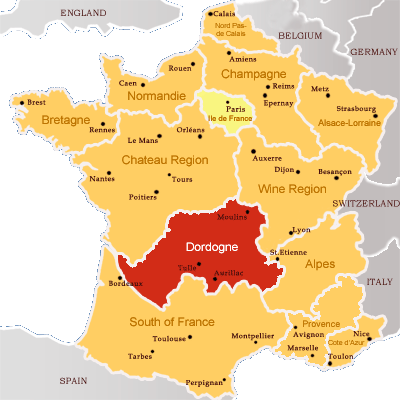
Dordogne
Departments of FranceWikipedia
44
MENTIONS
20
EPISODES
20
PODCASTS
Search complete. 44 mentions across 20 episodes found for "Dordogne".
Sep 23, 2026

Asia SulerHOST
Right now, in this moment, as this is being released, I am in southern France, visiting the Paleolithic caves of the deep ancestors.
Asia SulerHOST
I am in the Dordogne region of France in Les Aisées, and I am here once again.
Asia SulerHOST
So I was here last year for the first time, fulfilling a dream of mine that I have been holding and nurturing within myself, a dream that I talk about in this recording.
Asia SulerHOST
It's Genesis, how it first came in, working on my next book or working on this book that really has been... a part of my world now for almost seven years.

Caroline FrostGUEST
I have.
Caroline FrostGUEST
I return a weary warrior from a very, very civilised charity walk through the Dordogne.
Caroline FrostGUEST
Beautiful weather.
Caroline FrostGUEST
That sounds

Charles FosterGUEST
Samuel Johnson, he could just as well have written his depressive couplets and promulgate his pedantic definitions.
Charles FosterGUEST
Sitting in a tower in the Dordogne like Montaigne.
Charles FosterGUEST
Dickens.
Charles FosterGUEST
Dickens, the ultimate London chronicler.

Dan KieranHOST
And also, we only went down a couple of meters, but the temperature plummeted by 15 degrees.
Dan KieranHOST
And so you start to, this is the Dordogne, this is south of France.
Dan KieranHOST
This is, I don't know how hot it would have been 20,000 years ago.
Dan KieranHOST
I should find that out.

KatHOST
I think most people, when they think of going to France, they think of Paris, they think of the French Riviera, they maybe think of Normandy, maybe the Alsace for the Christmas markets.
KatHOST
But a lot of people don't think to go to the southwest of France, particularly like the Dordogne and Lattes departments.
KatHOST
Again, people do go and know about it, but it's like so few compared to all these other places in France.
KatHOST
And so we really wanted to go road trip through here.
ChrisHOST
So it was a
KatHOST
nine-day road trip.
KatHOST
We went to the Dordogne, the lot department, and then we went down to Albi, Carcassonne, and Toulouse and ended there.
KatHOST
So no Bordeaux, didn't make it to the Pyrenees.

Andrew PryorHOST
After the revolution, foie gras gradually shifted from an exclusive royal delicacy to the broader French table and eventually to the Christmas tradition that it is today, where it appears at an estimated 75% of French Christmas dinners in some form.
Andrew PryorHOST
Today, foie gras in France is primarily a product of two regions, the southwest, the Dordogne, the Georges and the Londres, and the Lot-et-Gon, where over 90% of production is concentrated and around 30,000 people work in the industry.
Andrew PryorHOST
And Alsace in the east, which has its own distinct tradition rooted in exactly the Jewish culinary heritage that brought the product to France in the first place.
Andrew PryorHOST
France remains the world's largest producer and consumer.
13 MINS LATER
Andrew PryorHOST
A controversy that is playing out in courts and legislators right now, even in 2026.
Andrew PryorHOST
And one of the most extraordinary flavours in French food.
Andrew PryorHOST
If this episode made you hungry or made you want to book a flight to the Dordogne, parfait.
Andrew PryorHOST
That's exactly what it was supposed to do.

Bryce CriseNARRATOR
Had they been used to contain anything else but liquids, I should have found traces of the fact, but only in a very few cases did I find some carbonized grain in the jars, and only twice the small quantity of a white mass, the nature of which I could not determine.
Bryce CriseNARRATOR
so we see that this prehistoric nation not only grew corn but stored it for future use the means this prehistoric people had of crushing or milling the grain was the same as usual The saddle kerns, or two stones with flat surfaces, between which the grain was crushed and roughly triturated, so frequently found on the continent, and the pestle and mortar of the lake dwellings, as also round stones for fitting into hollows such as are found in the lakes, the cave dwellings of the Dordogne, and in the dolmens of France.
Bryce CriseNARRATOR
dr schliemann in describing the trojan saddle cairns says they are either of trachyte or of balsotic lava but by far the larger number are of the former material they are of oval form flat on one side and convex on the other and resemble an egg cut longitudinally through the middle their length is from seven inches to fourteen inches and even as much as twenty-five inches The very long ones are generally crooked longitudinally.
Bryce CriseNARRATOR
Their breadth is from 5 inches to 14 inches.

Alexandre FranchiGUEST
In my family photos, because I'm from Montreal, but my family's from France, and occupied France.
Alexandre FranchiGUEST
My grandmother used to talk to me about the Germans because they were in the southwest, Dordogne, and...
Alexandre FranchiGUEST
And, you know, occupation.
Alexandre FranchiGUEST
And I have photos in old family albums of women being shaved and tattooed the swastika on the forehead because they slept with German soldiers.

Scott AllsopHOST
On the 12th of September 1940, four teenagers discovered the prehistoric cave paintings at Lascaux in the Dordogne region of southwestern France.
Scott AllsopHOST
Welcome to HistoryPod.
Scott AllsopHOST
in early september eighteen-year-old marcel ravidat noticed an opening in the hillside near the village of montignac whilst exploring the area with his dog this appeared to lead to an underground passage which ravidat initially attempted to investigate however he chose to postpone his exploration until the twelfth of september when he returned with three friends a narrow vertical shaft led to a passage approximately thirty metres long as the passage narrowed they saw the first paintings in what is now known as the axial gallery The walls contained numerous representations of animals including horses, bulls, bison and deer that were painted approximately 15,000 years ago during the Upper Paleolithic period.

Valerie CarusoHOST
But remember I said Merlot is grown in France's motherland more than any other grape? Other similar style blends in southwestern France employ Merlot, such as Bergerac.
Valerie CarusoHOST
Looking at a map of southwestern France, probably one of those areas I really want to go hang out in the most, I can see where the Garonne and the Dordogne rivers meet.
Valerie CarusoHOST
If we follow the Dordogne river east, We can find that Merlot goodness in Bergerac, one of France's first AOCs, or demarcated appellations, in 1936.
Valerie CarusoHOST
Makes both red and rosé AOP Bergerac wines, same grapes as Bordeaux, Merlot, Cab Sauve, Cab Franc, Malbec, but often at competitive prices.
Valerie CarusoHOST
Within the Bergerac region, you'll also find AOP Pécharment, Same red grapes grown in four communes by about 46 or so producers, dark fruit-laden wines that are age-worthy as well as interesting to break out for a dinner party.
10 more episodes mention Dordogne.
Create an account to see the whole feed, search across every transcript, and follow the entities you care about.