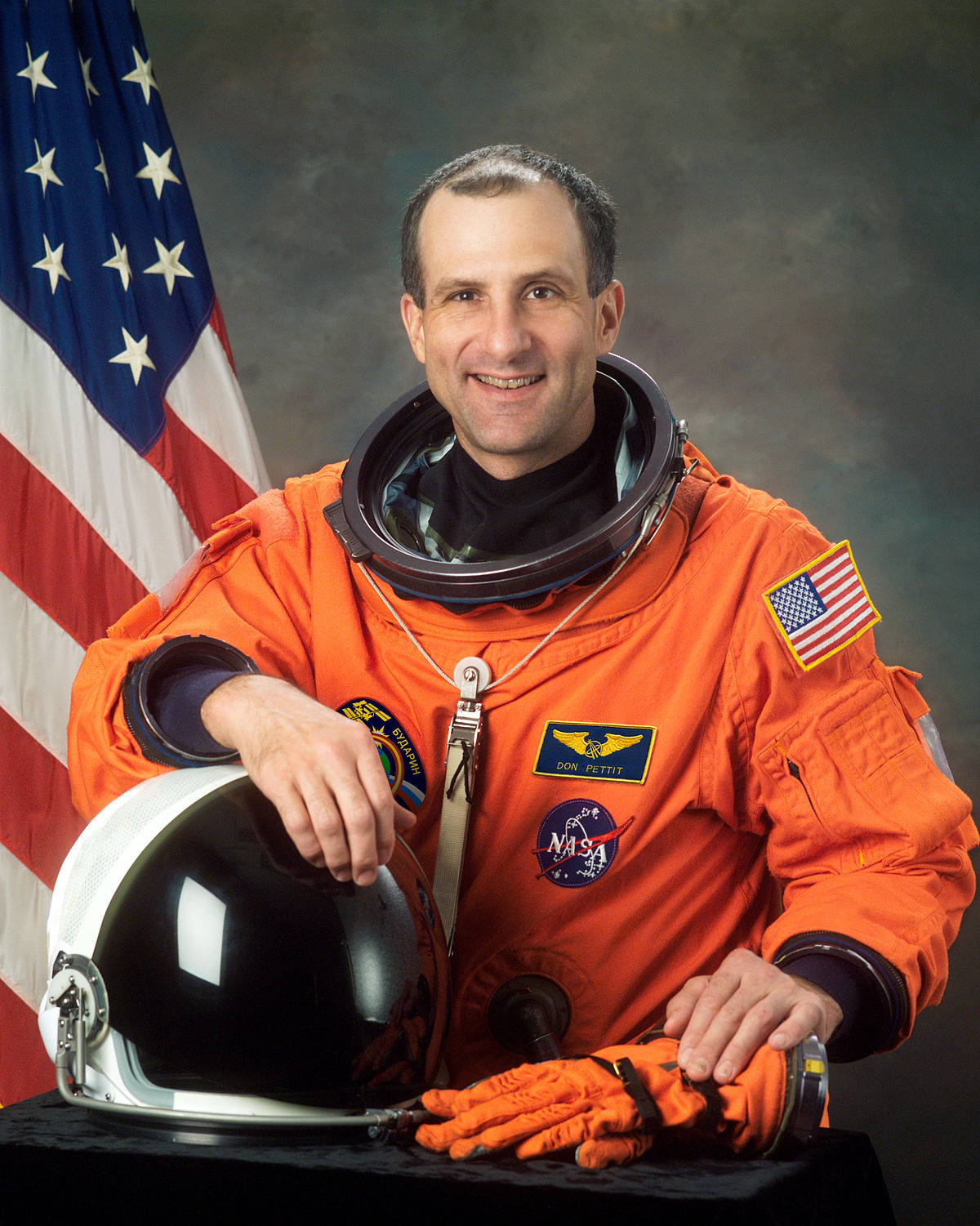
Donald Pettit
American astronaut and chemical engineer
4
APPEARANCES
4
PODCASTS
May 2, 2026


Don PettitGUEST
... uh, when it gets dark, you can continue to do useful and productive things, uh, for many hours of the day.
Don PettitGUEST
And, and, uh, human beings want to do this to such a degree that, that, uh, you could say, "Hey, we're not gonna be able to see the stars anymore," uh, you're, you're gonna lose that argument.
Don PettitGUEST
Uh, but what you can do is try to minimize the lighting, figure out how to solve the stray lighting so that the lighting that you do use is useful lighting for illuminating things on the ground, and minimize the light that just scatters and goes straight into space.
Don PettitGUEST
It's, has a big hump in the blue, and then a big hump in the, throughout the middle and into the red.

Don PettitGUEST
If you look at particle agglomeration, and I studied aerosol dynamics when I was in graduate school dealing with chemical reactions, and this was at University of Arizona in the chemical engineering department.
Don PettitGUEST
And aerosol particles, typically five microns or less, and they stay suspended in in an air environment, a gas phase environment, and they can bump into each other and coagulate and settle down, or they can just keep zooming around.
Don PettitGUEST
If you look at particles that are 500 micron upwards to a millimeter to a couple millimeters in diameter, it's hard to look at how they agglomerate on Earth Because they settle out so quickly.
Don PettitGUEST
You put a bunch of sand in a bag and shake the bag up and all the sand falls to the bottom of the bag here on Earth.
Don PettitGUEST
But if you do the same thing in a weightless environment, the sand will just float all around and bump and collide into each other like little tiny asteroids.
6 MINS LATER
Andy PonirosHOST
for another time that would be great i could see why it's one of your favorites it's amazing also what i thought was really cool is that how you took these pictures that some of them uh you took with a basic camera i think at 800 millimeter lens if i remember correctly but then you also i thought this was really cool you took something that was going to be discarded from an imax camera and you were able to make it into like a barn door camera in space how'd you do that

Donald PettitGUEST
"Wow, I should do this on my next flight." And I did that after my flight in two thousand twelve, two thousand thirteen.
Donald PettitGUEST
I made a list of stuff that I wanted to bring on my next flight, and that was fast lenses, which I did.
Donald PettitGUEST
Another thing I brought, and this is just in my personal kit, I brought one of the sync cords that you can take two camera bodies and sync them together so that when you push the shutter on one camera body, they both take a picture at the same time.
Donald PettitGUEST
It takes about seven to 10 seconds to go from full, bright sunlight to full dark, dark, dark.
Derek FahsbenderHOST
And how does that work? What does your post-production workflow look like? That's a lot of data to comb through.

Don PettitGUEST
Uh, they're part of the answer of what it's like to live and work in space, and to tell this story to everybody on planet Earth that might not have an opportunity to get into space.

Lester HoltHOST
Don Pettit, a veteran astronaut, has logged nearly 600 days in space, most recently spending five-plus months on the Space Station, spending his off-duty time snapping photos and shooting video in the orbiting outpost's cupola window.
Don PettitGUEST
For me, nighttime imagery is such a vivid display of, of what Earth beauty has, and it's hard to capture with a photograph.
Don PettitGUEST
Uh, certainly horizon views from orbit of the Milky Way rising and the, the flashes on Earth are, are lightning storms.
Don PettitGUEST
You have the atmosphere on edge which is glowing green, kind of like a slice of key lime pie.