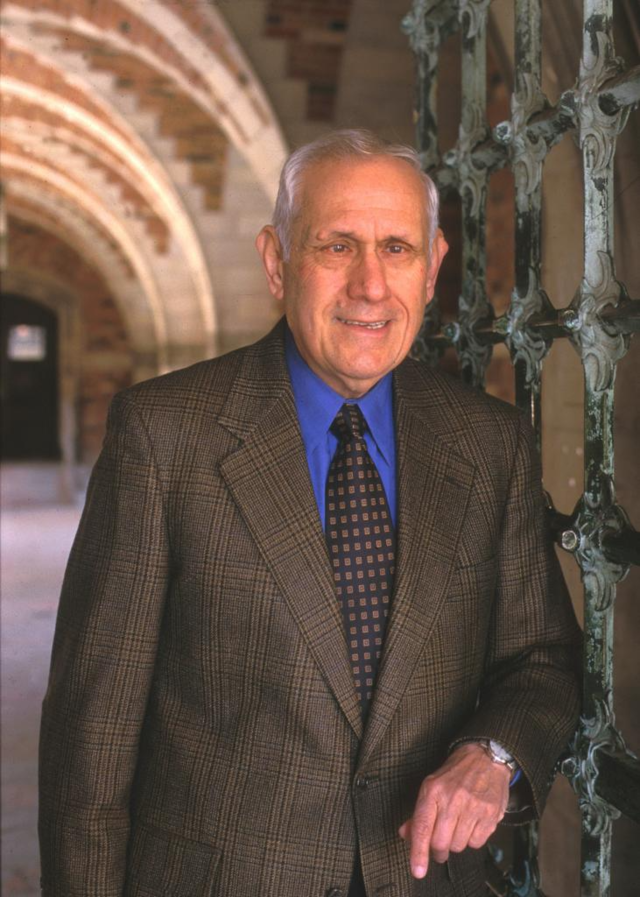
Donald Kagan
American historianWikipedia
23
MENTIONS
9
EPISODES
8
PODCASTS
Search complete. 23 mentions across 9 episodes found for "Donald Kagan".
Sep 14, 2026

Steven B. SmithGUEST
As there is about everything.
Steven B. SmithGUEST
Uh, most of what I have come to admire about Pericles was due in part to reading Don Kagan's, the great Don Kagan, historian at Yale, his book, his biography of Pericles.
Jay NordlingerHOST
Mm-hmm.
Steven B. SmithGUEST
Pericles of Athens.

Steven B. SmithGUEST
... as there is about everything.
Steven B. SmithGUEST
Uh, most of what I have come to admire about Pericles was due in part to reading Don Kagan's, the great Don Kagan, historian at Yale, his book, his biography of Pericles-
Jay NordlingerHOST
Mm
Steven B. SmithGUEST
...
Elizabeth CoreyGUEST
that's really quite dangerous, actually, for political community.
Todd WarnerHOST
The podcast that just got released was my conversation with Hillsdale's Paul Ray about eminent Yale University classics professor Donald Kagan, who made it his life's mission to defend the integrity of liberal education, specifically what he described, the education and formation of the complete man and the complete woman against soulless education in technique.
Todd WarnerHOST
I want to ask you this before we move on to the next essay of Rational Conduct.
Todd WarnerHOST
Has the fight for liberal education, has the fight to mold our young people into the complete man and complete woman, are we on our last dying breaths or is there hope? What's your sense about that?

Joe TascaHOST
Indeed, he is.
Joe TascaHOST
Americans like, well, he's from, born in Lithuania, but Donald Kagan will always make that case also.
Joe TascaHOST
Yeah.
Joe TascaHOST
Of course, he wrote that great four-volume study of the Peloponnesian War.

Mark SelickHOST
The subsequent treaties would refine Persian claims while addressing Spartan concerns, revealing that this first agreement was very much a starting point rather than the final settlement.
Mark SelickHOST
The historian Donald Kagan also provides an interesting take why Chalcidius accepted such vague pro-Persian terms.
Mark SelickHOST
He would write, Alcibiades no doubt was instrumental in the Spartans' willingness to accept so unbalanced an accord.
Mark SelickHOST
A veteran of many negotiations, he was the senior partner in the discussions, and Chalcidius followed his advice.

Joe TascaHOST
Indeed, he is.
Joe TascaHOST
Americans like, well, he's from, born in Lithuania, but Donald Kagan would always make that case also.
Joe TascaHOST
Yeah.
Joe TascaHOST
Of course, he wrote that great four-volume study of the Peloponnesian War.

Joe TaskaHOST
Indeed, he is.
Joe TaskaHOST
Americans like, uh, well, maybe he's from, born in Lithuania, but, uh, Donald Kagan will always make that case also.
John DavieGUEST
Yeah.
Joe TaskaHOST
And of course, he wrote that great four-volume study of the Peloponnesian War.

Joe TascaHOST
Indeed, he is.
Joe TascaHOST
Americans like, well, he's from, born in Lithuania, but Donald Kagan will always make that case also.
Joe TascaHOST
Yeah.
Joe TascaHOST
Of course, he wrote that great four-volume study of the Peloponnesian War.

Paul RaheGUEST
What are they really up to? What do they really want? What do these moves mean? So the skills that he developed himself, but that he passed on to his students, were skills in trying to see behind the headlines, so to speak.
Paul RaheGUEST
Um, you know, if, if, if, if back in the days when we had newspapers, uh, you know, if, if you were to read the New York times, Don Kagan would say, who wrote the piece? What's the agenda of the person who wrote the piece? Does it come out in the piece? Um, the person who's giving the interview, uh, The people who are providing information to the reporter, what's their agenda? Right.
Paul RaheGUEST
So in other words, in some sense, Don Kagan taught you how to read a newspaper, read between the lines.
Paul RaheGUEST
And the other thing I'd say about him, He was born before World War II.
Paul RaheGUEST
He came of age, so to speak, during World War II.
Paul RaheGUEST
They didn't know the full details until later, but they had a pretty good idea.
Paul RaheGUEST
So he followed it very closely.
Paul RaheGUEST
And a lot of what made the American University when I was a student, I started at Cornell in 1967, graduated from Yale in 1971, went to Oxford from 71 to 74 on a Rhodes Scholarship, came back to Yale, did a PhD with Don Kagan from 74 to 77.