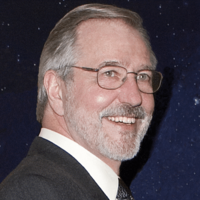
Donald J. Kessler
American astrophysicistWikipedia
22
MENTIONS
6
EPISODES
6
PODCASTS
Search complete. 22 mentions across 6 episodes found for "Donald J. Kessler".
Oct 1, 2026

Katie StoneHOST
Sometimes they stay in orbit around the Earth.
Katie StoneHOST
We'll explore the consequences of polluting our upper stratosphere, including what the Kessler effect is, as well as discover who is currently responsible for all the trash in space and what's the plan for cleaning it up.
Katie StoneHOST
This episode has activities and vocabulary in our learning guide.
Katie StoneHOST
Find it all at childrenshour.org. Just look for space junk.
10 MINS LATER
Alice GormanGUEST
We have the capacity to harm it and our capacity to harm it has an impact on what satellites can do for us, all the good things that they can do.
Alice GormanGUEST
Most people would be used to using their phones to find out where they are, get weather information, look up the internet.
Alice GormanGUEST
All of that could be gone if If what they call the Kessler syndrome happens, a series of collisions that once they start, they don't stop.
Alice GormanGUEST
Something collides with something, it breaks into thousands of pieces.

DennisHOST
Right.
DennisHOST
And then they talk about some of the biomimicry solutions scientists are working on to clean it up.
ReggieHOST
[trills]
DennisHOST
Yeah, let's listen.
11 MINS LATER
Mindy ThomasSOUNDBITE_SPEAKER
You better believe it, Guy Raz.
Guy RazSOUNDBITE_SPEAKER
So then why don't we just invent like a, like a giant space net for them?
Mindy ThomasSOUNDBITE_SPEAKER
Well, scientists have actually thought of that, but it wouldn't work because it would be so hard to capture all of that junk and keep it from floating out of the net.
Guy RazSOUNDBITE_SPEAKER
And of course I guess a vacuum cleaner wouldn't work because it needs the air pressure here on Earth to suck things in.

DennisHOST
[pigeon coos] Right.
DennisHOST
And then they talk about some of the biomimicry solutions scientists are working on to clean it up.
DennisHOST
[pigeon coos] Yeah, let's listen.
DennisHOST
[pigeon coos] [upbeat music] Okay, here we go.
8 MINS LATER
MindySOUNDBITE_SPEAKER
You better believe it, Guy Raz.
Guy RazSOUNDBITE_SPEAKER
So then why don't we just invent like a, like a giant space net for them?
MindySOUNDBITE_SPEAKER
Well, scientists have actually thought of that, but it wouldn't work because it would be so hard to capture all of that junk and keep it from floating out of the net.
Guy RazSOUNDBITE_SPEAKER
And of course, I guess a vacuum cleaner wouldn't work because it needs the air pressure here on Earth to suck things in.

DennisHOST
Right.
DennisHOST
And then they talk about some of the biomimicry solutions scientists are working on to clean it up.
ReggieHOST
[coos]
DennisHOST
Yeah.
11 MINS LATER
MindySOUNDBITE_SPEAKER
You better believe it, Guy Raz.
Guy RazSOUNDBITE_SPEAKER
So then why don't we just invent like a, like a giant space net for them?
MindySOUNDBITE_SPEAKER
Well, scientists have actually thought of that, but it wouldn't work because it would be so hard to capture all of that junk and keep it from floating out of the net.
Guy RazSOUNDBITE_SPEAKER
And of course, I guess a vacuum cleaner wouldn't work because it needs the air pressure here on Earth to suck things in.

Ben AnsellHOST
are really worried about is the potential chain reaction that a space collision could begin.
Ben AnsellHOST
Enter the Kessler syndrome.
John CrassidisGUEST
I truly believe that in 50 years we're going to be in what's known as Kessler syndrome.
John CrassidisGUEST
So Kessler in 1978 was a NASA engineer, came up with what essentially I'll call a prediction now, that objects will be colliding with other objects, they create more objects, and we get to a point where the probability of collision is going to be so great that we can't use that orbit anymore.
John CrassidisGUEST
I'm particularly worried about low Earth orbit a couple hundred miles up or so.
John CrassidisGUEST
And if we continue to do what we're doing and not fix this problem, I think in 50 years we're going to be in a lot of trouble.
John CrassidisGUEST
Astronomer Sam
Ben AnsellHOST
Lawler told me that the phenomenon that Donald Kessler predicted might already have begun.