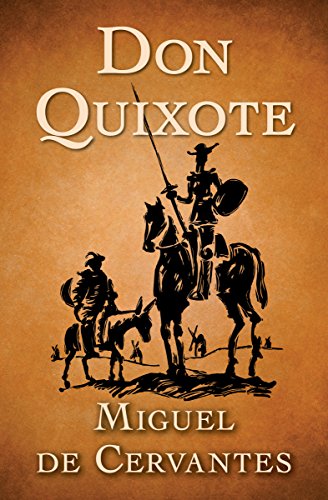
Don Quixote
Novel by Miguel de CervantesWikipedia
2.3k
MENTIONS
138
EPISODES
130
PODCASTS
Search complete. 2250 mentions across 138 episodes found for "Don Quixote".
Sep 24, 2026

Jacke WilsonHOST
Well-read in the classics, I'm glad.
Jacke WilsonHOST
Okay, your podcast has given me so much context and insight into some of my favorite authors and has only made my to-be-read list grow enormously, with the exception of Mike's un-recommendation of Don Quixote.
Jacke WilsonHOST
with the addition of authors such as Sol Bello, Haruki Murakami, and Carl Ove Nausgaard.
Jacke WilsonHOST
Okay, those are three good books for you to look for, Kaylee, but let me tell you, I'm already imagining the people who are furious to hear that Don Quixote has been crossed off your list, and they condemn Mike and me, as they probably should, for having it crossed off.
Jacke WilsonHOST
So let me just tell you, Kaylee, I was keeping this as a surprise, but I'll preview it here.
Jacke WilsonHOST
Mike has been going through a reconsideration of his own recommendation.

Robert W. SchneiderHOST
So in theory, the La Mancha team would be a smart idea, but that is where the commonalities end.
Robert W. SchneiderHOST
Don Quixote wasn't a gay man in a homophobic society, and Aldonza had never abandoned her children after driving her husband to suicide.
Robert W. SchneiderHOST
La Mancha was about the past glories of an imaginary hero.
Robert W. SchneiderHOST
Halloween was about the now.
Robert W. SchneiderHOST
Now, you see, Charlie should be impish, charming, and incredibly endearing.
Robert W. SchneiderHOST
Think like David Wayne or Robert Morris or Jack Cassidy.
Robert W. SchneiderHOST
José Ferrer was sonorous, blustery, and he radiated no charm, but he had played Don Quixote, so Marr liked that fact.
Robert W. SchneiderHOST
Maher even had Lee and Michaels write a pseudo The Impossible Dream in a song for Charlie called It Will Be Green Again about how you can always return to the beauty of the meadow after the harshness of spring.

David FloraHOST
Question 14.
David FloraHOST
The phrase tilting at windmills comes from an adventure of which fictional knight? Don Quixote.
David FloraHOST
Question 15.
David FloraHOST
The Adventure Game, The Crystal Maze, and Nightmare are all TV shows that have elements that helped inspire the format for what live action cooperative activity? Escape Rooms.

Andrew BiswellGUEST
Because he would go along with his father to the Free Trade Hall to hear the Hallé Orchestra.
Andrew BiswellGUEST
and often the music that was performed had some sort of literary reference, like, for example, Don Quixote or A Midsummer Night's Dream.
Andrew BiswellGUEST
And in his writing about music, he says that he came to literature by way of music, that he would hear something like The Midsummer Night's Dream overture first and then be curious to look it up.
Andrew BiswellGUEST
And of course, there's a lot of popular song in the book as well, which is both.

Ashlee VanceHOST
I mean, you see the world operating more and more efficiently in this image.
Ashlee VanceHOST
It takes me back sometimes to Don Quixote, which was one of my favorite books.
Ashlee VanceHOST
And there's like an argument you could make where Sancho Panza kind of represents this very capitalist time is money type attitude that had taken over society and Don Quixote.
Ashlee VanceHOST
Make it
Anna GátGUEST
make sense.
Ashlee VanceHOST
Yes, like very rational.
Ashlee VanceHOST
And Don Quixote represents this figure lost in time who's trying to restore some of the magic and the uncertainty and the sparkle of the world.
Ashlee VanceHOST
There's a book called The Re-enchantment of the World that gets into some of this ideas.

Mignon FogartyHOST
The rarest words dropped off faster than the law predicted, but it happened the same way in every language.
Mignon FogartyHOST
Other researchers looked at other samples, including James Joyce's Ulysses, Cervantes's Don Quixote in Spanish, massive French novels, Finnish texts with complex word forms, and even constructed languages like Esperanto, and the pattern still held.
Mignon FogartyHOST
So we've got this pretty enticing, universal-ish pattern, but scientists have been arguing about why it happens for 90 years.
Mignon FogartyHOST
Zipf's original idea about language gravitating toward the least effort it can get away with while preserving clarity is one possibility.

ExpatriateNARRATOR
Exactly as Cervantes took the old ideal of chivalry and showed what came of a man attempting to act as if it were real, so Ibsen takes the ideals of Brand and Peer Gynt and subjects them to the same test.
ExpatriateNARRATOR
Don Quixote acts as if he were a perfect knight in a world of giants and distressed damsels instead of a country gentleman in a land of innkeepers and farm wenches.
ExpatriateNARRATOR
Brand acts as if he were the perfect Adam in a world where, by resolute rejection of all compromise with imperfection, it was immediately possible to change the rainbow bridge between flesh and spirit into as enduring a structure as the Tower of Babel was intended to be, thereby restoring man to the condition in which he walked with God in the garden.
ExpatriateNARRATOR
And Peer Gynt tries to act as if he had in him a special force that could be concentrated so as to prevail over all other forces.
ExpatriateNARRATOR
They ignore the real, ignore what they are and where they are, not only like Nelson shutting their eyes to the signals a brave man may disregard, but insanely steering straight on rocks no man's resolution can move or resist.
ExpatriateNARRATOR
Observe that neither Cervantes nor Ibsen is incredulous in the Philistine way as to the power of ideals over men.
ExpatriateNARRATOR
Don Quixote, Brand, and Peer Gynt are all three men of action seeking to realize their ideals in deeds.
ExpatriateNARRATOR
However ridiculous Don Quixote makes himself, you cannot dislike or despise him, much less think that it would have been better for him to have been a Philistine like Sancho.

Ian CockburnHOST
And in the Woodhouse Handbook by Norman Murphy, Norman Murphy was very keen to find the origin of all Woodhouse's quotations.
Ian CockburnHOST
And he had a lot of trouble with this one, but he eventually tracked it down to an early 18th century translation of Don Quixote by Peter Motto.
Ian CockburnHOST
And in fact, In Bartlett's familiar quotations, which was the quotations dictionary that Woodhouse used the most, there are loads of quotations to this Peter Motto and his translations, including many that Woodhouse frequently used.
Ian CockburnHOST
All of these are first recorded in English by Peter Motto.
Ian CockburnHOST
Yeah, well, that's actually makes it all the more admirable that he used these phrases because he could have said, well, that is nonsense.
Ian CockburnHOST
What does that mean? Ha! And just ignored all of these idioms.
Ian CockburnHOST
But no, apparently his translation of Don Quixote is very unpopular by critics.
Ian CockburnHOST
They think it's a terrible translation.

Jay RuudHOST
Uncle Toby, who's kind of idealistic and unconventional, is a kind of quixotic character, I guess you could say.
Jay RuudHOST
And also the second part of Don Quixote is very self-reflexive and refers to the first part.
Jay RuudHOST
So there's some of that that I think Stern is, or people have thoughts that Stern is influenced by.
Jay RuudHOST
And if there's any contemporary that he's influenced by, it's probably Swift.

Pamela NagamiNARRATOR
It was at one of these tournaments that Edward III established the great Order of the Garter, which continues to this day and may be looked upon as a heritage left to us by the chivalric spirit of the Middle Ages.
Pamela NagamiNARRATOR
chivalry was a thing of french creation and throve naturally on french soil it is principally the french and provencal troubadours who have celebrated it by their song in england it never developed so freely it seemed like a thing imported foreign in its very nature to english simplicity and english bluntness still throughout the middle ages the chivalric spirit ruled supreme all over europe in england and france alike when chivalry ceased to be an enthusiasm it became a fashion and lingered on as a fashion till cervantes heaped ridicule upon it in his don quixote till its absurdities became so manifest that it faded away amid the scorn and laughter of mankind edward the third aimed at being a type of fashionable knighthood in his day chivalry had not yet become an absurdity it had lost much of its early simplicity and elevation but still in the black prince and some of his knights such as sir john chandos sir walter manny and sir james audley we find all the nobleness of early chivalry let us look a little closer at this chivalry and see what it meant and what was the ideal which it held up to its followers it had no artificial origin but sprang up as a natural outcome of feudalism and so of early teutonic manners a feudal vassal owed certain definite duties to his superior knighthood was the formal act by which the fitness of a young man to take upon him these duties was recognised and he was declared worthy to enter the rank of warriors it was to the crusades that chivalry owed its religious character by taking part in the crusades the knight could best find a field in which he might give free play to all the noble sentiments which animated him and if the knight was to fight for christ it was right that religion should take under her control the important act which initiated a young man into the rank of knighthood the education of a future knight began at the age of seven it was the custom for the sons of gentlemen to be brought up in the castles of the nobles where first they acted as pages attending upon the lords and ladies afterwards they were advanced at the age of fourteen to the rank of squires and waited upon their lords both at home and abroad they aided in their toilet carved before them a table and riveted their armour as they attended them to the tournament or the battle attention was paid to their education in all things connected with the management of arms or of horses they were taught above all to be courteous to ladies to be respectful and obedient to their superiors thus bred up in the atmosphere of chivalry they were fit and eager when manhood came to be raised to the dignity of knighthood this was accompanied by many solemn ceremonies the squire who was to be knighted was first made to lay aside his clothes and enter a bath the symbol of purification on coming out he was clothed with a white garment the symbol of purity next in a red robe the symbol of the blood he was bound to shed in the service of the faith and lastly in a close black coat the symbol of the death which awaited
Pamela NagamiNARRATOR
him he then spent the next twenty-four hours in fasting at evening he entered the church or chapel and passed the night in prayers in the morning he confessed and received absolution and then partook of the communion he was next present at the
Pamela NagamiNARRATOR
mass of the holy ghost and sometimes listened to a sermon on the duties of knighthood then advancing to the altar with the sword of a knight hanging from his neck he knelt before the priest who took the sword and blessed it and then returned it to him after this he went and knelt before the noble who was to arm him knight who was called his godfather before him he swore to maintain the right to fight for the faith to serve his sovereign prince to protect the weak and oppressed above all to be the champion of women to obey his superiors to honour his companions to keep faith with all the world to forswear all treason and avarice to acknowledge as his only aims glory and virtue when he had taken his oath knights and ladies advanced to clothe him in his new armour the spurs the coat of mail the cuirass and the gauntlets and to gird on his sword then his godfather struck him three blows with the flat of his sword saying in the name of god of st michael and of st george i dub thee knight the young knight then seized his helmet and sprang upon his horse brandishing his lance and rode out to show himself to the crowd outside the
128 more episodes mention Don Quixote.
Create an account to see the whole feed, search across every transcript, and follow the entities you care about.