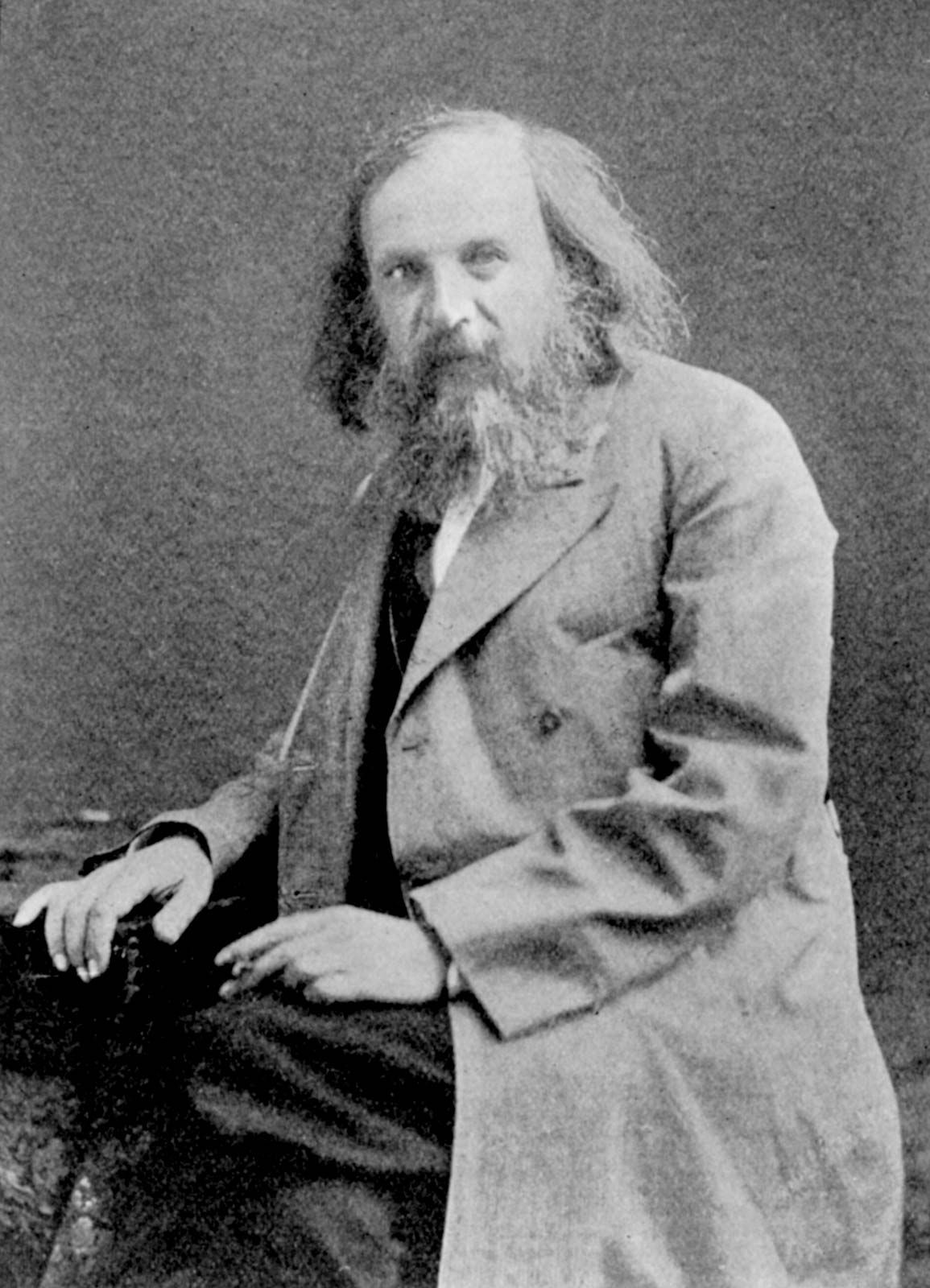
Dmitri Mendeleev
Russian chemistWikipedia
40
MENTIONS
31
EPISODES
26
PODCASTS
Search complete. 40 mentions across 31 episodes found for "Dmitri Mendeleev".
Oct 29, 2026

LouisHOST
Yeah, I know the song.
LouisHOST
Uh, so, the periodic table, that's, um, it's got lots of elements, um, uh, it was founded by Mendeleev, oh yes, uh, Mendeleev, um, who's some Russian dude, um, uh, who was supposedly sleeping on a train one day, uh, and then he was like, hold on, and So he had this puzzle where he put the elements in order, because the original order they had was based on atomic weight.
LouisHOST
But then he was like, hold on a second, I should swap a couple random elements and arrange them in rows of eight.
LouisHOST
And then he was like, wait, that works.
LouisHOST
And he was like, yeah, I know, I left them there.
LouisHOST
And then they were later filled and they were like, oh, damn, he's right.
LouisHOST
So, yeah, he got the 101st element named after him, Mendeleevium.
LouisHOST
And a fun thing about the periodic table is attempting to spell your name.

Jim KwikHOST
Albert Einstein came up with a theory of relativity in a dream.
Jim KwikHOST
Even the periodic table where we did a prior episode on how to memorize technical information like the periodic table, chemist Dmitri Mendeleev actually came up with the periodic table in a dream.
Jim KwikHOST
He's quoted as saying, I saw in a dream a table where all the elements fell into place as required.
Jim KwikHOST
Awakening, I immediately wrote it down on a piece of paper.

Santosh KrinskyHOST
They are remembered, recounted, and persist long-term, while the evanescent, daily incoherent dream sequences disappear and are quickly forgotten.
Santosh KrinskyHOST
Some noted examples of dream experiences includes the discovery of the periodic table of elements by Dmitri Mendeleev, or James Watson's famous description of the double helix of DNA, both of which eventuated from dream experiences.
Santosh KrinskyHOST
Mary Shelley wrote Frankenstein after a particularly frightening dream experience.
Santosh KrinskyHOST
Some transcriptions of dream experiences come in symbolic forms and require interpretation.

Chris LehtoHOST
So our fractal universe, the hypothesis, predicts that we will find new structures.
Chris LehtoHOST
And just like Mendeleev's periodic table, the idea is we could actually predict what those will be based off of the recurring pattern.
Chris LehtoHOST
So let's sit with what this means and consider it a little bit more.
Chris LehtoHOST
So first, you have six exact 10 to the 24th matches that suggest there is a universal geometric law.

JyotiHOST
This
AartiHOST
was after Mendeleev had come up with his design of the periodic table in 1869.
AartiHOST
So the table was actually expanded to include a new column for the noble gases.
AartiHOST
Wow.

Judah PollackGUEST
Because the science tells us that it is exactly these sorts of behaviors we need in order to have breakthroughs.
Judah PollackGUEST
Whether it's Dimitri Mendeleev waking up from a nap and having the periodic table in his head, or Werner Heisenberg walking home from dinner with Niels Bohr across a park and suddenly discovering the uncertainty principle.
Judah PollackGUEST
The stories about this process are seemingly endless.
Judah PollackGUEST
Now at this point, some of you might be saying to yourselves, well, I'm just not a creative type.
21 more episodes mention Dmitri Mendeleev.
Create an account to see the whole feed, search across every transcript, and follow the entities you care about.