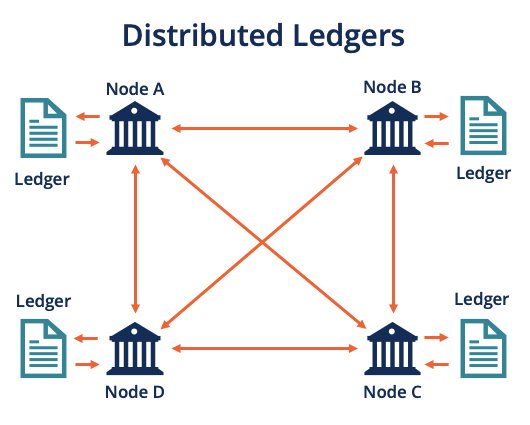
Distributed ledger
71
MENTIONS
26
EPISODES
25
PODCASTS
Search complete. 71 mentions across 26 episodes found for "Distributed ledger".
Oct 30, 2026

Dean NolanGUEST
Yeah, I hear that a lot of times.
Dean NolanGUEST
People talk about distributed ledger and blockchain and crypto and Bitcoin and all the terminology does get kind of confusing.
Dean NolanGUEST
I think to your specific question, DLT technology, that's the infrastructure.
Dean NolanGUEST
That's that distributed ledger that is established on a blockchain and it really creates that, I'd say the blockchain-based ledger containing the shared record of all the digital asset and its activity.
Dean NolanGUEST
Right.
Dean NolanGUEST
Cryptocurrency is one type of digital asset that's stored on a blockchain ledger or stored in DLT.
Dean NolanGUEST
And cryptocurrency represents money.
Dean NolanGUEST
Examples would be Bitcoin, which I think started in the late 2000s, you know, around the time of you really took off a lot during the whole 2008 depression.

Chris HollifieldGUEST
It's a development out of the end of the first financial crisis in 2008.
Chris HollifieldGUEST
And then B, also, I mean, Luxembourg's been a fairly early mover in terms of actually looking at how we can bring examples of tokenized or DLT financial services inside the kind of regulatory framework.
Chris HollifieldGUEST
So the example that always springs to mind for me is that, you know, our regulator was already looking at, you know, without the existence of a regulatory framework for crypto, how can we regulate crypto exchanges or what elements of the business need regulation? With the result that in 2016, you know, it's a long time pre-MICA, we were already providing licenses to institutions like Bitstamp and then slightly later Bitflyer.
Chris HollifieldGUEST
for the to regulate their their fiat activity and then provide some investor protection and then obviously you know crypto is one element of dlt but it's a very you know it's one only one element of it um one of the one of the things that we realized also quite early on was the broader impact it has on financial services particularly securities generally And so you can see that through the development of the local Luxembourg blockchain laws, which start back in 2019 and now have four iterations, basically allowing for the use of DLT across all sorts of different elements of securities.
Chris HollifieldGUEST
And then the uptake that we've seen on the industry side in that both in terms of fund tokenization, you know, some examples of TA on blockchain and then also some bond tokenization as well.
Chris HollifieldGUEST
So, I mean, I think it is important to kind of remember where we come from and the kind of expertise that we have developed, even if I am tooting my own horn, tooting Luxembourg's horn a little bit there.
8 MINS LATER
Chris HollifieldGUEST
There's very little actual trading that's happening on those tokenized instruments.
Chris HollifieldGUEST
And there could be reasons for that.

Umar FarooqHOST
Whether that means going from what used to be batch-based rails or overnight processing rails to real-time processing systems in most of the big countries in the world.
Umar FarooqHOST
And then now even other rails like crypto-based rails, DLT-based rails.
Umar FarooqHOST
I feel these have been some very interesting developments that have really come together to make our business even stronger and bigger than it used to be.
Max NeukirchenHOST
I agree, Umar.

Nicholas AllenGUEST
And each one of those hops need to perform their same, you know, AML and anti-money laundering and screening processes so that they all keep their hands clean.
Nicholas AllenGUEST
In the case of stablecoins, based on DLT, it's peer-to-peer.
Nicholas AllenGUEST
So you've got a single hop.
Nicholas AllenGUEST
So that means you no longer need to worry about all of the intermediary hops and repeating all of those regulatory or compliance checks at each one of those hops.

Daniel VogelGUEST
Our link with Gibraltar started in 2017.
Daniel VogelGUEST
I was in the Financial Action Task Force, um, talking to a few group of regulators around the world who were very skeptical about crypto, and, uh, and Gib at that time was writing the DLT framework.
Daniel VogelGUEST
And it was very early, and it was interesting to see a jurisdiction like Gibraltar taking a risk at that time of something that seemed quite uncertain.
Daniel VogelGUEST
Today, you know, crypto is playing a very, very important role.
31 MINS LATER
Theresa PatienceGUEST
Uh, I think Gibraltar has had a longstanding history of being a jurisdiction that has embraced innovation and has been a fast mover when it's seen market opportunities.
Theresa PatienceGUEST
Um, I've been calling Gibraltar my home, uh, happily for the last eight years.
Theresa PatienceGUEST
Uh, when I came to the jurisdiction, it was in the dawn of the new DLT regime, distributed ledger technologies, um, blockchain regulation, and Gibraltar was one of the first movers on that front as well, and we haven't stopped since then.
Theresa PatienceGUEST
I've been incredibly privileged and, and honored to have been working with Minister Feetham on a lot of his, um, projects in the jurisdictions and, um, the focus on bringing in new, um, markets and new opportunities.

Lawrence CalcanoGUEST
Yep.
Sonali BasakHOST
We have a relationship with DLT.
Lawrence CalcanoGUEST
Yep.
Sonali BasakHOST
Um, where's that all going at the end of the day? What role is, uh, tokenization gonna ultimately play in private markets in particular? We get this question a lot-
Lawrence CalcanoGUEST
You know, we've rolled it out.
Lawrence CalcanoGUEST
We've raised, um, a lot of funds on that on one of the major bank platforms.
Lawrence CalcanoGUEST
Um, and DLT can play a really important role in reducing, um, the, the NIGOs, the, the not in good order, uh, uh, o- orders that are in.
Lawrence CalcanoGUEST
Um, and so I think there's a real role for the distributed ledger leveraging those technologies.

speaker_0NARRATOR
Smart contracts can also automate processes that currently require multiple intermediaries or manual intervention.
speaker_0NARRATOR
The origins of Pontes lie in the Eurosystem's twenty twenty-four exploratory work on the settlement of DLT-based transactions in central bank money.
speaker_0NARRATOR
That exercise involved both public and private sector participants and highlighted access to a risk-free central bank settlement asset as an important requirement if tokenized financial markets are to develop at scale.
speaker_0NARRATOR
Pontes initially offers a core set of services that the Eurosystem intends to expand in response to market requirements and technological developments.
speaker_0NARRATOR
Pontes provides a risk-free euro-denominated settlement asset alongside emerging private alternatives such as regulated stablecoins and tokenized commercial bank deposits.
speaker_0NARRATOR
Pontes therefore helps preserve one of the traditional foundations of the financial system, the use of central bank money as the ultimate settlement asset.
speaker_0NARRATOR
The objective is to ensure that even if securities markets increasingly migrate towards DLT-based infrastructures, settlement does not become entirely dependent on privately issued digital money.
speaker_0NARRATOR
Meanwhile, the separate project to develop a retail digital euro is also progressing.
Tark PatienceGUEST
Quite a remarkable amount of progress, to be honest.
Tark PatienceGUEST
So in my role within Gantt, which was an organization initially established to focus on the DLT and crypto industry in 2018, as our regulatory framework was introduced.
Tark PatienceGUEST
But as the name suggests, we are an association to represent new technologies in general.
Tark PatienceGUEST
And as everyone is aware, artificial intelligence has made sci-fi-like leaps and bounds.
Tark PatienceGUEST
And as we've seen with the tokenisation bill and other regulations that are in the pipeline, Gibraltar can move quickly to be ahead of the curve.
Tark PatienceGUEST
And it's benefited us historically.
Tark PatienceGUEST
As I mentioned earlier, in 2018, we were the first jurisdiction globally to have a full regulatory framework for DLT firms.
Tark PatienceGUEST
The world has evolved.

J.R.GUEST
TDS, that's weird.
J.R.GUEST
So Royal Bank of Canada, RBC, Toronto Dominion Bank, TD, Bank of Montreal, BMO, Bank of Nova Scotia, Scotia Bank, Canadian Imperial Bank of Commerce, and National Bank of Canada are all working together on this DLT.
Joe JaquintHOST
Essentially, that's the six largest banks in Canada, pretty much.
J.R.GUEST
Yes, but look at BMO.
J.R.GUEST
Europe, there's a, I want you to look up a word, it's Pontes, P-O-N-T-E-S. It's the Eurosystems Distributed Ledger Technology.
J.R.GUEST
So over there we had TDS.
J.R.GUEST
In Europe we have the DLT, and basically what it is, it's a solution that connects market platforms with target services to settle DLT-based wholesale transactions using central bank money.
J.R.GUEST
Well, guess what that is? That is the central bank digital currency.

speaker_0NARRATOR
[on-hold music] Capital Market Insights from ICMA.
Andy HillHOST
I'm Andy Hill, co-head of Market Practice and Regulatory Policy at ICMA, and I would like to provide a brief overview of the article I co-authored with my colleague, Francisco Parente, for the latest edition of the quarterly report that looks at developments in DLT repo and collateral.
Andy HillHOST
When people talk about distributed ledger technology, tokenization, and digital assets, the conversation often focuses on bond issuance.
Andy HillHOST
But one of the most promising applications may actually lie elsewhere, in collateral management and repo markets.
Andy HillHOST
In fact, unlike many other areas of digital finance, DLT based repo is no longer just a concept.
Andy HillHOST
Commercial solutions are already operating in the market today, while central banks, market infrastructures, regulators, and industry participants around the world are actively building the foundations for broader adoption.
Andy HillHOST
So what makes repo and collateral such compelling use cases? The answer lies in the role they play in the financial system.
Andy HillHOST
Yet the infrastructure supporting these activities remains highly fragmented.
16 more episodes mention Distributed ledger.
Create an account to see the whole feed, search across every transcript, and follow the entities you care about.