disseminated intravascular coagulation
ConditionWikipedia
68
MENTIONS
18
EPISODES
18
PODCASTS
Search complete. 68 mentions across 18 episodes found for "disseminated intravascular coagulation".
Nov 2, 2026

Mike DePasqualeGUEST
So I think about... bleeding around the heart causing effusion and tamponade think about tension pneumothorax if you're bleeding into your chest wall or into your chest cavity and you can't expand your lungs then we think about hypoxemia could be from the bleeding into your chest and you can't expand your lungs could also just be from pulmonary injury or airway obstruction tracheal trauma that sort of thing Then we think about closed head injury, if you're having trouble breathing or moving air because the brain's having trouble making that communication, either through direct traumatic injury to the brain or through some nervous system issue that you've sustained.
Mike DePasqualeGUEST
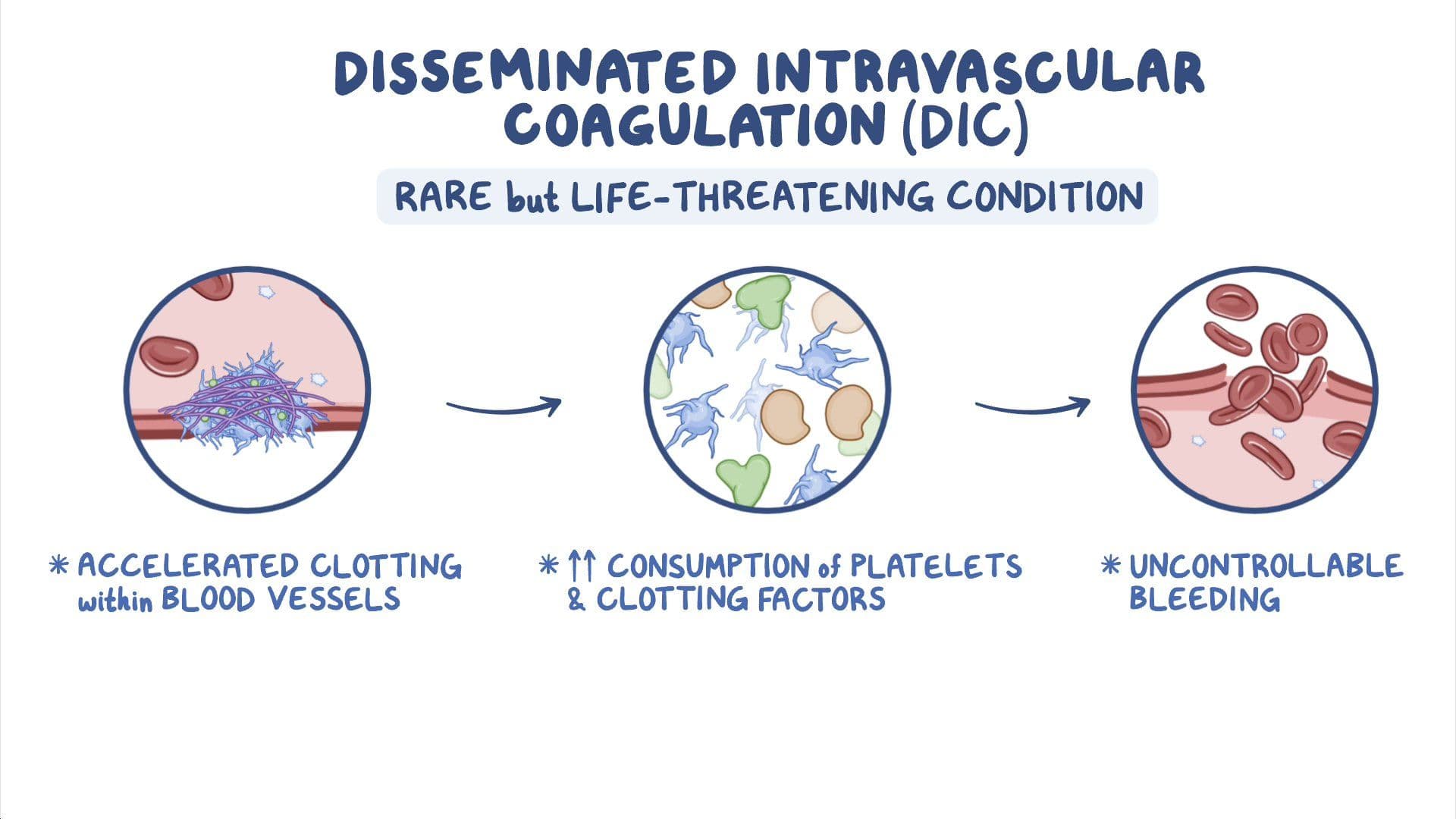
And then one that we think about less often but is also I think equally as important is DIC, which is disseminated intravascular coagulation, which is where Um, you wind up losing clotting factors and becoming, um, hypocagable and then start bleeding and then you're back to square one.
Casey PatrickHOST
So those are just the five trauma killers that we came up way back when we brainstormed.
Casey PatrickHOST
There's obviously other things that can be deadly in trauma, but if we're thinking about hemorrhagic shock, obstructive shock, hypoxemia, high C-spine injury, closed head injury, and traumatic brain injury, and then sort of that subacute DIC, that gives us a pretty good mindset framework to start those patients in the field.
Casey PatrickHOST
We have to think about tourniquet.
Casey PatrickHOST
We have to think about our resuscitation, TXA, make sure that we've got oxygenation and ventilation, making sure that we're not hypoxic or hypotensive with traumatic brain injury.
Casey PatrickHOST
We know that's going to increase our mortality.
Casey PatrickHOST
So it gives us a good framework with which to base our exam, our history, our approach in the truck, even simple things like warming the back of the truck and keeping our patient warm when we, you know, you may say DIC, that doesn't hit us in the truck.

speaker_0HOST
Platelets are the cells responsible for the initial plug when a blood vessel is damaged.
speaker_0HOST
When they drop that fast in sepsis, we immediately fear DIC, disseminated intravascular coagulation.
speaker_1HOST
DIC is a catastrophic complication.
speaker_0HOST
The intense cytokine storm activates the coagulation cascade inappropriately, causing millions of microscopic blood clots to form in the tiny capillaries all over the body.
speaker_1HOST
These microclots consume all of the body's platelets and clotting factors.
speaker_0HOST
It's clotting to death and bleeding to death at the exact same time.
speaker_0HOST
But his labs show his fibrinogen is incredibly high at 605.
speaker_0HOST
How does that rule out DIC?

LaShanta BriceGUEST
The first one is to look at bleeding or clotting disorders.
LaShanta BriceGUEST
If a patient has unexplained bleeding, low fibrinogen could point to conditions like disseminated intravascular coagulation or congenital afibrinogenemia.
LaShanta BriceGUEST
Secondarily, monitoring of DIC is important for laboratories to help clinicians.
LaShanta BriceGUEST
Fibrinogen levels often drop in conceptive coagulopathies.
LaShanta BriceGUEST
It's a part of DIC panels alongside PT, APTT, a platelet count, and D-dimer.
LaShanta BriceGUEST
Liver assessment is also important.
LaShanta BriceGUEST
Since fibrinogen is synthesized in the liver, low levels can reflect hepatic synthetic dysfunction.
LaShanta BriceGUEST
Driven by analyzers that have lower maintenance and user-friendly interfaces, matching the U.S. market standards, trend towards the near-home model for healthcare needs.

AmberGUEST
concept of what's going on and thank goodness because that would have been so much more traumatic if I had been like oh I'm like really hemorrhaging you know it was it was like in that moment yeah I'm like
Kaylee SummersHOST
actively dying and meanwhile you're like I'm good just like developing DIC but like NPD
AmberGUEST
exactly so I don't know thank goodness for those those uh you know high ammonia levels keeping me feeling like that.
AmberGUEST
So my husband, and so really this is like, his trauma is really kicking in here because he's like, I just remember the hospitalist who is there now dealing with this hemorrhage because my OB had gone home because again, she wasn't working.
AmberGUEST
He's like, her white coat just had blood up to the elbow.
AmberGUEST
He's like, she was like, covered in your blood she had her arm up you know all the way inside of you and and he's like I just knew like this is not normal obviously um and so they did some labs and and they're giving me all the things and they're like you know she's in DIC um we need to take her to the ICU so Somehow throughout all this, the only thing I remember, other than just occasionally saying, I'm fine, was I remember when this doctor told me, she was like, Amber, we're going to take you to the ICU.
AmberGUEST
And I distinctly remember... like waking up to hear that and then just being like, fuck, and then going back to sleep.
Kaylee SummersHOST
Like I was like, that's not good.

Charlie WienerHOST
Option C, pure red cell aplasia.
Charlie WienerHOST
Option D, sepsis with DIC.
Charlie WienerHOST
And option E, thrombotic thrombocytopenic purpura.
Cathy Handy MarshallHOST
The question is asking about common complications of CLL.
Cathy Handy MarshallHOST
Hypogammaglobulinemia is common and can be associated with significant risk for infections, primarily of mucocutaneous etiologies such as sinusitis and bronchitis.
Cathy Handy MarshallHOST
In addition, women can have frequent urinary tract infections.
Charlie WienerHOST
So these patients are at risk of sepsis and DIC, as mentioned in option D.
Cathy Handy MarshallHOST
Yeah, but I don't think that's the answer here.

KristaGUEST
Because after the amniotic fluid embolism, I started to bleed uncontrollably.
KristaGUEST
And I went into what's called DIC, which is disseminated intravascular coagulation, which is where you bleed uncontrollably.
KristaGUEST
Your body forgets how to clot.
KristaGUEST
the blood.

Esther GodfreyGUEST
And they are the two photos that show her off as beautiful as she was before lots of medical interventions.
Esther GodfreyGUEST
And she had so many blood transfusions because she got like DIC.
Esther GodfreyGUEST
She got so swollen and she looked really different.
Esther GodfreyGUEST
But those two photos initially were the ones that I share.

MHOST
Very frequent that I hear people using the term disseminated intravascular coagulopathy, and I'm not sure that we're using it correctly.
MHOST
So number one, sorry, going on a tangent, but number one, can you talk about what's the real definition of that? And is acute obstetric coagulopathy a distinct form of DIC or is it its own entity? How can we sort of make sense of
MHOST
all of this?
MHOST
Yeah.
Beverly HuntGUEST
That's not what's happening in obstetric coagulopathy.
Beverly HuntGUEST
Not in the early days.
Beverly HuntGUEST
If you've lost control and you can't keep up with blood loss and the patient gets hypoxic, the hypoxia will stimulate a DIC.
Beverly HuntGUEST
But to start with, with somebody who's really, really bleeding out, you get massive activation of fibrinolysis and it will... break down all of the fibrinogen, fibrin, factor V, and the clots that have formed where you want them to locally in the uterus.

speaker_2UNKNOWN
It's devastating.
speaker_2UNKNOWN
This inflammation damages the lining of blood vessels throughout the entire body, which triggers the final, often lethal stage, DIC, or disseminated intravascular coagulation.
speaker_1UNKNOWN
Disseminated intravascular coagulation.
speaker_1UNKNOWN
Just the name sounds terrifying.
1 HR 30 MINS LATER
speaker_2UNKNOWN
Yes.
speaker_1UNKNOWN
And what does that lead to?
speaker_2UNKNOWN
It often leads to DIC, or disseminated intravascular coagulation.
speaker_1UNKNOWN
DIC.

RachelHOST
Arrhythmia may occur due to hyperkalemia, hypercapnia, acidosis and sympathetic surge.
RachelHOST
Disseminated intravascular coagulation, DIC, occurs in response to hypothermia and rhabdomyolysis.
RachelHOST
The myoglobin released from damaged muscle effectively blocks the kidneys, so acute kidney injury and subsequent renal failure may occur.
RachelHOST
Genetically, most MH is caused by mutations in the RYR1 gene encoding for the ryanidine receptor, but a small proportion, approximately 1%, are due to problems with the dihydropyridine receptor.
RachelHOST
Interestingly, it's not always revealed during a patient's first anaesthetic.
RachelHOST
What do we see? The cardinal features of MH are tachycardia, rise in ETCO2 and rise in temperature with rigidity following exposure to a triggering agent.
RachelHOST
Progression to acidosis, hyperkalemia, hypoxia, arrhythmia and DIC ensues.
RachelHOST
That being said, a rise in temperature can be a late sign.
8 more episodes mention disseminated intravascular coagulation.
Create an account to see the whole feed, search across every transcript, and follow the entities you care about.