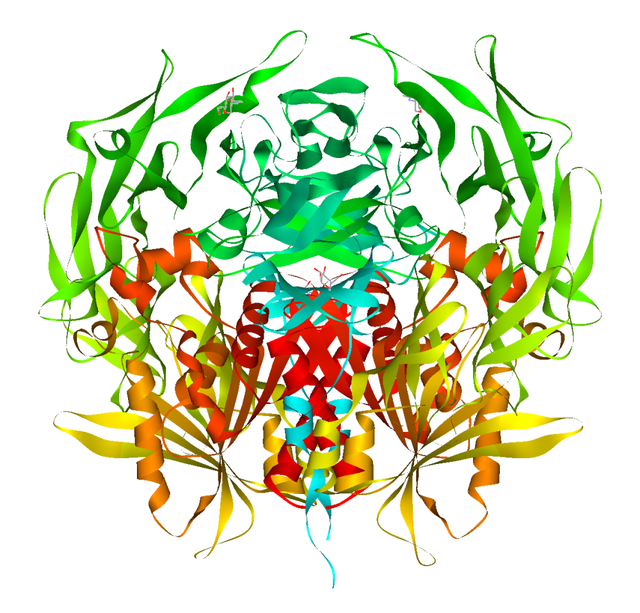
Dipeptidyl peptidase-4
ProteinWikipedia
20
MENTIONS
13
EPISODES
12
PODCASTS
Search complete. 20 mentions across 13 episodes found for "Dipeptidyl peptidase-4".
Nov 11, 2026

Licia MotaCORRESPONDENT
Well, Abstract 1445, presented by Ibis and colleagues, brings some Trigand filings.
Licia MotaCORRESPONDENT
Using the TriNetX database, researchers compared GLP-1 receptor agonists with DPP-4 inhibitor in patients with rheumatoid arthritis and type 2 diabetes.
Licia MotaCORRESPONDENT
After propensity score matching, more than 3,000 patients were included with three years of follow-up.
Licia MotaCORRESPONDENT
And the results were striking.

Catherine CroftsGUEST
There's a reasonable number of studies that have been done.
Catherine CroftsGUEST
The DPP-4 inhibitors prevent the breakdown of GLP-1.
Catherine CroftsGUEST
And some studies said there was either no change, some studies said there was a decreased amount of fasting glucagon, but with the postprandial, it was also decreased.
Catherine CroftsGUEST
And again, a reasonable number of studies.
Catherine CroftsGUEST
So, right, that's fine.
Catherine CroftsGUEST
So that is what has what happens during an oral glucose tolerance test, isolated information.
Catherine CroftsGUEST
What actually happens in practice? Especially, you know, there's a lot of information to say that for people with type two diabetes, there's some improvements in their HbA1c levels with these medicines, but what happens in people with type one? So there's a study that was done of the addition of Xanatide, which is a GLP-1, agonist, or the citagliptin, which is the DPP-4 inhibitor.
Catherine CroftsGUEST
I always get that.

Dave KnappHOST
15 instances in total across 134,000 patients.
Dave KnappHOST
And we're talking about 10 people versus five people on SGLT2 inhibitors, DPP4 inhibitors.
Dave KnappHOST
But I think the number to hone in on is the 15 total cases, the 10 versus five.
Dave KnappHOST
It is extremely rare that this is happening.

Ambreesh ChawlaGUEST
And clinically, it ranges from an arthralgia to a frank seronegative inflammatory arthritis that sometimes gets called seronegative RA.
Ambreesh ChawlaGUEST
The proposed mechanism is that DPP-4, which is also known as CD26 on T-cells, is expressed on synovial fibroblasts as well.
Ambreesh ChawlaGUEST
So inhibiting DPP-4 can have inflammatory and immunomodulatory effects within the joint.
Ambreesh ChawlaGUEST
As I mentioned, the timing is quite variable.

Clete BarrickHOST
So I want you to hear this from me.
Clete BarrickHOST
A large 2025 database study found more shingles and more cold sores on a GLP-1 than on a DPP-4 inhibitor.
Clete BarrickHOST
That's stuff like Genuvia.
Clete BarrickHOST
Shingles was about 29% more likely and cold sore is about 39% more likely.
Clete BarrickHOST
That takes us nicely to autoimmune diseases.
Clete BarrickHOST
You'll see a lot of headlines that GLP-1s raise the risk of autoimmune diseases like rheumatoid arthritis, psoriasis, or thyroiditis.
Clete BarrickHOST
Those come from large database studies that found risks 8% to 30% higher on a GLP-1 than on a DPP-4 inhibitor.
Clete BarrickHOST
But the DPP-4 inhibitors are not a neutral comparison.

Jens Juul HolstGUEST
So that was the first clinical evidence.
Jens Juul HolstGUEST
But, you know, at the same time, Other groups, and particularly Novo Nordisk, were working with the natural peptide and trying to see what could be done to rescue that, and discovered that the big thing was to attach a fatty acid to the molecule and make it bind to albumin in the circulation, avoid elimination in the kidneys, and then also stabilize it towards the DPP4 enzyme that we had demonstrated was completely deleterious to the hormone.
Jens Juul HolstGUEST
It was ready for a long time, but it was then approved in 2009 and
Vivienne ParryHOST
2010.

Tamara MilderSOUNDBITE_SPEAKER
that? Yes, to see whether hospitalization is disruptive to the continued use of these medicines.
Tamara MilderSOUNDBITE_SPEAKER
To do that, we also studied another common tablet known as DPP-4 inhibitors used for type 2 diabetes that don't have those same concerns.
Norman SwanHOST
That's Tamara Mildred.
Norman SwanHOST
So what they did was they used dispensing data, in other words, data from pharmacies about whether or not they dispensed these drugs and hospitalization data, so linking hospitalization to dispensing data over a period of 90 days to link these two drugs to see what the 90-day use looked like.
Tamara MilderSOUNDBITE_SPEAKER
And so we did indeed find that people using these medicines were 83% more likely to discontinue the medicine around the time of hospitalisation compared with other times.
Tamara MilderSOUNDBITE_SPEAKER
And surprisingly, we weren't expecting to have a positive finding for the other medicine without those safety concerns.
Tamara MilderSOUNDBITE_SPEAKER
There was a 55% increased risk of discontinuing the DPP-4 inhibitor around the time of hospitalisation compared to other times, suggesting that this is not just limited to SGLT2 inhibitors, which may be paused around the hospitalisation, but potential implications for other medicines.
Norman SwanHOST
You've already said earlier that there's a risk to discontinuation.

Tamara MilderGUEST
to see whether hospitalization is disruptive to the continued use of these medicines.
Tamara MilderGUEST
To do that, we also studied another common tablet known as DPP-4 inhibitors used for type 2 diabetes that don't have those same concerns.
Norman SwanHOST
That's Tamara Milder.
Norman SwanHOST
So what they did was they used dispensing data, in other words, data from pharmacies about whether or not they dispensed these drugs and hospitalization data, so linking hospitalization to dispensing data over a period of 90 days to link these two drugs to see what the 90-day use looked like.
Tamara MilderGUEST
And so we did indeed find that people using these medicines were 83% more likely to discontinue the medicine around the time of hospitalisation compared with other times.
Tamara MilderGUEST
And surprisingly, we weren't expecting to have a positive finding for the other medicine without those safety concerns.
Tamara MilderGUEST
There was a 55% increased risk of discontinuing the DPP-4 inhibitor around the time of hospitalisation compared to other times, suggesting that this is not just limited to SGLT2 inhibitors, which may be paused around the hospitalisation, but potential implications for other medicines.
Norman SwanHOST
You've already said earlier that there's a risk to discontinuation.

Mike BelkowskiHOST
And then the authors bring in another layer that I find really interesting.
Mike BelkowskiHOST
Certain oral bacteria produce DPP4-like enzymes.
Mike BelkowskiHOST
DPP4 is relevant because the human DPP4 enzyme degrades endogenous GLP-1.
Mike BelkowskiHOST
So now we're starting to ask whether there could actually be a bidirectional relationship between incretin signaling and the oral microbiome.
Clete BarrickHOST
Things look pretty similar.
Clete BarrickHOST
Best study, which used three national insurance databases, found about 1.6 fewer flare-ups per 100 patients every year on a GLP-1 than on a DPP-4 inhibitor.
Clete BarrickHOST
That's medicines like Genuvia.
Clete BarrickHOST
And also the SDLT2 pills inhibitors did at least as well.
Clete BarrickHOST
So that comes up because of the cancer headlines that generally have surrounded GLP-1s.
Clete BarrickHOST
The short answer is that there is no sign that GLP-1s raise lung cancer risk.
Clete BarrickHOST
Two large database studies found less lung cancer on a GLP-1 than on a DPP-4 inhibitor.
Clete BarrickHOST
But that gap was about two cases per 1,000 patients over a period as long as 10 years.
3 more episodes mention Dipeptidyl peptidase-4.
Create an account to see the whole feed, search across every transcript, and follow the entities you care about.