Digital signal processing
95
MENTIONS
12
EPISODES
7
PODCASTS
Search complete. 95 mentions across 12 episodes found for "Digital signal processing".
Nov 5, 2026

Jake WilliamsHOST
So it was a really interesting cybersecurity gig, was doing some paid research for some folks.
Jake WilliamsHOST
I did DSP, digital signal processing, way back in the day.
Jake WilliamsHOST
I am not a master at it by any stretch of the imagination.
Jake WilliamsHOST
DSP was a component of what I was like, the project itself wasn't DSP,
Richy NoelGUEST
but I, I either had to do that or outsource it
Jake WilliamsHOST
right.

speaker_0HOST
The new series comprises the Classic Sub 8, Classic Sub 10 and Classic Sub 12.
speaker_0HOST
Each model features a glass fiber driver, Class D amplification and DSP processing, with Ellipson targeting both stereo and home cinema applications.
speaker_0HOST
The entry-level Classic Sub 8 is equipped with an 8-inch driver and 150 watts amplification.
speaker_0HOST
Designed for smaller living spaces and compact systems, it's intended to extend low frequency performance without demanding significant floor space.
speaker_0HOST
Across the range, Ellipson has standardised a number of key technologies.
speaker_0HOST
Fibre glass cone construction has been selected for its combination of rigidity and low mass with the aim of delivering controlled base response.
speaker_0HOST
Amplifier power ranges from 150W to 300W depending on the model, while DSP boost processing provides up to 6.3dB of reinforcement at 33Hz to extend low frequency performance.
speaker_0HOST
All three models feature adjustable crossover controls, switchable 0° and 180° phase settings, line level inputs and outputs, and automatic standby operation.

Reza Nasiri MahalatiHOST
But then you have more sophisticated types of lidars, coherent lidars, which kind of like CW radar, they send like FM or PM waveforms like chirps or ranging codes.
Reza Nasiri MahalatiHOST
And as we know, you need to apply DSP to those waveforms to be able to do a range and velocity estimation.
Reza Nasiri MahalatiHOST
So for those types of coherent lidar, it's very important to have a linear detector that does not distort the waveform, right? So coherent LIDAR uses, operates in the photoconductive regime because linearity matters.
Reza Nasiri MahalatiHOST
So again, you should decide, do you care for linearity or do you care for sensitivity? And then that determines how you want to bias.
6 MINS LATER
Reza Nasiri MahalatiHOST
It gives us, you can set a negative bias voltage and it holds the PIN diode at that constant bias voltage.
Reza Nasiri MahalatiHOST
Also, nicely converts current to voltage for us.
Reza Nasiri MahalatiHOST
So, this voltage can now, you can feed it to an ADC if you like and digitize it and then do DSP on it.
Reza Nasiri MahalatiHOST
Okay, so this circuit is basically photons in and electrons out.

Todd FrielHOST
Which one?
RexGUEST
DSP.
RexGUEST
Ah, DSP.
RexGUEST
Digital
Todd FrielHOST
Signal Processing.
speaker_1ADVERTISER
Find fall your way at Ross.
Reza Nasiri MahalatiHOST
Last time, um, we, uh, started talking about the most general type of, um, FMCW radar, which is the MIMO radar, right? Uh, that's the case where you have multiple transmitter antennas, multiple receiver antennas, and then it enables you to, uh, this, this antenna diversity basically enables you to determine the, the direction of arrival of targets with some, uh, clever DSP.
Reza Nasiri MahalatiHOST
Uh, so we started by introducing this idea of the virtual antenna array, and this is a purely mathematical construction.
Reza Nasiri MahalatiHOST
Basically, uh, if you have a MIMO array which has, uh, N sub TX transmit antennas and N sub RX receive antennas, so physically you only have NTX plus NRX antenna elements, right? Um, but mathematically we showed that it is equivalent, and by mathematically equivalent, I mean, uh, essentially the signal that you receive from it, uh, is equivalent to a, a SIMO array, single input multi-output, where you have just one transmitter and you have P receivers, where P is equal to the number of transmitters times the number of receivers in the original antenna array.
Reza Nasiri MahalatiHOST
So the tilde is for the, uh, virtual array.
Reza Nasiri MahalatiHOST
Yeah, you can, you can cross-check.
Reza Nasiri MahalatiHOST
Uh, but the point is, uh, now we can, uh, basically do all of our DSP, uh, in, in the, in the virtual, uh, um, in the s- in the signal model that we define on the virtual array.
Reza Nasiri MahalatiHOST
Uh, so the way it looks like is, like, let's say physically you have a two-by-three MIMO array.
Reza Nasiri MahalatiHOST
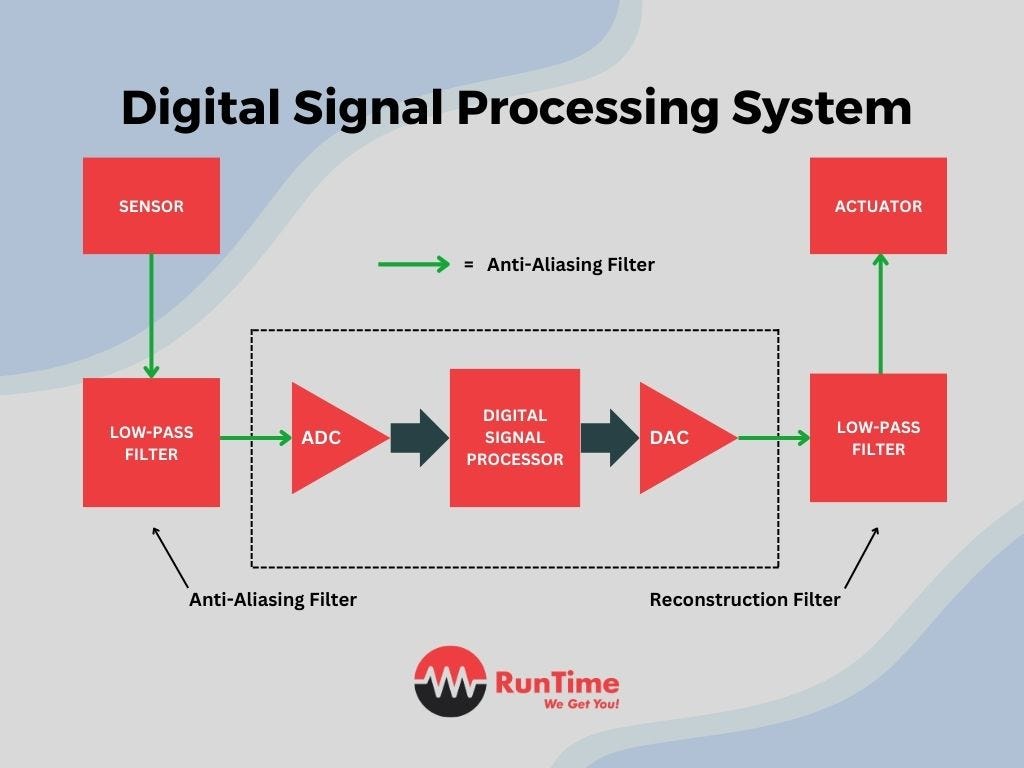
Then you apply some filtering to get rid of out of band noise and just keep the frequency content where you know there is signal.
Reza Nasiri MahalatiHOST
And then you digitize it through an ADC, and then you do some processing in DSP to estimate your range and bearing angle, and we'll talk about the processing.
Reza Nasiri MahalatiHOST
Now note that this is kind of like a generic block diagram.
Reza Nasiri MahalatiHOST
Specific systems might be different from this in certain aspects.
Reza Nasiri MahalatiHOST
There's the oscillator.
Reza Nasiri MahalatiHOST
There's the waveform generator.
Reza Nasiri MahalatiHOST
and then the amplifiers on the transmit and the receive side, filter, ADC, and possibly some DSP on board to basically process the signals.
Reza Nasiri MahalatiHOST
Some of them you don't do the DSP on board and just give you, you know, digitized signals and then you can have a separate microcontroller or some compute elsewhere that does the processing for you.
Reza Nasiri MahalatiHOST
It can even be fully implemented in analog.
Reza Nasiri MahalatiHOST
So you might not even, uh, need to use like a ADC and a DSP.
Reza Nasiri MahalatiHOST
Uh, um, you can, you can do it much simpler.
Reza Nasiri MahalatiHOST
But it comes with all, uh, uh, sorts of, uh, uh, you know, um, um, um, uh, caveats in terms of, uh, specifically the error in ranging has, has, has dependency on the amplitude of the received echo and also on the angle of where the target is.
12 MINS LATER
Reza Nasiri MahalatiHOST
Where is this coming from? Well, we know rho is, uh, basically the time of flight, um, times the speed of light over two, and then we have just plugged in, uh, uh, uh, for, for tau, we have, we have plugged in, um, this expression, which is delta F over B.
Reza Nasiri MahalatiHOST
So that's our time of flight, okay? So really, the magic or the power of, of, of, of this idea of CTFM or FMCW is that we have converted a, um, range estimation problem to a frequency estimation problem.
Reza Nasiri MahalatiHOST
So now we just need to, uh, estimate the frequency of the signal, uh, in, in DSP.
Reza Nasiri MahalatiHOST
And, uh, as I said last time, there is tens or possibly hundreds of algorithms, uh, for, for frequency estimation.
Reza Nasiri MahalatiHOST
Uh, so there's a Mu that's...
Reza Nasiri MahalatiHOST
Uh, Mu and Alpha are just constants, okay? So you can completely ignore them, uh, basically for the purpose of DSP.
Reza Nasiri MahalatiHOST
But this is for completeness, uh, included here.
Reza Nasiri MahalatiHOST
Mu is the gain of, uh, your low noise amplifier on the receive, uh, receiver front end.
Reza Nasiri MahalatiHOST
So we assume a target going at 100 miles per hour that was just a few meters in front of the receiver, and receiver working at seventy-seven gigahertz.
Reza Nasiri MahalatiHOST
Even for that case, we, we showed that your FT is less than one percent, uh, of, uh, or F Doppler is less than one percent of FT, so that's why we can, we can ignore it.
Reza Nasiri MahalatiHOST
But this is one of those cases that it's extremely, extremely important to remember these assumptions that go into our, uh, algorithms and the DSP because you might be working on some different application.
Reza Nasiri MahalatiHOST
Say you're working on, uh, uh, a military radar that, that is supposed to track missiles, and missiles can go, I don't know, ten or 100 times faster than this maybe, and then this assumption breaks down.
2 more episodes mention Digital signal processing.
Create an account to see the whole feed, search across every transcript, and follow the entities you care about.