Diffie–Hellman key exchange
43
MENTIONS
17
EPISODES
17
PODCASTS
Search complete. 43 mentions across 17 episodes found for "Diffie–Hellman key exchange".
Nov 19, 2026

Mitch AshleyHOST
Well, you know, I just have two parting thoughts, two words, parting thoughts.
Mitch AshleyHOST
Diffie-Hellman, it's all about the math.
Mitch AshleyHOST
It's all about the folks.
Mitch AshleyHOST
You don't know who Diffie or what Diffie-Hellman is, two folks' names.
Mitch AshleyHOST
That's why we have PKI.
Mitch AshleyHOST
That's why we have public and private keys and how it works.

Muhammed EsginGUEST
And I doubt that we would need to kind of constantly keep upgrading encryption schemes every, I don't know, two years or something.
Muhammed EsginGUEST
I think they will stay like, just like RSA and Diffie-Hellman or like the Descriptor.
Muhammed EsginGUEST
stayed for a long time I think lattice-based cryptography especially like the standard ones and the hash-based cryptography will survive for a reasonable period of time but maybe we may need to increase the key lengths or maybe we may need to make some tweaks but I don't think they will be completely broken even with advances in AI yeah
Douglas TumanHOST
yeah yeah uh what do you you know there's this idea that obviously like you're saying right by 2029 it could be a real risk to crypto but it comes with potentially a risk right if we start implementing um these changes um to be quantum proof just in case but that adds complexity complexity uh and then like we're saying with ai you can make create perhaps a greater attack surface in terms of finding flaws, finding flaws in the math or the implementation? How do you think we should be striking that balance? I mean, is it, you know, kind of the risk reward and is it worth going fully quantum proof at the risk of, you know, perhaps adding potential exploits, things like that?

Simon PatkovicGUEST
Cryptography, encryption.
Simon PatkovicGUEST
How does it look on packet level? What can you do with it? Why you cannot open it? How the keys get exchanged? How the internet works? what, what the value of Diffie-Hellman protocol is and how, you know, if, if that never happened, if, if we definitely never came up with a public encryption, we'd never be able to have internet in the digital age.
Simon PatkovicGUEST
And, and, and now we're looking at this and it's the end of that golden age.
Simon PatkovicGUEST
It's, I call it in the blog, in the blog, I call this, this 30, I don't know, is it 35 or so 40 years, almost 74 when he came up with it.

Eyal de LaraGUEST
There are other possibilities, but just bear with me.
Eyal de LaraGUEST
I'm going to go through one possibility that uses the Diffie-Hellman protocol, which my guess would probably be very familiar to you.
Eyal de LaraGUEST
But we're not going to spend too much time on it, so just bear with me for a second, and then we'll see why the existing techniques are not sufficient, and I'll then describe an approach that we've taken to augment the existing techniques.
Eyal de LaraGUEST
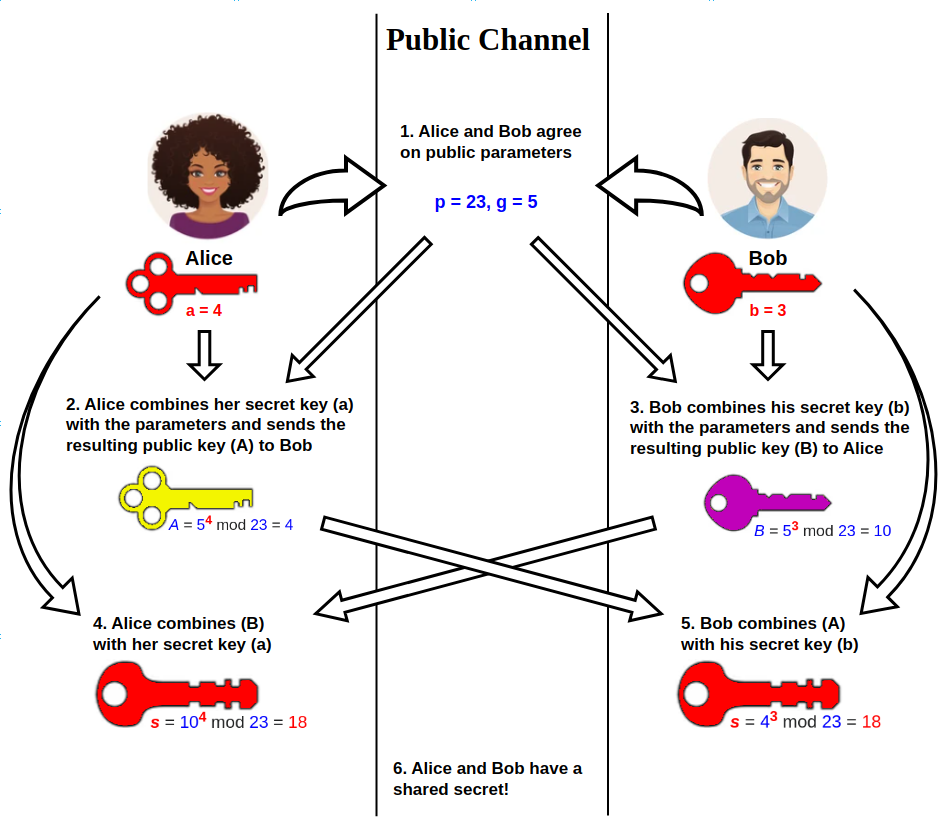
So in this case, we're assuming that there are two principals, Alice and Bob, that want to talk to each other.
Eyal de LaraGUEST
They have private keys, in this case A and B, and they have to somehow agree on a shared encryption key that will be used to secure their communications.
Eyal de LaraGUEST
So this is a watered down version of Diffie-Hellman.
Eyal de LaraGUEST
Let's assume that A takes the initiative and starts the communication.
Eyal de LaraGUEST
What A has to do is come up with a random value J.

James MesserHOST
Encryption is not a requirement for this data type.
James MesserHOST
Which IPSec protocol provides this hashing and integrity check without encrypting the payload? Would that be GRE, ESP, Diffie-Hellman, AHA, are isochemp maybe you know one of these maybe you've used some of these maybe you're familiar with these obviously all of these topics are from the exam objectives you really should know what each one of these happens to be if you don't recognize any of these or you can't explain to yourself or someone else what does that do what does it mean not just what the what the letters stand for which I guess is important to some degree.
James MesserHOST
You might see it written out on the exam.
James MesserHOST
But more importantly, what does that do? Why is that important? That is the key part of this exam.
James MesserHOST
The question asks, An administrator wants to ensure data sent over a VPN has not been modified in transit and the sender's identity is verified.
James MesserHOST
Encryption is not a requirement for this data type.
James MesserHOST
Which IPSec protocol provides this hashing and integrity check without encrypting the payload? Is that GRE, ESP, Diffie-Hellman, AH, or ISACAM? Let's see what you think the answer is.
James MesserHOST
We will close our poll.

Mark ErhardtHOST
The new idea is to have a coordinator-less approach where I think the first one was to advertise your IP address plus a public key.
Mark ErhardtHOST
And then the other participant that is also trying to hole punch would use that public key with its own to make an elliptic curve, Diffie-Hellman curve.
Mark ErhardtHOST
shared secret and that way find the actual connection.
Mark ErhardtHOST
And they just both start at the same time to punch out from their firewalls.

Pat ManleyGUEST
So there was a gentleman named Peter Shore.
Pat ManleyGUEST
He developed an algorithm, theoretically, in the 90s and said, if you run this algorithm on a quantum computer that has enough logical qubits, you're going to break RSA, elliptic curve, Diffie-Hellman, all of the public key cryptography that we rely on for a lot of our transactions, everything, right? Yeah.
Pat ManleyGUEST
So that happens in the 90s.
Pat ManleyGUEST
It's like, yeah, sure.
Pat ManleyGUEST
And here we are, 30 years later, we're close.
Pat ManleyGUEST
So the threat for us is Peter Shor's algorithm.
Pat ManleyGUEST
And what does that do? Essentially, if you think about the RSA, Diffie-Hellman, it's a factorization algorithm.
Pat ManleyGUEST
You had a big prime number, another big prime number, multiply those together.

Darren KitchenGUEST
And I find that intersection to be some of the most interesting in cybersecurity.
Darren KitchenGUEST
We do, as an industry, a really good job at cryptography and things like Diffie-Hellman and key exchange and all of these amazing technologies on the bit side.
Darren KitchenGUEST
But there's always that human element.
Darren KitchenGUEST
And if you've been in this industry for long enough, you know that social engineering and humans are oftentimes the easiest targets.

Ken NalboneHOST
So NIST has finalized NIST internal report 8547, which establishes definitive timelines to deprecate quantum vulnerable public key algorithms after 2030 and completely disallow them under NIST's standards after 2035.
Ken NalboneHOST
Replacing earlier tiered drafts, the final guidance subjects all key strengths of legacy schemes, including RSA, ECDSA, and Diffie-Hellman, to the same phase-out schedule.
Ken NalboneHOST
Organizations are directed to inventory cryptographic assets and migrate software, hardware, and network protocols to post-quantum standards like MLKEM and MLDSA.
Ken NalboneHOST
So, Tom, can complex enterprise IT infrastructures complete the migration to post-quantum cryptography before the 2035 cutoff?

Scott AaronsonGUEST
We're going to get to that.
Scott AaronsonGUEST
But I mean, you know, the risk from quantum computing mostly comes from it, you know, breaking our existing forms of public key encryption, specifically RSA and Diffie-Hellman and elliptic curve cryptography.
Scott AaronsonGUEST
These are three encryption schemes that account for a lot of what we use anytime you are ordering from Amazon and sending them your credit card number or, in general, using HTTPS in your web browser.
Scott AaronsonGUEST
Or you are using cryptocurrencies like Bitcoin or Ethereum.
7 more episodes mention Diffie–Hellman key exchange.
Create an account to see the whole feed, search across every transcript, and follow the entities you care about.