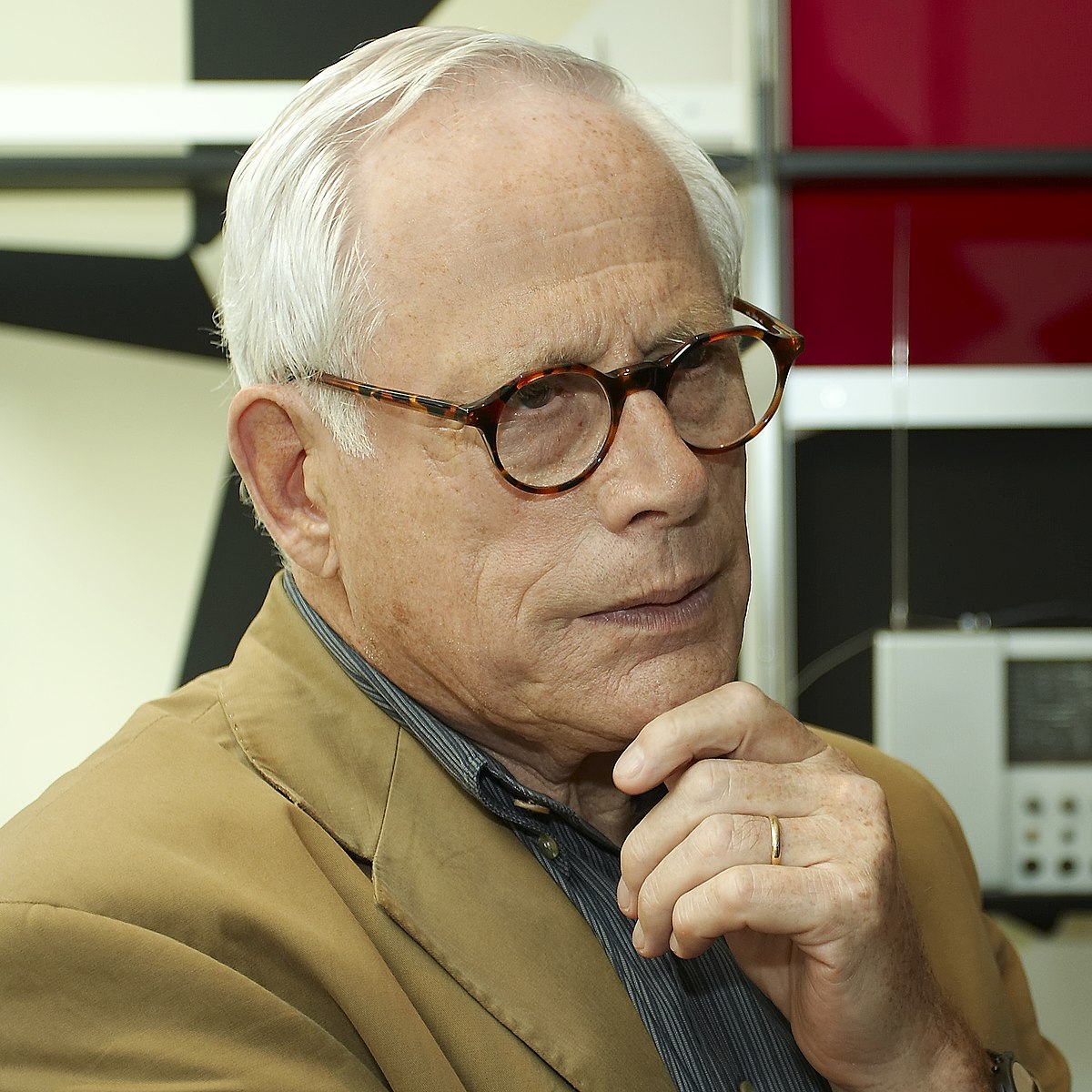
Dieter Rams
German industrial designerWikipedia
19
MENTIONS
14
EPISODES
13
PODCASTS
Search complete. 19 mentions across 14 episodes found for "Dieter Rams".
Nov 21, 2026

Richard BanfieldGUEST
And the people that buy, they're also human beings.
Richard BanfieldGUEST
So principles that work, like the Dieter Rams design principles.
Richard BanfieldGUEST
If you guys know Dieter Rams, he's the guy who produced all the Braun products, which if you go to the San Francisco Museum of Modern Art, you'll see all his products that he designed in the 40s.
Richard BanfieldGUEST
And guess what they look exactly the same as? They look at all the Apple products.
Richard BanfieldGUEST
The Apple guys literally walked down and saw all the Dieter Rams products and said, we're doing that.
Richard BanfieldGUEST
It's very similar
speaker_5UNKNOWN
to the entertainment industry.
C. Todd LombardoGUEST
People, the products are for people, so let's make sure we think about that.
C. Todd LombardoGUEST
These are quotes from Dieter Rams.
C. Todd LombardoGUEST
You guys know who Dieter Rams is? Some of you might, some of you might not.
C. Todd LombardoGUEST
When he wrote What is Design? Last one is, I think, the most striking.
C. Todd LombardoGUEST
It's as little design as possible.
C. Todd LombardoGUEST
Have you ever seen your television remote control? There's probably 1,000 buttons on it.
C. Todd LombardoGUEST
You might use maybe eight to 10 of them, probably two or three.
C. Todd LombardoGUEST
So this is Dieter Rams.

Noah KaplanGUEST
You know, you think of the 50s with mid-century products and mission and modernism, but you forget that the people designed them were the architects.
Noah KaplanGUEST
Mies van der Rohe, Dieter Rams, Charles and Ray Eames, these are the people designing the actual objects during the time, Cyrenian.
Noah KaplanGUEST
you know, like bringing these lines in from the outside and bringing the natural materials into the way our electronics and media is delivered.
Noah KaplanGUEST
And then when you look what happened during our era, I'm like you, you know, born in New York in the 70s, you know, I grew up living for music, living for live music, flipping through all the record crates, figuring out how to get our next fix, you know, how to tape swapping, recording stuff all the way, you know, like how obsessed we all were.

Daniel JacksonGUEST
Story number two, the iPod.
Daniel JacksonGUEST
What was the novel about the iPod? So as has been commented on many times, although the industrial design was super cool, that was not a novelty, right? Here's Dieter Rams' Pocket Radio from 1958.
Daniel JacksonGUEST
Joni Ive was certainly inspired by this.
Daniel JacksonGUEST
The idea of designing things that looked like that was not new.

Noah LandowGUEST
Number two, my personal website is noahlandau.com and I kind of have interests unrelated to technology.
Noah LandowGUEST
I also try to write an essay there every month or two and sometimes it's on, as I mentioned in passing earlier, my background is in architecture, so I've written a couple of articles and essays and stuff about kind of architecture education and about this Dieter Rams shelving design that I am a big fan of.
Noah LandowGUEST
And I think the one that just came out a day or two ago was about the Apple Lisa, which was a really interesting computer before the Apple Macintosh, which is sort of oft forgotten, but a really, really interesting machine.
Noah LandowGUEST
And I had a a brief opportunity for a couple of weeks to use when I was a little kid and I wrote a little essay about that.

Matt LopezGUEST
Braun, yeah, that's right.
Matt LopezGUEST
Anyway, Dieter Rams had designed this wall unit.
Matt LopezGUEST
I think it was like back in the 80s, if I'm not mistaken.
Matt LopezGUEST
Could have been sooner or later.

Ben HartmanGUEST
And I think that mindset continues and trickles down even to the small-scale grower.
Ben HartmanGUEST
And Dieter Rams, who's a German product designer from the 50s and 60s, put it best.
Ben HartmanGUEST
He said, let's do less but better.
Ben HartmanGUEST
And our goal every season is to do just that.

Ken SakataGUEST
So design design is incredible.
Ken SakataGUEST
There's a movie about Dieter Rams that is amazing.
Ken SakataGUEST
I think it's just called Rams.
Ken SakataGUEST
Yes.
Ken SakataGUEST
Incredible movie, a documentary.
Ken SakataGUEST
But that opens up a gateway into reading about everything Dieter Rams, which is seen as...
Ken SakataGUEST
Unfortunately, it's kind of like a mood board image rather than a human being.
Ken SakataGUEST
Like taste signaling, right? Yeah.

Duncan CrosseGUEST
It took my love of science and maths and combined it with creativity and art.
Duncan CrosseGUEST
I found the work and philosophy of Dieter Rams to be highly influential.
Duncan CrosseGUEST
I mean, that's such a common thing to say nowadays, but it was true for me back then as well.
Duncan CrosseGUEST
I still think his 10 design commandments are very relevant today, and I tried to put them into practice in all my work, but I'm formulating my own ideologies on that now too.

Barry ShepherdHOST
We're opening with a question that a German industrial designer asked himself back in the late 1970s.
Barry ShepherdHOST
That designer was Dieter Rams, the legendary head of design at Braun, the man whose work shaped everything from the pocket radio to the modern smartphone.
Barry ShepherdHOST
And his question was this.
Barry ShepherdHOST
Is my design good design? Now, you might be thinking, what does a sleek hi-fi system have to do with a Guardian arrangement on a power press? More than you'd expect, because Rams went on to answer that question with his famous 10 principles for good design.
4 more episodes mention Dieter Rams.
Create an account to see the whole feed, search across every transcript, and follow the entities you care about.