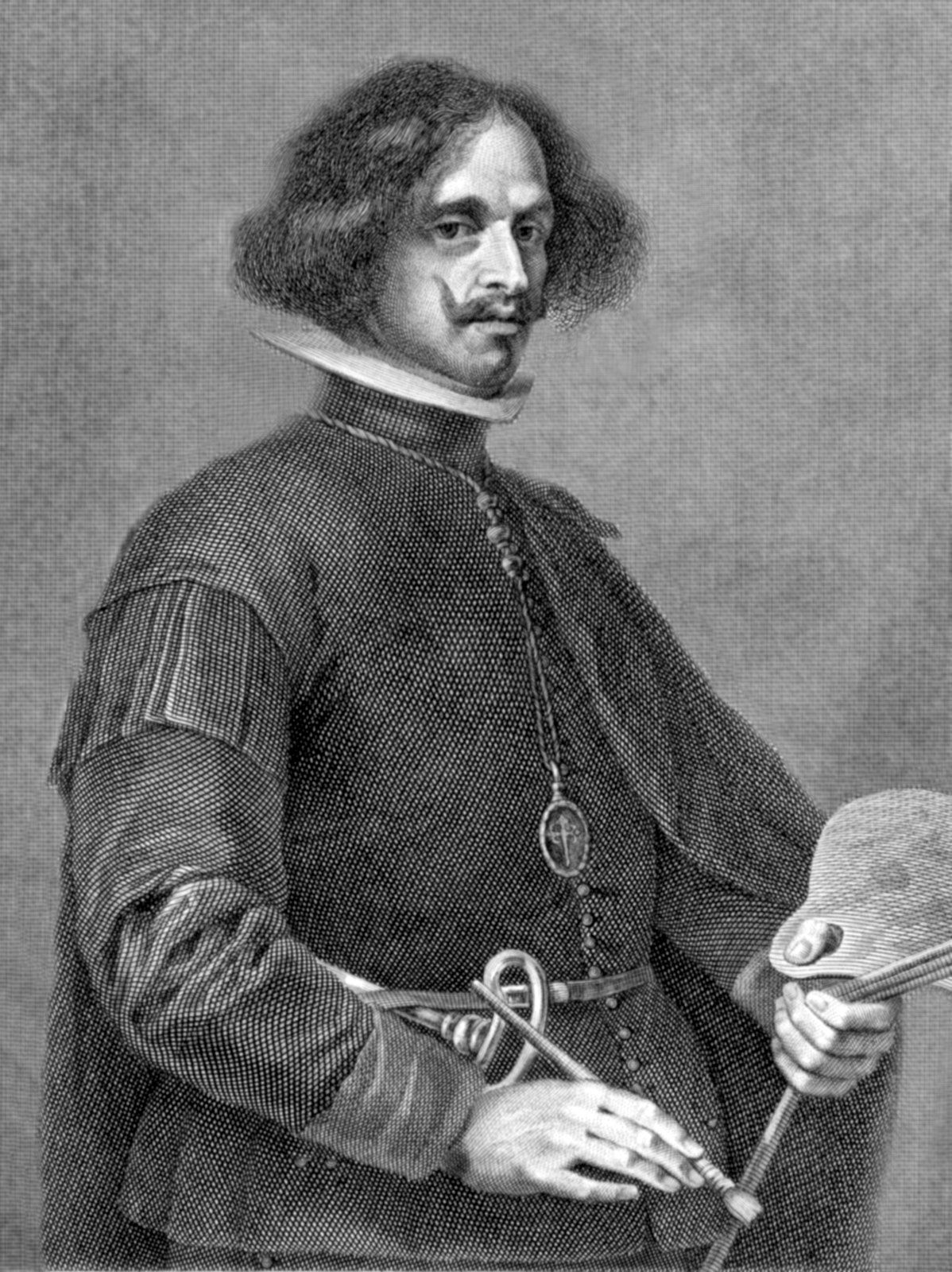
Diego Velázquez
Spanish painterWikipedia
27
MENTIONS
11
EPISODES
11
PODCASTS
Search complete. 27 mentions across 11 episodes found for "Diego Velázquez".
Sep 25, 2026

Todd UlbrichNARRATOR
Still, they occasionally are wrong.
Todd UlbrichNARRATOR
But the Venetians and Velázquez never.
Todd UlbrichNARRATOR
At least after his style was formed, early pictures like the Adoration of the Magi in our gallery are of little value.
Todd UlbrichNARRATOR
I ought perhaps to have added in that Manchester address, only one does not like to say things that shock people, some words of warning against painters likely to mislead the student.

speaker_3NARRATOR
His face was large and fleshy.
speaker_3NARRATOR
He had thrown himself into the arrogant attitude of Velazquez's portrait of Del Borro in the Museum of Berlin, and his countenance bore of set purpose the same contemptuous smile.
speaker_3NARRATOR
He advanced and shook hands with Dr. Porrett.
speaker_3NARRATOR
"Hail, brother wizard, I greet in you, if not a master, at least a student not unworthy my esteem." Susy was convulsed with laughter at his pompousness, and he turned to her with the utmost gravity.

Simon WhistlerHOST
Picasso had entered a period of frenzied activity, dedicated to revisiting and recreating works by early masters that he admired.
Simon WhistlerHOST
Starting in 1957, he produced 58 works, in which he reinterpreted Las Meninas, a 17th century masterpiece by Diego de Velázquez.
Simon WhistlerHOST
From 1959 to 1961, he applied the same approach to Luncheon on the Grass by Manet.
Simon WhistlerHOST
The series, inspired by the Impressionists, consists of 140 drawings, 27 paintings, and four linoleum cuts.

speaker_0HOST
we see focus from way back, demonstrated for the first time in the history of art.
speaker_0HOST
Diego Velazquez, a hundred years later, is the embodiment of this painting.
speaker_0HOST
And he would copy this technique.
speaker_0HOST
Titian was really the founding father and pioneer of this method that would later be called sight-size and would become the pivotal method of portrait painting that would lead to Van Dyck and to the British school of the 18th century and then to the finest portrait painter of the 19th century, John Singer Sargent.

speaker_1NARRATOR
For instance, Raphael's Portrait of a Young Man and Leonardo da Vinci's Lady with an Ermine were stolen by the governor of occupied Poland, Hans Frank, and kept in his private residences during the war.
speaker_1NARRATOR
The head of the Luftwaffe and Hitler's designated successor for most of the war, Hermann Göring, stole numerous paintings by Vincent van Gogh and Diego Velázquez, amongst many others, for his private collection.
speaker_1NARRATOR
countless other paintings had mysterious journeys in germany during the war before being found in the nineteen forties nineteen fifties or even in more recent times it is estimated that six hundred and fifty thousand artworks and cultural objects some obviously more valuable and culturally revered than others, were stolen as part of the Nazi plundering of the continent between 1933 and 1945.
speaker_1NARRATOR
Hoffmann was one of the more prominent individuals involved in assembling his own private art collection out of looted Nazi paintings.

Dan GelernterHOST
It's not something that people think of justifiably.
Dan GelernterHOST
The French collection here is weak as well, but for the Spanish and the Dutch, who were superior painters, we have Rembrandt, Velázquez, Vermeer, Velázquez representing the Spanish court painters, and by far the greatest...
Dan GelernterHOST
And Velázquez is one of the greatest painters in history.
Dan GelernterHOST
As far as his handling of paint and his ability to represent not just what people look like, but their actual character, he's at the tip top.
Dan GelernterHOST
And we've recorded a short video about why I think Juan de Pareja, his portrait of one of his servants, actually, who was also a painter, which is in the Met, which was the first thing the Met bought for over a million dollars, why that, I think, is the greatest painting in the hemisphere.
Dan GelernterHOST
It's also fascinating because it's an unfinished painting.
Dan GelernterHOST
The face is relatively finished, but the The shoulders, the chest of the sitter are really unfinished.
Dan GelernterHOST
The background is very lightly done, as most of Velázquez was.

Mark PentletonHOST
Now, this is tricky because this is referring to two specific paintings or two collections of paintings.
Mark PentletonHOST
First of all, Las Meninas by Velázquez.
Mark PentletonHOST
Um, and these are the, the ladies in waiting, the maids in waiting.
Mark PentletonHOST
And the dark visions that are, uh, talked about in this clue are the works of Goya, the dark, uh, somber paintings of, of Goya.

MarkHOST
Now, this is tricky because this is referring to two specific paintings or two collections of paintings.
MarkHOST
First of all, Las Meninas by Velázquez, um, and these are the, the ladies in waiting, the maids in waiting.
MarkHOST
And the dark visions that are, uh, talked about in this clue are the works of Goya, the dark, uh, somber paintings of, of Goya.
MarkHOST
Um, and those ones he painted apparently onto the walls of his house.

Demi-Michelle SchwartzHOST
So if you could step into any painting and live in its world for a time, which painting would it be?
C.J. DentonGUEST
So there's a painting by Velázquez which is called Las Meninas.
C.J. DentonGUEST
And what I love about that painting is that it's a painting which is about looking and not quite knowing what you're looking at.
C.J. DentonGUEST
So It's really surreal in that there are loads of characters.

Piotr NaterNARRATOR
Francisco Surbarán, 1592 to 1662, the first to give them full expression.
Piotr NaterNARRATOR
From the same school came Diego Velázquez de Silva, 1599 to 1660, a Sevillian, though his exact study of the Netherlanders and his long sojourn in Italy enabled him to break the bonds in which his fellow artists lay and gave him a wider range.
Piotr NaterNARRATOR
The silvery, airy coloring peculiar to him diffuses a charm of sentiment over his pictures.
Piotr NaterNARRATOR
Landscapes, genre pieces, as well as religious subjects occupied his brush, till his career was ultimately determined by Philip IV appointing him his court painter.
Piotr NaterNARRATOR
After this, he devoted himself to painting the portraits of persons of eminence, and this work, in his hands, acquired a more dignified, imposing, and noble character than in those of the Netherlanders.
Piotr NaterNARRATOR
In coloring, Velázquez combined the excellencies of the Venetian and Netherlands schools.
Piotr NaterNARRATOR
He and Murillo, who was born two decades later, constitute the most brilliant double star in the artistic firmament of Spain.
Piotr NaterNARRATOR
Sculpture, too, was transplanted to Spain by the admirable Berruguete in the first half of the 16th century and found there, especially in the south, a race of zealous devotees, reaching down to the present day.
1 more episode mentions Diego Velázquez.
Create an account to see the whole feed, search across every transcript, and follow the entities you care about.