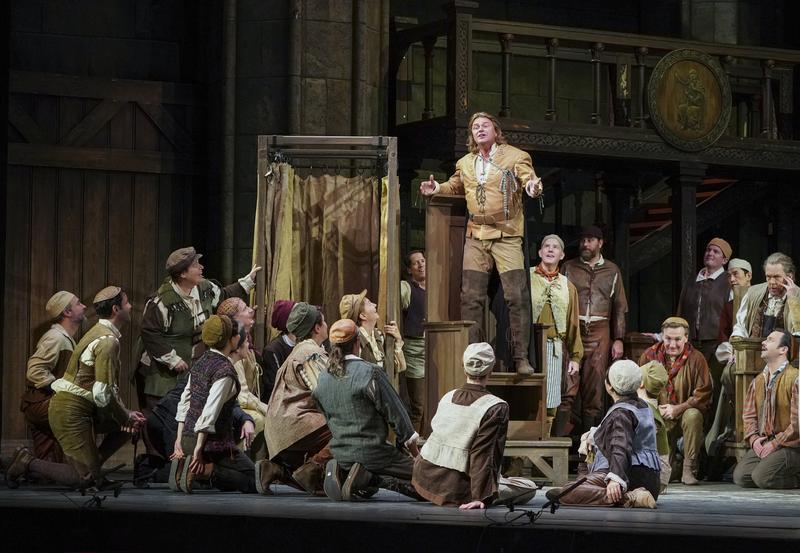
Die Meistersinger von Nürnberg

Die Meistersinger von Nürnberg

Music drama by Richard WagnerWikipedia

Search complete. 11 mentions across 9 episodes found for "Die Meistersinger von Nürnberg".

Oct 10, 2026

David WalesNARRATOR
75:15
After Tannhäuser, he never heard a note of Wagner's music.
David WalesNARRATOR
75:19
However he might have reacted to Tristan, it is hardly possible that Schumann could have brought himself to dismiss Wagner as a bad musician if he had been spared to hear Die Meistersinger.
David WalesNARRATOR
75:32
Schumann was present when Wagner read one evening to an assemblage of acquaintances his Lohengrin libretto.
David WalesNARRATOR
75:40
Like a number of other listeners, he could not grasp just what method Wagner could employ in setting such a text to music.
Weston WilliamsHOST
55:59
My father has regaled me of many a story of, uh, of, um, driving to, uh, you know, Lyric Opera Chicago, the Met, whatever, um, in like the middle of a snow storm, and they had the cheap s- the cheap standing room only seats in the very back where you kinda have to lean, lean over.
Weston WilliamsHOST
56:15
And because you're surrounded by people who are younger, who can stand and, you know, um, and are, like, committed to, like, watching Die Meistersinger standing up, it's just a...
Weston WilliamsHOST
56:26
You create a culture that is sustainable going forward rather than simply prioritizing, uh, a, you know, a, you know, a, a theater experience, if that makes sense, where you're going in, you're paying for a seat, you're dressing up.
Weston WilliamsHOST
56:45
What we're tr- what I think is exciting about this is that it has the potential to create a culture of people who could have... w- who could talk, uh, in their own terms, in excited terms, about what the opera means to them without having all of this cultural milieu of, like, people surrounding them who don't, who know the opera better than they do, and often, let's be honest, make it known that they know the opera better [laughs] than they do.

Unknown podcast

George Frideric Handel-Herbert Francis Peyser

Sep 27 · 1 Mention

speaker_6NARRATOR
82:03
politics aggravated the situation the more so as george the second and the prince of wales were at odds and the supporters of the latter determined to set up a rival opera company to ruin but the story of handel's pertinacious efforts to float new operatic enterprises for almost another ten years is too long involved and too honeycombed with intrigue contending influences and low tactics of one sort or another to be examined here the composer's hanoverian origin stirred many parties against him moreover he was a self-willed imperious person who like richard wagner more than a century later had the gift of stimulating antagonism he was wrote w mcnaught a pervading presence a busybody forever intruding upon public affairs He had taken to ordering the amusements of the town in his own interest, and he belonged to the wrong party.
speaker_6NARRATOR
83:05
One almost fancies oneself confronted with a chapter from the life of the creator of Die Meistersinger.
speaker_6NARRATOR
83:12
Yet what a treasury of glorious music Hendel was pouring out with incalculable lavishness during these agitated years.
speaker_6NARRATOR
83:21
Let us mention in passing a few of the new operas as they came and went.
David WalesNARRATOR
80:19
After Tannhäuser, he never heard a note of Wagner's music.
David WalesNARRATOR
80:22
However he might have reacted to Tristan, it is hardly possible that Schumann could have brought himself to dismiss Wagner as a bad musician if he had been spared to hear Die Meistersinger.
David WalesNARRATOR
80:35
Schumann was present when Wagner read one evening to an assemblage of acquaintances his Lohengrin libretto.
David WalesNARRATOR
80:43
Like a number of other listeners, he could not grasp just what method Wagner could employ in setting such a text to music.

Unknown podcast

Robert Schumann, Tone Poet Prophet And Critic-Herbert Francis Peyser

Sep 23 · 1 Mention

speaker_2NARRATOR
77:14
However, he might have reacted to Tristan.
speaker_2NARRATOR
77:17
It is hardly possible that Schumann could have brought himself to dismiss Wagner as a bad musician if he had been spared to hear Die Meistersinger.
speaker_2NARRATOR
77:27
Schumann was present when Wagner read one evening to an assemblage of acquaintances his Lohengrin libretto.
speaker_2NARRATOR
77:35
Like a number of other listeners, he could not grasp just what method Wagner could employ in setting such a text to music.

Unknown podcast

George Frideric Handel-Herbert Francis Peyser

Sep 17 · 1 Mention

speaker_3NARRATOR
74:02
He had taken to ordering the amusements of the town in his own interest, and he belonged to the wrong party.
speaker_3NARRATOR
74:09
One almost fancies oneself confronted with a chapter from the life of the creator of Die Meistersinger.
speaker_3NARRATOR
74:16
yet what a treasury of glorious music handel was pouring out with incalculable lavishness during these agitated years let us mention in passing a few of the new operas as they came and went ezio orlando il pastor fido ario dante algina arminio berenice faramondo serres the last name calls for a word by itself xerxes has nothing to do with the persian ruler of antiquity it is the comic opera handel's first and only one which stands up extraordinarily well under modern stylized conditions of revival apart from which it contains possibly one of the most universally beloved melodies that handel ever wrote this melody heard at the very beginning of the piece appears in the score as a larghetto to the words ombra me fu a song of gratitude to a plane tree for its beneficent shade but for generations it has been slowed from the pace originally prescribed to a solemn swelling hymn known to uncounted millions as handel's largo and far more know it as a churchly canticle than its lightly moving operatic context almost every one of this mass of operas furthermore is charged with grand arias of all the emotional varieties common to its epoch gems enshrined in practically every one of the great anthologies of the eighteenth century song it was not until seventeen forty one that handel concluded his period of operatic creativity with deidemia written to a libretto by paolo roli london's taste for opera had during more than a decade shown continued fluctuation but in seventeen thirty one a new situation brought about an event that was to provoke a development of capital importance for handel's future the children of the chapel royal presented in a private performance his masque estor on the composer's birthday the success of the performance was such that it resulted in others one of which was given without handel's consent by one of his rivals the master was equal to the occasion he added some numbers to the score and gave half a dozen representations at the king's theatre but as a biblical subject could not be acted on the stage the masque was given in concert form in the presence of the royal family and of high society the handelian oratorio had more or less come into being in the summer of seventeen thirty three and went to oxford the university authorities had offered him a degree of doctor of music oxford is said to have known little of his music at that time yet his arrival there might according to newman flower have been the triumphant entry of a king the town was overcrowded even accommodations at the hostels ran out and people slept in the streets the composer brought with him a new oratorial athalia composed to a text which samuel humphreys had adapted from racine hugo leichentritt claims that the rector dr holmes aimed to bring about a rapprochement between the hanoverians and the jacobites a whole week of handelian works was offered with hearings of esther and deborah athalia the utric te deum assis and galatea and other creations in the end the master did not receive the honorary degree some have believed that he turned it down when he was told it would cost a hundred pounds like haydn half a century after he found the academic honours of oxford expensive and later a story gained currency that handel had shouted in his particular brand of english wat the daifle i draw away my money for what a blockhead vish i no want had it been practical he might have brought a whole opera production to oxford in place of such a luxury he compromised on oratorios the more so because the dividing line between such entertainment and the opera of the period was not so sharply drawn as it was eventually to become the chief differences between the two forms lay in the preponderance of choruses such as in opera were regarded as hardly more than side issues meanwhile he seemed unable to resist the lure of the theatre again and again he returned to italian opera he continued his earlier partnership with heidegger he made trips to italy and elsewhere and secured new singers the castrato carestini the prima donna strada his enemies increased in number and power and resorted to the basest tactics imaginable to discredit and injure him the so-called opera of the nobility opened at a playhouse in lincoln's inn fields lured his singers away from him by fair means or foul and by securing the great farinelli obtained a trump card handel who in time parted company with heidegger would burn his fingers the moment his fortune seemed on the upgrade even the weather was against him what with the thames freezing over in one of the years that he obstinately returned to opera and cutting down his audiences he lost money ruinously he went into bankruptcy he wore himself out to such a degree that he had a mental and physical breakdown and had to go to the continent to aix-la-chapelle for a cure his amazing resilience of spirit and body helped him back to health and actually encouraged him to make another attempt at an operatic season with his egregious associate heidegger at the king's theatre early in seventeen thirty eight for which he composed his comedy a few months earlier his royal friend queen caroline had died and handel gave voice to his genuine grief in the great funeral anthem the ways of zion do mourn and despite his misfortunes he busied himself with a charitable enterprise the promotion of a society for the support of decayed musicians which enlisted his active sympathies for the rest of his life not even benefactions of the sort could mollify the legions of his implacable enemies his aristocratic foes to hasten his complete downfall actually hired hoodlums to tear down his posters and precipitate noisy disturbances whenever they thought trouble-making could in some way or other harm him yet a few friends stood unshakably by his side none more faithfully than the loyal mrs just when his creditors had seized him and threatened him with imprisonment the news of his tribulations gave rise to a popular movement of sympathy in seventeen thirty five he had delighted the english public by his alexander's feast composed on dryden's ode to st cecilia produced triumphantly at the covent garden theatre it had been written in twenty days as the years passed handel's composing activity seemed incredibly accelerated in the freezing winter of seventeen thirty nine he wrote to keep myself warm as rowland says the little cecilia cantata in a week the version of milton's poem under the title l'allegro il benzerosso ed il mederato in just under a fortnight and the glorious concerti grossi opus six in a month distracted by his last operatic cares incidentally handel had received about this time a testimonial of public admiration in the form of a marble statue by the sculptor which a manager of musical entertainment named tyers had caused to be erected in vauxhall gardens a meeting-place of london society where handel's works made up the best-liked musical features still by the spring of seventeen forty one handel in a moment of profoundest disheartenment prepared to throw up the sponge and leave for good and all his home for the past thirty years at long last he was fed up on the struggle and announced one last concert for april eighth seventeen forty one and then when the darkness before dawn seemed blackest he sat down to create his masterpiece the most universally beloved choral work ever composed that summer charles jenyns gave handel a compilation of scriptural texts which he called messiah jenyns was a literary amateur born at gopsle hall in leicestershire and educated at balliol college oxford rich and bizarre he was vastly conceited and especially proud of the manner in which he had assembled the various biblical texts used in this case handel had been associated with him before in the oratorial saul seventeen thirty nine and in l'allegro ed il penseroso a year later as a supplement to which he had added some poor verses of his own to the lines of milton and called the product il moderato robert manson myers thinks it extraordinary that handel turned to this eccentric millionaire for his libretto of messiah jenyns was of another mind and even later wrote to an acquaintance i shall show you a collection i gave handel called messiah which i value highly he has made a fine entertainment of it though not near so good as he might and ought to have done there are some passages far unworthy of handel but even more unworthy of messiah and deploring handel's maggots he added that he had with great difficulty made him correct some of the grossest faults in the composition doubtless handel had he so chosen could have picked his text himself he compiled the book of israel and egypt unaided in seventeen thirty eight and when a good deal earlier the bishop of london wanted to help him with the words for the coronation anthems he retorted i have read my bible very well and i shall choose for myself mr myers in his encyclopaedic study of messiah feels certain that handel must have controlled the choice of passages selected like haydn mozart schubert and other supreme musicians handel could create with a rapidity which ignominiously shames composers of our supposedly speedy age even bearing that fact in mind the composition of messiah between saturday august twenty two seventeen forty one and monday september fourteen following remains one of the miracles of music shut up in a little room on the first floor of his home on lower brook street hanover square none can say exactly what went on handel is supposed to have uttered afterwards the words of st paul whether i was in my body or out of my body as i wrote it i know not nobody seems to have dared intrude upon this mystic concentration food was left near him but usually found untouched when the servant came to remove it he sat at his desk like a stone figure and stared into space sometimes his man stood in awe to see his master's tears drop on the music paper and mingle with the ink when he was composing he was despised a visitor is reported to have found the trembling composer sobbing with intense emotion and after the hallelujah chorus he uttered those historic words i did think i did see all heaven before me and the great god himself the autograph score with its blocks its angry erasures and general untidiness offers fierce evidence of his tumultuous feelings and flaming ecstasies possibly between april and late august of seventeen forty one he was shut up in his four walls planning the work for we have no clear idea just what he did during this period sketches and fragments do not clear up what mystery there may be for the composer destroyed all but some fugitive scraps part three part four of george friedrich handel by herbert f piezer this libervox recording is in the public domain handel appears to have been reluctant to submit such music to the capricious taste of aristocratic london so when william cavendish lord lieutenant of ireland invited him to visit dublin and permit the public of that generous and polite nation hear his oratorio handel assented at once the more so because it was a question of assisting three benevolent institutions of ireland one of them the charitable music society for the relief of imprisoned debtors with his usual impulsiveness he even agreed to present some special oratorio solely for the benefit of the unfortunates jailed for debt he was happy to shake the dust of london from his feet for a while before starting on his irish journey incidentally he composed in a fortnight part of another oratorio samson based on milton's samson agonistes and containing that noble air of lament total eclipse which was to affect him so poignantly some years later for his dublin productions he had two exceptional women singers susanna maria cibber also an illustrious tragic actress and signora avoglio a highly trained italian the chorus was recruited from dublin st patrick's cathedral and christ church messiah did not receive its first hearing until april thirteenth seventeen forty two reports emanating from the last rehearsals greatly whetted public appetite and on the morning of april thirteenth faulkner's journal ran the following this day will be performed mr handel's new grand sacred oratorio called the messiah the doors will be opened at eleven and the performance begin at twelve the stewards of the charitable music society request the favor of the ladies not to come with hoops this day to the music hall in fishamble street the gentlemen are desired to come without their swords mr myers relates that handel's polite audience comprised bishops deans heads of the college the most eminent people in the law as well as the flower of ladies of distinction and other people of the greatest quality the audience was transported in some ways the heroine of the occasion was mrs cibber who sang the air he was despised with such tenderness and pathos that the rev patrick delaney who had harboured a bitter prejudice against actresses and singers so far forgot himself that he rose and solemnly exclaimed woman for this be all thy sins forgiven thee It was late in August 1742 before Handel returned to London.
speaker_3NARRATOR
90:37
The hostility of the English aristocracy was still strong and continued for some years, although the forceful voice of Alexander Pope had been raised in his favor, little as that poet is said to have known about music.
David WalesNARRATOR
7:45
It sounded like an old tin kettle.
David WalesNARRATOR
7:48
He pronounced Wagner's horn parts unplayable, so that Wagner had to call upon Hans Richter to try out for him some passages in Die Meistersinger in order to demonstrate that they were anything but impossible.
David WalesNARRATOR
8:02
With the elder Strauss, Hans von Bülow was repeatedly at loggerheads, and when he once attempted to thank Bülow for some favor the latter had shown young Richard Strauss, Bülow exploded with the words, You have no right to thank me.
David WalesNARRATOR
8:17
I did your son a favor, not on your account, but only because I consider his talent deserves it.
Lisa SimeoneHOST
1:36
By most accounts, Wagner himself was no hero, but he wrote a lot of stirring music on the topic.
Lisa SimeoneHOST
1:42
Take Die Meistersinger von Nürnberg, a comic love story set in the 16th century.
Lisa SimeoneHOST
1:48
The protagonist in this tale is Walter, a knight and classic Wagnerian hero, a social outsider who refuses to assimilate to the norms of society.
Lisa SimeoneHOST
1:59
The opera centers on an ancient guild of master singers, amateur poet musicians who work day jobs as local craftsmen.
Lisa SimeoneHOST
2:33
We'll hear a 1999 Teldec recording now.
Lisa SimeoneHOST
2:36
Ninth Music Director Daniel Barenboim conducts the Chicago Symphony Orchestra.
Lisa SimeoneHOST
2:41
This is the Prelude to Act Three of Die Meistersinger von Nürnberg by Wagner.
Lisa SimeoneHOST
2:48
[music]The prelude to Act Three of Die Meistersinger von Nürnberg by Wagner, a recording by the Chicago Symphony Orchestra led by Daniel Barenboim.
Sebastian FaulksGUEST
5:11
Um, you know, I don't have the answer to that, by the way [laughs], but I think it's quite an interesting thing to think about.
Sebastian FaulksGUEST
5:17
Uh, I m- I remember being at the opera in London not long ago watching an endlessly long Wagner opera, Die Meistersinger.
Sebastian FaulksGUEST
5:23
And, you know, everyone was falling asleep, and in the long intervals people would compare notes about which bits they'd slept through.
Pat KennyHOST
5:30
[laughs]

We value your privacy

We use cookies to understand how you use our platform and to improve your experience. Click “Accept All” to consent, or “Decline non-essential” to opt out of non-essential cookies. Read our Privacy Policy.