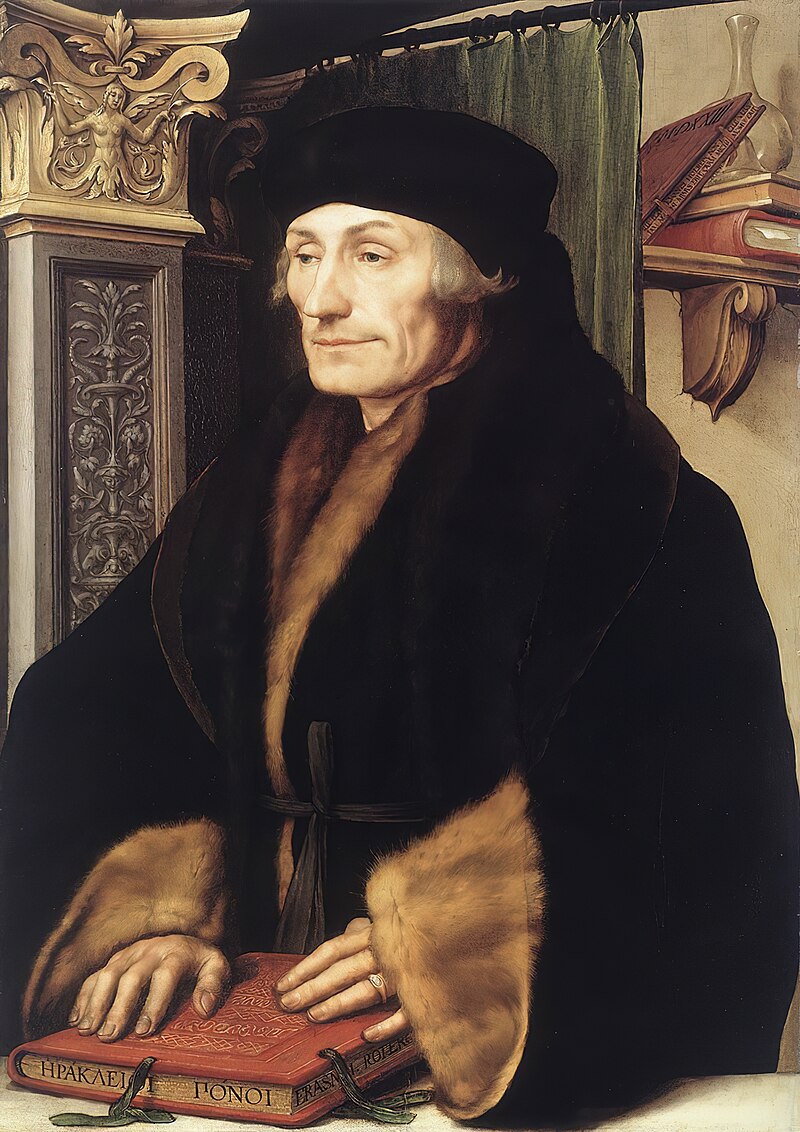
Desiderius Erasmus
Dutch theologianWikipedia
477
MENTIONS
142
EPISODES
117
PODCASTS
Search complete. 477 mentions across 142 episodes found for "Desiderius Erasmus".
Oct 27, 2026

Michael ReevesGUEST
And there would have been no reformation without this truth.
Michael ReevesGUEST
And you can see that when you compare Erasmus with Luther.
Michael ReevesGUEST
Erasmus was the great scholar who'd provided the Greek New Testament through which Luther had been converted.
Michael ReevesGUEST
But Erasmus wasn't considered the first reformer.
Michael ReevesGUEST
He was the man who'd made the Scriptures available.
Michael ReevesGUEST
But while providing the coals for the Reformation, his possession of the Scriptures and his deep study of the Scriptures changed little for the man himself because of how he treated them.
Michael ReevesGUEST
Erasmus buried the Scriptures under convenient assertions of their vagueness.
Michael ReevesGUEST
And he accorded the Scriptures little practical, let alone governing, authority.

KendallHOST
Oh my goodness.
KendallHOST
Where he borrows a story from Erasmus and it's the tale of a priest who says mopsimus instead of sump-simus and refuses to change it when it's incorrect.
KendallHOST
Sumptuous or sump-simus? So the Latin word sumpsimus.
KendallHOST
And he refused to change it.

John MoffattHOST
This, of course, was subversive in a world of religious and secular monarchs.
John MoffattHOST
Erasmus of Rotterdam started his career as an Augustinian friar and became one of the most influential scholars and mediators of humanist thought of his generation.
John MoffattHOST
He and his English friend, Sir Thomas More, represented a strand of humanism that integrated classical learning and its human insights with Christianity in a much more sober style.
John MoffattHOST
That sober style itself owed much to the ideals of the devotio moderna we looked at before, getting close to the Jesus of the Gospels and the simple basic messages of Scripture, growing in virtue.

Keith FoskeyHOST
This week, I also had the opportunity to interview Jordan Cooper, who is a Lutheran scholar and was grateful to get the opportunity to talk to him.
Keith FoskeyHOST
And he and I talked a little bit about the subject of the bondage of the will, which was obviously Luther's famous work where he addressed the arguments of Desiderius Erasmus regarding the bondage of man in sin.
Keith FoskeyHOST
And Cooper says that Luther's work I didn't know this, and he said it was written in a week, it was written very quickly, and so there were some things in the bondage of the will that were very Luther-like, meaning he was verbose and he was powerful in his speech and sometimes a little less precise but very bold.
Keith FoskeyHOST
When we compare the bondage of the will with Luther and the freedom of the will with Luther, I've said in the past, I think the bondage of the will is intended to be polemic, it's opposing Erasmus, it's responding to arguments.
Michael ReevesGUEST
The great 16th century scholar Erasmus said, the sum of our religion is peace and unanimity, but these can scarcely stand unless we define as little as possible.
Michael ReevesGUEST
In other words, don't define your beliefs too carefully or we'll never have peace.
Dave TheriaultHOST
Have you ever had a discussion with someone where you realized that even though you're using the same words, you have a different set of definitions? This is one of the reasons that it's important to take the time to define our terms when engaging in debates or dialogue.
7 MINS LATER
Michael ReevesGUEST
That strikes our culture as authoritarian.
Michael ReevesGUEST
And this was just what some thought at the time of the Reformation.
Michael ReevesGUEST
The great 16th century scholar Erasmus said, the sum of our religion is peace and unanimity, but these can scarcely stand unless we define as little as possible.
Michael ReevesGUEST
In other words, don't define your beliefs too carefully or we'll never have peace.
Michael ReevesGUEST
And the spirit of Erasmus has really conquered in our day.

Gary NullHOST
In the Greek poet Hesiod's telling, Pandora opens a jar and releases every evil into the world.
Gary NullHOST
It became, by the way, a box, Pandora's box, only in the 16th century through a mistranslation by the scholar Erasmus.
Gary NullHOST
In the Garden of Eden, It is Eve who reaches for the fruit of knowledge.
Gary NullHOST
In Charles Perrault's fairy tale Blueberry, published in 1697, a young wife is nearly killed for opening the one door she was forbidden to open.

Doug NormanNARRATOR
They were starting to get tired of the stranglehold of the Pope.
Doug NormanNARRATOR
Humanists, and we tend to think of humanism as anti-church in our day, but the humanists were actually within the Catholic Church at the time, particularly people like Erasmus.
Doug NormanNARRATOR
They turned scholars back to biblical sources, especially Erasmus because he produced the Greek New Testament in 1516.
Doug NormanNARRATOR
And then Luther... emerged to preach a message that could be re-preached, printed, and sung.
Doug NormanNARRATOR
And that message was that sinners are justified by grace through faith.

Pamela NagamiNARRATOR
if you do not want to commit suicide always have something to do suicide must have been forever tempting him for he was ever at work it was because he was so thoroughly alive that he filled the whole era with his life contemporary with one of the greatest of centuries sixteen ninety four to seventeen seventy eight he was the soul and essence of it to name voltaire said victor hugon is to characterize the entire eighteenth century italy had a renaissance and germany had a reformation but france had voltaire he was for his country both renaissance and reformation and half the revolution He carried on the antiseptic scepticism of Montaigne and the healthy, earthy humour of Rabelais.
Pamela NagamiNARRATOR
He fought superstition and corruption more savagely and effectively than Luther or Erasmus, Calvin or Knox or Melanchthon.
Pamela NagamiNARRATOR
He helped to make the powder with which Mirabeau and Marat, Danton and Robespierre, blew up the old regime.
Pamela NagamiNARRATOR
if we judge of men by what they have done said lamartine then voltaire is incontestably the greatest writer of modern europe destiny gave him eighty-three years of existence that he might slowly decompose the decayed age he had the time to combat time and when he fell he was the conqueror no never has a writer had in his lifetime such influence despite exile imprisonment and the suppression of almost every one of his books by the minions of church and state He forged fiercely a path for his truth until at last kings, popes, and emperors catered to him, thrones trembled before him, and half the world listened to catch his every word.

Aaron MoldenhauerGUEST
I think maybe the central point of what you're getting at is the role of the will when it comes to salvation.
Aaron MoldenhauerGUEST
This is where Luther tells Erasmus in The Bondage of the Will, you've got right to the central question.
Aaron MoldenhauerGUEST
And it's going to fit under here.
Aaron MoldenhauerGUEST
If I need to make a decision for Jesus to be saved...
Jordan CooperGUEST
He engages very carefully with texts.
Jordan CooperGUEST
And Melanchthon was very much part of what we think of as the Renaissance, the humanists, someone like Desiderius Erasmus, who obviously comes into conflict with Luther.
Jordan CooperGUEST
Melanchthon always has something of a relationship with Erasmus.
Jordan CooperGUEST
And so he's from a very different background than Luther is theologically.
132 more episodes mention Desiderius Erasmus.
Create an account to see the whole feed, search across every transcript, and follow the entities you care about.