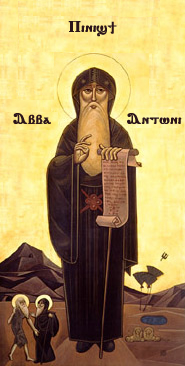
Desert Fathers
90
MENTIONS
42
EPISODES
38
PODCASTS
Search complete. 90 mentions across 42 episodes found for "Desert Fathers".
Sep 11, 2026

NickHOST
Origen and Augustine are two of the major figures who help shape that answer.
NickHOST
With Desert Fathers and early monastic tradition, demonology takes one of its most unsettling turns.
NickHOST
The demonic is no longer only in idols, temples, wilderness terror, or public exorcism scenes.
NickHOST
It turns inward.
10 MINS LATER
NickHOST
It becomes one of Christianity's great containers for corruption.
NickHOST
So where do demons in Christianity come from? From many places at once.
NickHOST
From the accuser in the Hebrew Bible, from Shittim, Azazel, Lilith, Psalm 91, and Wilderness Threat, from the Second Temple expansion of the Unseen World, from Tobit and Asmodeus, from the Watchers, from the Nephilim and the Giants, from the Spirits of the Giants, from Belial and Mestima, from Greek translation and the hardening of spiritual vocabulary, from Jesus' exorcisms, from Beelzebub and Kingdom language, From Paul's powers and rulers, from Paul's warning about pagan sacrifice, from Justin and Athenagoras attacking the old gods, from idols re-read as sites of demonic fraud, from Origen's providence, from Augustine's diabolical suggestion, from the desert fathers and Evagrius, from the noonday demon, from household bowls buried under the threshold, from late technical lore like the Testament of Solomon.
NickHOST
Then Christianity gathers all of that and gives it a more stable theological home.

RaghunathHOST
Sure.
Kaustubha DasHOST
And that's their, the, the, um... they're called the Desert Fathers.
Kaustubha DasHOST
And what, what is the term? There's a Western term that they use, um, it's slipping my mind right now.
Kaustubha DasHOST
I, I'll pull it up.

Christine SineHOST
And then...
Christine SineHOST
Lectio Divina, and then Desert Fathers and Mothers.
Christine SineHOST
And the last one that I read, The Love of Thousands, which I found very challenging and stretching, but very, very profound too.
Christine SineHOST
And I think that you are a woman of great wisdom.
6 MINS LATER
Christine SineHOST
yeah.
Christine SineHOST
Go ahead.
Christine SineHOST
No, I was just going to say, I know it was reading your book, Desert Fathers and Mothers, that made me aware of the fact that the Celtic saints had really been so influenced by them.
Christine SineHOST
And that to me is fascinating because you think of the distance that they had to travel often to meet these people.

James FinleyGUEST
I'd like to share something else about what I'm about to share here.
James FinleyGUEST
You know, when we read the stories of the Desert Fathers, where they would go out and say, give me a word, There's also stories in all the world traditions they have these where someone comes to the teacher and then there's a little narrative about the dialogue between the teacher and the student.
James FinleyGUEST
But these are archetypal dialogues that draw us into the dialogue so we can understand how echoes of that one dialogue is taking place in our life.
James FinleyGUEST
Because what the teacher says to the student in the story is being said to us.

Phil MasonHOST
Now here's the thing about...
Phil MasonHOST
You know the Desert Fathers, the early Desert Fathers? They left the busyness of the marketplace...
Phil MasonHOST
to go into the desert to find solitude and silence.
Phil MasonHOST
But guess what? The marketplace went with them.

EleanorHOST
And what they start doing is just like paying more attention to them.
EleanorHOST
And it's like, it's very similar to like the Desert Fathers stuff where they're kind of like, you can't just fucking get bricked into a wall and start spouting off.
EleanorHOST
Right.
EleanorHOST
Like, which I think is kind of fair enough because it's like, what does that mean? Like, so you don't become holy just because somebody bricks you into a wall is essentially the argument here.

Amy YoungHOST
But jumping right into it, it was an article you'd written, Scott, talking about... like for our soul health and development and that there are kind of these three zones, the stretch, the comfort zone, the stretch zone and the panic zone.
Amy YoungHOST
And as I was reading that, you also referenced the desert fathers and mothers, and there was a lot of the ways you were talking about the desert fathers and mothers that resonated with us.
Amy YoungHOST
ah, this is parallel to what a lot of cross-cultural workers are doing and have done.
Amy YoungHOST
And I just wanted to have this conversation because it also raised questions for me.
Bernie AndersonHOST
I am a huge fan of frameworks, Scott.
Bernie AndersonHOST
And to me, this is just an excellent framework for life and ministry and for everything we do.
Scott BrennanGUEST
Let me, like Amy, you mentioned the Desert Fathers.
Scott BrennanGUEST
Let me give you a context for this framework.

Malcolm GuiteGUEST
Eventually, they made this effort at the good and the ordered and the true, and they did it astonishingly in the name of Christ.
Malcolm GuiteGUEST
And then the really radical thing was that insofar as people thought about Christianity, it was brought by monks and hermits and celibate people, and it was almost a bit like the Desert Fathers flee from the world.
Malcolm GuiteGUEST
So, like, it would have nothing to do with soldiers.
Malcolm GuiteGUEST
Soldiers wouldn't want some, you know...

Angela MeirHOST
Active imagination is something we're going to be talking about today, and it isn't a New Age import.
Angela MeirHOST
Ignatius of Loyola built an entire discipline of it in the 16th century, The Desert Fathers were doing a version of it centuries before that.
Angela MeirHOST
And what we're recovering today is old, orthodox, and largely forgotten.
Angela MeirHOST
It is not new.
Angela MeirHOST
In my own longing for a deeply transformative Christian experience, I found that the psychologist Carl Jung had already provided us with tools.
Angela MeirHOST
tools that are deeply biblical and aligned with the Christian faith.
Angela MeirHOST
The rich spiritual tradition that we inherited from the Celtic saints, the Desert Fathers, and the Book of Acts is available for us today.
Angela MeirHOST
Let's journey together as we discover the spirit in Christianity and water the dry, aching areas of our soul.

MaryHOST
And I think also about how a lot of the There's a lot of Catholic rhetoric, if you want to be cherry-picky about our tradition, that a sort of detachment from everything, including human relationships and adoring only God, is kind of the pinnacle of the Christian existence, the pinnacle of the Christian life.
MaryHOST
And we have examples of great saints who did these kinds of things, like the Desert Fathers, for example.
MaryHOST
And a lot of this rhetoric is behind priesthood and religious life as well.
MaryHOST
maybe not to the same extent, but like I have given up human relationships for the pursuit of God to better adore God, to better pray, to better serve God.
32 more episodes mention Desert Fathers.
Create an account to see the whole feed, search across every transcript, and follow the entities you care about.